

Nations are not only protected by their borders, nor do they depend on a strong economy, high-rise buildings or modern highways for their survival. The real capital of any nation is its youth, and the most effective means of building youth is education. This is why every serious society considers its education system not just an institution for distributing degrees but a sacred responsibility to shape the future.
The purpose of education is not just for a student to pass an exam, but to instill in him a belief in justice, hard work and ability. If this belief is shaken, it is not just one student who suffers, the entire nation pays the price.
Every year, millions of young people head to the exam centers with dreams of becoming doctors, engineers, scientists and other fields. Their parents spend their savings, many families sacrifice their needs and thousands of students condense years of hard work into one exam. The foundation of this entire journey is only one thing: trust. The trust that the exam will be fair, that hard work will be rewarded and that one’s fate will not be a victim of recommendation, cheating or irregularities.
When this trust is broken, not only the results are suspicious but the entire education system becomes a question mark.
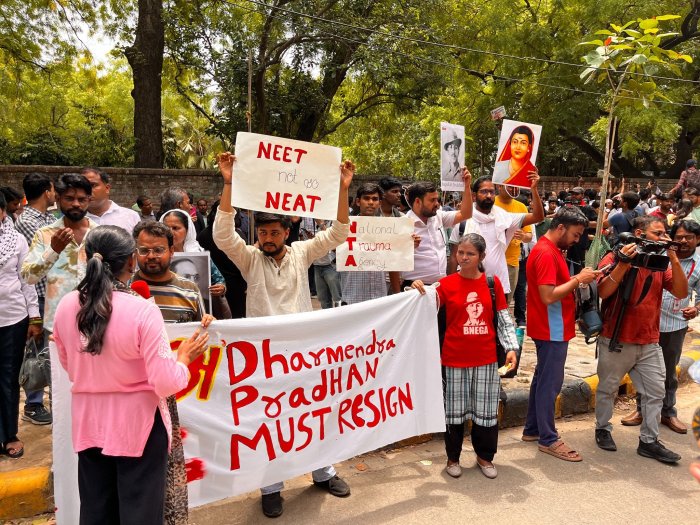
The NEET-UG 2026 exam, held in India for admission to medical colleges, has once again come under the scanner of similar questions. Several students claimed that their results were tampered with. Some candidates said that their OMR answer sheets and the released results did not match. One candidate even alleged that the marks he obtained were unexpectedly reduced by a large amount.

Some allegations may prove to be false after investigation, some complaints may turn out to be true, but the real issue is not who is right and who is wrong. The real issue is that the question has arisen in the minds of millions of youth whether their future is really being decided fairly?
The most valuable thing in the education system is transparency. If an examination body has to give explanations repeatedly in defense of its reputation, this itself is an indication that there is a crack in the wall of trust somewhere. Trust is an asset that is built over years, but one incident can weaken it.
World history is witness that those nations develop where merit is an uncompromising principle. There, even a poor student believes that if he works hard, he will definitely get what he deserves. This belief motivates the youth to sacrifice sleep at night, this belief gives him the courage to stand up again after failure.
More Read
On the contrary, when the feeling arises that more influence, recommendation or system flaws can be a source of success than hard work, the personality of the youth starts to break down from within. He does not just lose the exam but also loses hope.
This is the moment when the most valuable asset of society starts to become heartless. Heartless youth not only loses their destination, but the destination of the nation also gets blurred. Then the best minds either become silent or turn to other countries. This process is known today as “brain drain”, but its root is often the loss of trust in justice.
In this era of artificial intelligence, the transparency of examinations has become more important than ever. If AI can be used to create fake documents, then the same AI can also be used to make the examination system more secure and transparent. Technology is neither an enemy nor a friend; the real question is its use. That is why examination bodies have a greater responsibility than ever to respond to every objection in a timely, reasoned and transparent manner so that there is no room for rumors.
Questions have been raised from time to time on the system of examinations, recruitments and admissions in India. Each such incident teaches us a lesson that nations are built not only by the curriculum but by a system based on justice. Which has been lacking in India for the past several years.
Education is not just about books, it is also a social contract. In this contract, the student gives his hard work and the state assures him of justice. If even one condition of this contract is broken, the whole building starts shaking.
Ultimately, the question is not just about NEET, it is about the Indian nation which entrusts its future in the hands of its youth. If the youth lose faith in their education system, they are not only missing out on exams but are also missing out on the future. And when the future loses faith in its own system, then nations not only lose momentum, they also lose their direction.
More Read
The building of education is not built with bricks and stones but with trust. And trust is the foundation in which, if once there is a crack, its voice is heard for generations.