
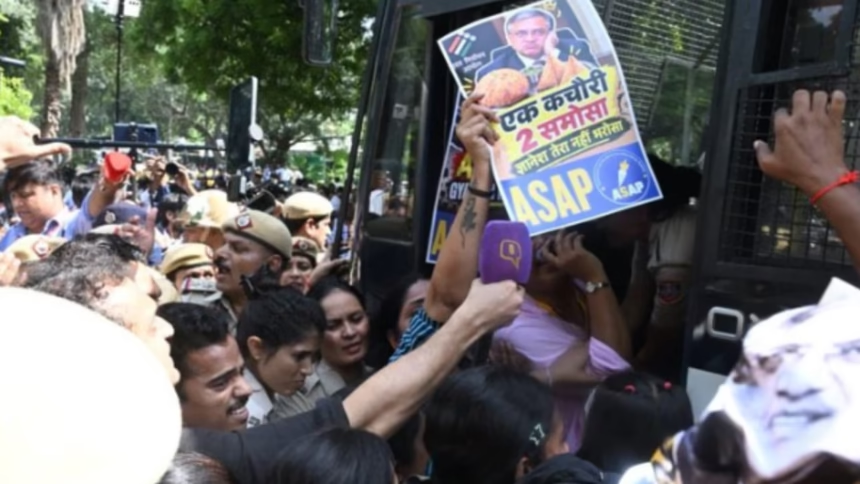

When a student, a lawyer and an Opposition MP stand in the same crowd, a republic is remembering what it is for. The detail that stands out from the protests in New Delhi is the guest list. Independent MP Kapil Sibal, All India Students’ Association president Neha Bora, and activists Prashant Bhushan and Yogendra Yadav were among those on the street. In Mumbai, supporters of the Gen Z-led Cockroach Janta Party waved the national flag and chanted “Gyanu, it’s done bro.” Not long ago, these would have been separate rallies with separate grievances, separate hashtags and separate WhatsApp groups. Now they share one demand, that the resignation of Chief Election Commissioner Gyanesh Kumar is what they need of the hour is, over revisions to the voter rolls.
The sceptics’ case deserves a hearing. The Election Commission and the government deny any wrongdoing, and the Commission insists its actions are lawful. The BJP says the Opposition is running a smear campaign because it keeps losing elections, and that no constitutional body in India is under dictatorial rule. Some Opposition leaders may well be here because the crowd is here. On October 2, the Commission also directed officials to register newly eligible voters and those omitted from the rolls, a step that can be read as either a genuine correction or a pressure valve.
But the allegations are specific enough to deserve scrutiny. Two of the three election commissioners are reported to have raised objections at least 14 times in ten months, mostly over the voter-list revision. Commission data indicates that rolls in some regions could shrink by as much as 30%. A dispute of that scale is a public matter, not a party spat. And whatever the final verdict on the charges, the shape of this protest is the story.
Edmund Burke wrote in 1770 that “when bad men combine, the good must associate; else they will fall, one by one, an unpitied sacrifice in a contemptible struggle.” A grievance held privately is a complaint. Held jointly, by people who otherwise have little in common, it becomes a public. Democracies rarely die of too much association. They die when atomised, exhausted citizens conclude that nothing can be done.
The Cockroach movement began in May as a satirical online campaign, named after India’s chief justice described unemployed youth and online activists as “cockroaches.” By July, its street protests over exam-paper leaks had forced the education minister to resign, one of the sharpest political setbacks of Narendra Modi’s tenure since 2014. The Opposition did not create that moment. Parties arrived later, joining a civic current already running, and the Congress-led INDIA alliance has since announced a march to the Election Commission and “Save Democracy” rallies. That is the healthy order of things: parties following the public rather than summoning it on cue. As political analyst Rasheed Kidwai has observed, after more than twelve years in power, challenges arriving from many sections of society make dissent harder to box in as “anti-national.”
More Read
The digital commons has produced a new kind of civic educator, and Dhruv Rathee is its best-known face. His video asking whether India is becoming a dictatorship drew over 24 million views, and his reach has long exceeded that of any Opposition party’s own channel, with some parties screening his videos in public. Critics call him partisan and accuse him of selective use of facts, and that argument is legitimate. Even so, a subject like voter-roll revision dies in a footnote unless someone makes it legible, and a generation that learned to care about institutions through explainer videos is a generation paying attention. He too is in India now to join the movement.
The protesters are claiming the Constitution, not rejecting it. They carry the tricolour, and their target is the conduct of the office meant to referee elections, not the idea of elections. B.R. Ambedkar warned the Constituent Assembly in November 1949 that “in politics, bhakti or hero-worship is a sure road to degradation and eventual dictatorship.” A movement that demands accountability from an office-holder, rather than devotion to a leader, is the antidote to that danger. It is constitutional morality practised in public.
The state’s response is itself a test. Police stopped student and civil society groups from gathering at Jantar Mantar, detained protesters, and charged several for violating orders banning mass gatherings in the capital. Every democracy knows this reflex and has been warned against it. John Morley, Gladstone’s biographer, served as the Secretary of State for India, is credited with the statement “You have not converted a man because you have silenced him.” Mill made the deeper case in On Liberty, where he said, “if all mankind minus one held a single opinion, mankind would be no more justified in silencing that one person than he, if he had the power, would be justified in silencing mankind”. Suppression turns a dispute about voter rolls into a dispute about legitimacy, which costs any government far more.
More Read

The maxim long attributed to Gladstone, that justice delayed is justice denied, points to the way out. Publishing the deletion data, opening the revision process to independent audit, and explaining the reported internal objections would do more for the Commission’s credibility than silence. An institution confident in its conduct has no reason to fear scrutiny.
Hope is not a prediction. The protests have not won, and not every demand may prove right. The movement must stay nonviolent and disciplined, and accept an honest audit even if it clears the Commission. The Opposition must resist the temptation to hijack a movement it did not start. The government, in turn, must treat a nationwide protest as information rather than insult.
John Philpot Curran said in 1790 that “the condition upon which God hath given liberty to man is eternal vigilance.” It is usually quoted as a warning, but it now reads as a description. A veteran lawyer and a first-time protester practising vigilance side by side, for the same reason, is not the picture of a failing democracy. It is the picture of one being put back to work.
Democratic culture is made of habits including assembling, arguing, being counted, and being answered. A country in which people from every background rediscover those habits at the same moment has not lost its democracy. A better future when it first appears looks not as a victory, but as a crowd that has found common cause.