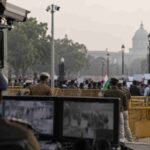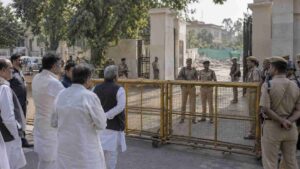
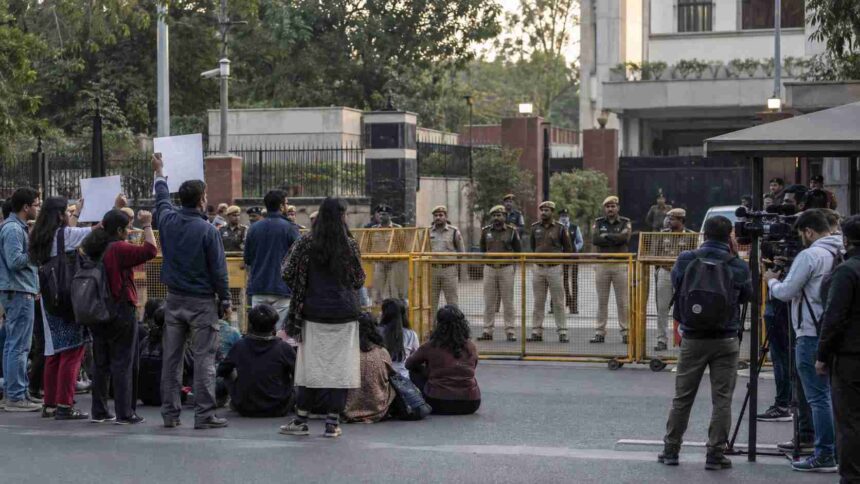

Supporters of the Cockroach Janata Party gathered outside Parliament Street Police Station in Delhi, demanding the immediate arrest of those who attacked Sanjay, the father of CJP activist Nishu Azad. CJP leaders Saurabh Das and Ashutosh Ranka were present. The group reiterated that the attackers remain free despite a clear public admission of the assault and despite the seriousness of the injuries.
The attack took place on the night of 23–24 June 2026 during the prolonged student protest at Jantar Mantar. Nishu, who had been active in the agitation, said a group confronted her on the road. When her father stepped in to protect her, he was struck on the head. Medical examination recorded three deep wounds on the skull. Nishu later stated that her father’s head was fractured at three places and that he was taken away bleeding. CJP founder Abhijeet Dipke and spokesperson Saurav Das alleged that around fifteen people participated in the assault while only one person was initially detained. They demanded that the police invoke provisions for attempt to murder and, where applicable, the SC/ST Act.
A subsequent video interview of one of the accused, identified as Swatantra Bhardwaj, intensified the controversy. In the recording Bhardwaj is heard saying he “cracked the skull” of Nishu’s father. He referred to Section 307 of the penal code, claimed the victim required sixty stitches, and described the injured man as being taken away in an ambulance in a condition in which he could have died. Bhardwaj further claimed that his arrest was prevented after a telephone call from Delhi BJP leader Kapil Mishra. The statement, once circulated, triggered fresh political reactions and renewed pressure on the police.
Delhi Police maintained that the injuries were recorded as simple in nature, that Bhardwaj and another individual named Suraj Kumar had been interrogated, and that a charge sheet would be filed in due course. CJP rejected this characterisation. Leaders pointed to the discrepancy between the medical description of three deep skull wounds and the police decision to treat the case as minor. They argued that the public confession by the accused removed any ambiguity about the identity of at least one attacker and made the continued delay in arrests untenable.
The June assault occurred against the backdrop of the larger CJP-led agitation that began over examination irregularities and the demand for the resignation of the then Union Education Minister. The Jantar Mantar sit-in had already seen multiple confrontations. Families of injured police personnel later held their own press conference alleging that officers had been attacked with stones, flower pots and footwear. The two narratives of violence, one involving a protester’s father and the other involving policemen on duty, continued to run parallel through the summer.
More Read
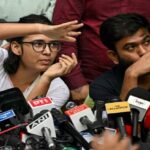
By now, the case of Sanjay had not been closed to the satisfaction of the CJP. The appearance of the accused’s own recorded claim that he had cracked the victim’s skull and the allegation of political intervention in his release provided the immediate trigger for today’s gathering at Parliament Street Police Station. Saurabh Das told those present that the organisation stood with every student and that the accused had himself admitted the attack on record. The demand remained straightforward, to register the appropriate sections, arrest those named, and end what the group described as protection of the perpetrators.
The protest outside the police station therefore marks the continuation of an unresolved complaint that began in June. A father who intervened to shield his daughter during a public demonstration suffered serious head injuries. One of the men accused of the assault later described the act in his own words on camera. The police response, the medical classification of the injuries, and the claim of political intercession remain the points of contention that brought CJP supporters back to Parliament Street three months later.