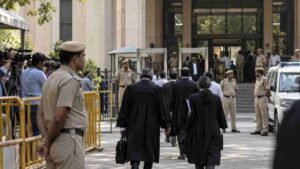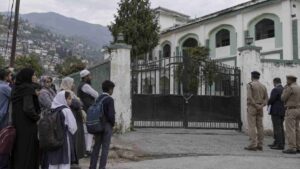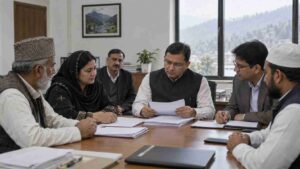


Two Delhi magistrates passed orders on Saturday that involve two prominent critics of the ruling establishment. One had released Cockroach Janta Party (CJP) founder Abhijeet Dipke after a second peace bond in seven days. In the defamation case filed in 2018 with the court, the other issued a bailable warrant against YouTuber Dhruv Rathee. The cases are unrelated, and there is no evidence in the record of how the one case affected the other. But each poses a question that the authorities have yet to answer.
Dipke: Detained On Friday, Bound Over On Saturday
Dipke was detained on Friday at Jhandewalan while heading to Connaught Place for the CJP’s “Lehra Do Tiranga” march, where police had imposed prohibitory orders. On Saturday, nearly 24 hours later, a Special Executive Magistrate at Mandir Marg granted him bail and directed him to furnish a ₹50,000 bond under Section 126 of the Bharatiya Nagarik Suraksha Sanhita (BNSS). The conditions are expected to be spelled out in the order.
This was his second bond in a week. On 10 October, Dipke was detained along with CJP leaders Saurav Das and Ashutosh Ranka and released the next day after an executive magistrate directed them to furnish bonds for maintaining peace. The police’s case on Saturday was that Dipke had violated that earlier bond, and it was on that basis that he was produced before the magistrate again. The fresh proceedings were initiated under Sections 126 and 170 of the BNSS. Section 126 allows a magistrate to require a bond of up to a year for keeping the peace. Section 170 allows police to make preventive arrests to stop cognisable offences.
The Question The Bond Raises
More Read

A peace bond is not a conviction, and no court has found that Dipke committed any offence. What it does is bind a person, under financial penalty, not to breach the peace. That makes the central question narrow and factual, what did Dipke do on Friday that amounted to a breach of the peace?
The public record does not answer it. By the available accounts, he was detained while travelling to a march that police had placed under prohibitory orders. Defying an order is not necessarily breaking the peace; a bond is intended to deal with the latter, not the former. If there is an allegation by police it should clearly state the type of violation. As of now, they have not, according to reports.
There’s also a structural aspect. The Union home ministry, and not the Delhi government, is responsible for the Delhi Police. Whether a march is deemed a breach of peace is a decision for the Centre and will be made twice a week. That is worth stating plainly, because the ministry has said nothing publicly about why.
More Read

Rathee: A 2018 Complaint And A Locked Door
On the same day, Judicial Magistrate Rahul Jain at the Saket courts issued bailable warrants against Rathee after being told that an attempt to serve summons at his Gurugram residence failed because the premises were locked. An order on 12 October had authorised the fresh service. The complainant is Vikas Sankrityayan, also known as Vikas Pandey, and the dispute concerns Rathee’s May 2018 video “BJP IT Cell Part 2.” The next hearing is on 31 October.
Pandey founded the social media page “I Support Narendra Modi.” His complaint also extended to Arvind Kejriwal over a retweet of the video, and that part of the dispute reached the Supreme Court. Reports say Rathee has lived in Austria for the past seven years. Pandey’s lawyer told the court that service attempts had failed for years because Rathee ordinarily lives abroad. The allegations in the complaint have not been established by any court.
What The Warrant Shows
A bailable warrant is routine when summons cannot be served. It does not mean Rathee has been found liable, and it can be satisfied by appearing and furnishing bail. Much of the eight-year gap, on the complainant’s account, comes from the difficulty of serving a person abroad, not from any step by the state. There is no evidence in the record that the government directed or encouraged this complaint.
Two features of the case remain notable. First, the complaint is criminal, not civil. Criminal defamation survives in Indian law, now under the Bharatiya Nyaya Sanhita, and the Supreme Court upheld its constitutional validity in 2016. A critic of the ruling party’s online operation therefore faces the possibility of a criminal conviction over a video, not just a damages claim. Second, the complainant is publicly identified with the party the video examined. That does not make the complaint baseless, and the court will decide its merits, but it does mean the process is being used by a supporter of the ruling party against one of its prominent critics.
What The Two Cases Share
The shared element is limited but real. In both, the legal step is lawful on its face and the heavier question lies behind it. For Dipke, it is whether a preventive power meant for threats to public peace is being used against a lawful political movement. For Rathee, it is whether a criminal defamation law that Parliament and the courts have preserved should still be available for a commentary video eight years on. Neither question is answered by the orders themselves, and neither authority, the Delhi Police or the Saket court, has been asked in public to explain.
What To Watch
For Dipke, the written order will show what conditions the magistrate attached to his release. If they restrict where he can go or what he can organise, that would effectively regulate a political movement through a preventive order, and it would likely be challenged before a higher court. A third detention would also test how many bonds the provision can be stretched to cover.
For Rathee, the 31 October hearing will show whether he appears, seeks to have the complaint quashed, or contests it from abroad. Either way, the case will keep a 2018 video in a criminal court well into 2026, and the choice of how to proceed now sits with him and the court.