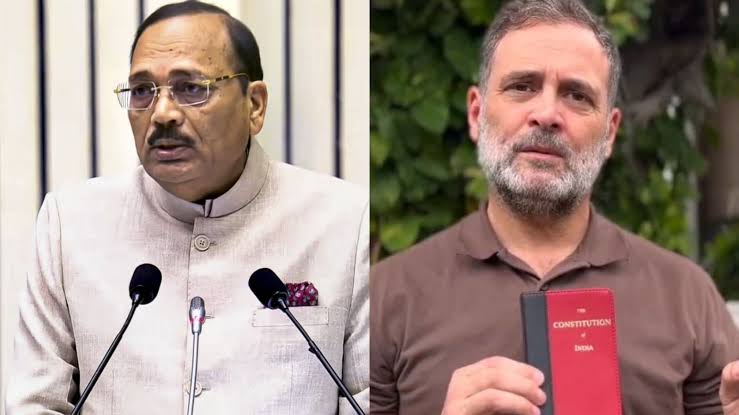

The capital city is now the arena of an unprecedented political and judicial fight[1][2]. In a shocking development that has reverberated through India’s political corridors, CJI Surya Kant turned down a request for a formal meeting from the Leader of the Opposition, Rahul Gandhi and Congress President Mallikarjun Kharge[3][4]. The decision came minutes before the INDIA bloc’s gigantic, high-voltage rally towards the Supreme Court raised the political temperature in Delhi to a boiling point[2][3][5].
At the heart of this confrontation are explosive allegations of electoral malpracticesknown as “vote chori” (vote theft) by the oppositionand a resolute demand for the immediate resignation of Chief Election Commissioner (CEC) Gyanesh Kumar[1][2][3]. We at Chaupal bring you a comprehensive breakdown of the chaos on the capital’s streets, the constitutional boundaries drawn by the Chief Justice, and what this means for the future of Indian democracy.
The CJI’s Refusal: A Lesson in Judicial Propriety
The standoff erupted after the opposition sent a formal letter to the CJI stating they would like an appointment between 4PM-5PM on Monday[3][6]. The INDIA bloc leaders wanted to present a detailed memorandum in person highlighting their issues with the Special Intensive Revision (SIR) of electoral rolls, issues of deletion of the names of millions of genuine voters and other irregularities[1][6][7].
Yet, in a classic demonstration of the limitations of a constitutionally designated role, the CJI’s desk had responded by way of a detailed, reasoned reply, withdrawing from the meeting[2][4]. Quoting the principles of the separation of powers, constitutional responsibility and court etiquette, CJI Surya Kant explained that Supreme Court does not have the administrative control over the functioning of Election Commission and other state affairs[4][6].
More Read
In addition, the Chief Justice mentioned a significant legal barrier: many petitions on these very same issues of elections, plus recent police suppression of protests, are already sub judiceand are presently before the Supreme Court[3][4]. An administrative, behind-closed-doors gathering with politicians on live matters may bring to mind concern of judicial bias[2].
Instead of private audience, CJI provided the constitutional remedy. The CJI reaffirmed that the Supreme Court is accessible to all citizens and their representatives and the CJI encouraged the opposition leaders to approach the court by filing a petition under Article 32 to protect their fundamental rights[2][6].
The Core Demands: ‘Vote Chori’ and the SIR Controversy
More Read

To appreciate the scale of the anger of the opposition, running into millions, Chaupal readers must understand the reasons that have led to the rise of this movement. The INDIA bloc has been aggressively protesting the systematic, institutionalized subversion of the electoral process[2][8].
The central issue is the Special Intensive Revision (SIR) of electoral rolls[1][2]. Oppn leaders argue that in the SIR, an inordinate number of voter names (presumably of communities, which generally tend to vote for the opposed party) have been maliciously removed from the Voter List[7][9].
Further, the opposition has brought up the voting system and called for an end to the current process and a return to paper ballots[10]. The anger is directed at CEC Gyanesh Kumar, whom the opposition points out has refused to acknowledge such blatant anomalies. They state there can be no truly free and fair election under his leadership, prompting their continued demand for his immediate resignation[1][2].
The March: Streets of Delhi Turn into a Fortress
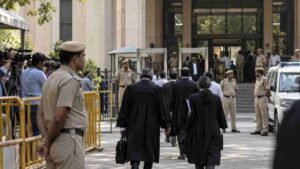
Unfazed by the Court’s denial of administrative hearing, the INDIA bloc chose to stage a protest on roads. [2] Heavy police personnel and barricades dominated central Delhi and Niti Aayog over Monday. [3][6][8]
Banners of the INDIA bloc plus top leaders of Congress, Samajwadi Party, Shiv Sena (UBT), DMK, and Trinamool Congress gather for a march from Barakhamba Road and Mandi House, toward the heavily fortified Supreme Court[1][11]. The images from the national capital were mesmerizing. Demonstrators, many of them wearing Batman masks as symbols of vigilantism against darkness, were heard shouting anti-government slogans calling for justice and transparency[1].
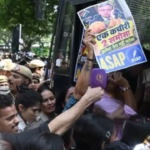
only for it to be scuttled[11]. The march was driven back by Delhi Police from reaching the highest court[11]. Prominent arrests ensued: Rahul Gandhi and others who believed they were fighting a political battle, maintained they were in a life-and-death struggle to save the soul of the nation’s democracy[1][12].
Furious Reactions: “The People Will Remember This”
The rejection of the delegation by the CJI had made the opposition camp angry and emotional. The opposition camp, Mainly Shiv Sena (UBT) MP Sanjay Raut had severely criticised the decision, questioning the role of the highest court in a purported democratic crisis[7][9] [9].
“We had called for a meeting because the INDIA bloc was planning to hold a big march to the CJI, ” an irate Raut told the press.[7] “The CJI’s job, which is to protect the Constitution, and who is the guardian of the Constitution, does not wish to meet us. For fighting for saving the democracy, when the votes have been stolen, millions of people have been removed from the voters’ list, and we want to speak to you, and you say you will not meet politicians. The people will remember this, ” Raut said.[7]
The same sense of rage was shared by other leaders. Congress MP Imran Masood pointed out the anger of the ground troops, asserting that “it is a spontaneous movement” of the people, rather than a purely political movement[7]. And DMK spokesman T.K.S. Elangovan questioned the Election Commission’s neutrality and hypothesised the outside “pressures” on the CJI for not meeting[7] [7].
Chaupal’s Take: What Lies Ahead?
The New Delhi Showdown is far from over. It’s almost as if the Supreme Court’s Surya Kant, taking a leaf from the Opposition’s own playbook, has sent them straight from the riot-racked streets and the bureaucratic corridors into the courtrooms[2][10]. Now the opposition bloc must put its hundred-million-strong street upsurge on the linewill the INDIA bloc file a blanket legal case against the Election Commission?
Based on legal academics yet the CJI’s position is beyond contestation under the Constitution. An administration-level discussion between the CJI and politicians, on a matter that is already a subject matter of a court case, would have quite deliberately bruised the court’s appearance of independence[2][4]. The court is providing a well-watched public stage for this sensational ‘vote chori’ charge to be tested with evidence by directing the politicians to write a petition[10].
The political trials of the capital, we feel, aren’t all petty political mudslinging; they speak of a huge trust deficit between the opposition, the Election Commission, and institutions that should be holding it in check. Rahul Gandhi and the INDIA alliance have exposed this to the nation by zeroing in on the electoral rolls[1][3].
But these protests and street marches can only carry the argument so far in a constitutional democracy. The full proof of these charges will not be delivered on the barricaded roads of Mandi House But within the sublime chambers of the Supreme Court[3][11] and with bated breath. One thing is assured, though: the capital is a pressure cooker and it’s just about to boil.
Keep following Chaupal for updates and ground reports on this developing story. Share your comments about the decision of the CJI and the INDIA march below!