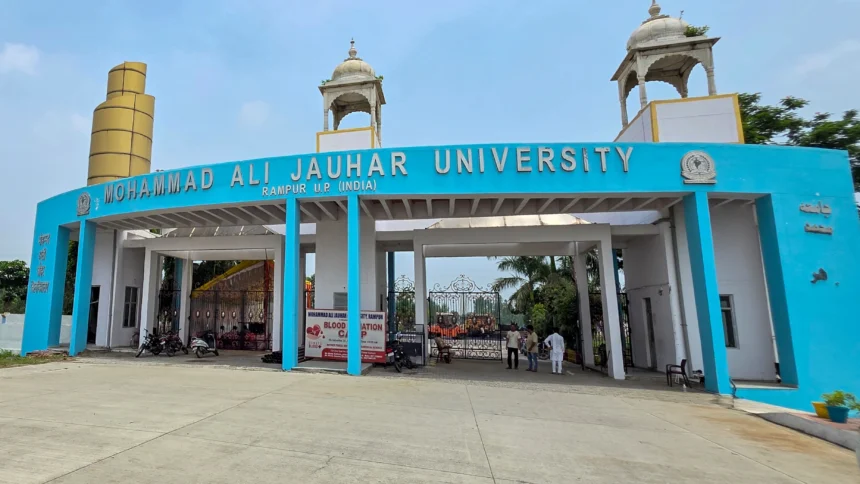

The Rampur Development Authority under the Yogi Adityanath government has issued a demolition notice targeting 38 out of 40 buildings at Mohammad Ali Jauhar University. This sudden move has left the future of over 3000 students hanging in uncertainty. The institution founded by Samajwadi Party leader Azam Khan has served as a vital centre of higher education for students from marginalised backgrounds particularly from Muslim communities in the region for nearly two decades.
Officials claim the structures lack proper building plan approvals under the 1973 Uttar Pradesh Urban Planning Act. Yet this technical argument appears selective at best. The university has operated on the campus with libraries hostels laboratories and academic blocks educating thousands without prior major intervention. Now after years of functioning, the bulldozers stand ready. It is seen as part of a larger pattern where the Yogi regime systematically targets institutions associated with Muslim leaders and communities.
Jauhar University represents hope for many first generation learners from nearby villages and districts. It offers affordable education across multiple departments helping uplift communities often sidelined in mainstream academic spaces. Demolishing nearly the entire infrastructure not only disrupts ongoing studies but also sends a chilling message. Is the state serious about education for all or does it selectively enforce rules against certain establishments while overlooking violations elsewhere.
This incident fits into a disturbing trend under the current Uttar Pradesh dispensation. From frequent scrutiny of madrasas to interference in minority run institutions the government actions consistently raise suspicions of bias. Political opponents including Akhilesh Yadav have labelled the demolition drive as vendetta politics aimed at weakening Azam Khan influence. The timing and scale of the action against a functioning university strengthen these perceptions. While authorities insist on legal compliance the haste and disproportionate impact on students suggest deeper motives.
Such steps risk alienating large sections of the population and undermining the state’s educational ecosystem. Muslim institutions have historically played crucial roles in providing access where government facilities fall short. Targeting them under the guise of regulation erodes trust and hampers inclusive development. The Yogi government must reconsider this aggressive approach. Regularisation of structures where feasible or phased compliance would better serve students than destruction.

The fate of Jauhar University is not merely about buildings. It questions the commitment to equitable education in Uttar Pradesh. Without transparent dialogue and student centric resolution this episode will be remembered as yet another attempt to diminish minority educational spaces rather than strengthen them.