

In the highly sophisticated theater of modern Indian politics, major legislative overhauls are rarely introduced in an administrative vacuum. They are frequently timed to serve as impenetrable public relations shields, designed to forcefully pivot the national discourse away from glaring domestic failures.
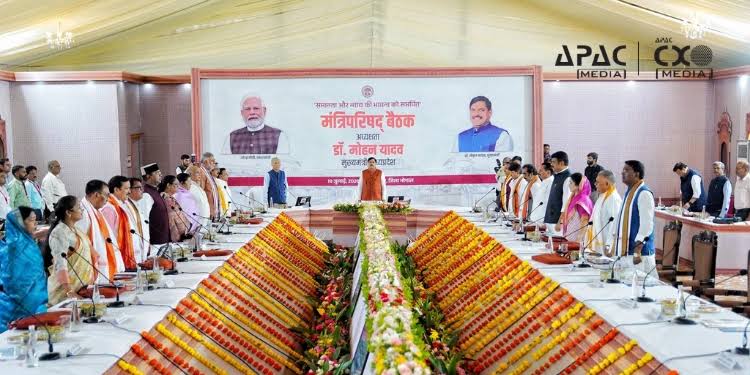
After a series of moves reminiscent of a game of chess, the political scene in the Hindi Heartland did Actually play this precise card. The state cabinet finally gave an official nod to the drafit of the Madhya Pradesh UCC Bill, opening doors for this piece of legislation to finally be introduced in the Legislative Assembly’s monsoon session that is set to be held soon.
Although the “Mainstream State” and its supporting press are greatly promoting this as a very major step toward gender equity and “Unity, ” a detailed analysis that is based on factual evidence and civic audits shows an absolutely terrifying reality. The whole idea of banning polygamy is the emotional face of a much deeper, sinister plan of setting up a surveillance state. Also, the timing of the Madhya Pradesh UCC Bill was just a perfect political veil that not only masked but completely hid a set of powerful accusations on senior-level corruption and widespread alienation of the youth from the political process.
The Death of Privacy: Institutionalizing the Moral Police
To comprehend the sheer administrative overreach of this legislation, one must scrutinize its clauses regarding consensual adult relationships.
More Read

According to reports, the draft bill proposes making it legally mandatory for couples in a live-in relationship to submit an affidavit to the local registrar within one month of cohabitation.
Most alarmingly, if any partner is under 21 years of age, the registrar is mandated to share this information directly with the individual’s parents and the local police.
In fact, it is an enormous attack on civil liberties and the basic Right to Privacy as well. The “Mainstream State, ” to be precise, is letting the local bureaucracy and the police force do practically whatever they want and be free to check their residents’ bedrooms as well through proper channels of law. In such a state, which is still facing a wave of backward vigilante violence where radical groups are, at their discretion, taking law enforcement into their hands on the streets – the passing of this demographic information to the local police opens the door for the government to be used in harassment, extortion, and the selective targeting of individuals, which amounts to a weapon of terror for individuals.
More Read
In a true democracy, people are consulted on the freedom they will accept as adults and that they will be responsible towards the state, i.e. through a constitution and not using watching eyes. If the state takes its citizen’s to ask their permission before living as they desire, there will not be a republic anymore but a digitally policed regime.
The Smokescreen for the Ujjain Land Scam
Why is the political elite so desperate to dominate the news cycle with polarizing, cultural legislation right now? A sophisticated electorate must connect the dots.
Only a few weeks before Madhya Pradesh UCC bill was passed by its state legislature, a powerful series of investigative journalistic pieces totally tore to shreds the government’s “Sushasan” (Good Governance) propaganda mask. The articles uncovered a colossal, mathematically orchestrated real estate grab by Mohan Yadav’s extended family, including the Chief Minister, in Ujjain.
The data was staggering: 137 individual plots spanning 168 acres, purchased for an estimated ₹45 crore, perfectly timed and geographically cherry-picked around upcoming taxpayer-funded government road projects.
Political insider trading and cronyism by the elite as described in the textbook were so glaring that they appeared to completely undermine the “Double Engine” storyline right before the electoral cycles. With no escape, the administration had to take refuge behind the Madhya Pradesh UCC Bill. Through hasty introduction of such a bill, the regime activated the “Identity Politics” lever effectively. Immediately, prime-time television forgot about 45 crore Ujjain land scam, and instead was completely dedicated to very emotional and polarizing debates on religious customs and civil laws.
The Hypocrisy of the Tribal Exemption
The legislation also contains another important feature that reveals the politicians behind the bill and their political expediency. The bill draft clearly gives some exceptions to the Scheduled Tribes (STs) of the state – Bhil Gond Korku Sahariya etc. on the ground that safeguarding of their “unique cultural heritage” is of paramount importance.
While this is a vital protection for Adivasi autonomy, it lays bare the sheer hypocrisy of the “Uniformity” argument. If the law is not actually uniform, its primary purpose is undeniably the targeted assimilation and legal policing of the Muslim minority.
Political commentators also acknowledge that the reason for this exception has to be understood as a reflection fear during the election. Basically the Government is very scared of the emerging, very well-organized, tribal Adivasis at the border regions of MP and Rajasthan – In particular the powerful call for a separate Bheel Pradesh. Political leaders are fully aware of In reality imposition of Brahminical homogeneity on these tribes will raise an unstoppable electoral and social revolt and because of this destroy their dominant majoritarian count.
The Erasure of the Unemployed Youth
The ultimate tragedy of this legislative spectacle is the continued erasure of the state’s human capital.
Along Uttar Pradesh, Madhya Pradesh is also suffocating due to a large youth unemployment crisis. Recently millions of highly capable, hard working students found themselves jobless because the catastrophic paper leaks affected everything from the state police exams to national NEET-UG medical tests.
The youth are desperate for robust job creation, transparent examination boards, and private-sector investment. Instead, the government offers them a bureaucratic apparatus designed to surveil their personal relationships.
Conclusion: Auditing the Priorities of the State
As the Madhya Pradesh UCC Bill heads to the Legislative Assembly, the middle-class taxpayer and the youth must fiercely reject this politics of distraction.
A government that spends its administrative bandwidth tracking live-in relationships while remaining utterly paralyzed in preventing multi-million-dollar exam leaks and elite land scams has fundamentally lost its moral authority. We must demand an administration that secures the future of its youth, not one that polices their private lives to cover up its own corruption.