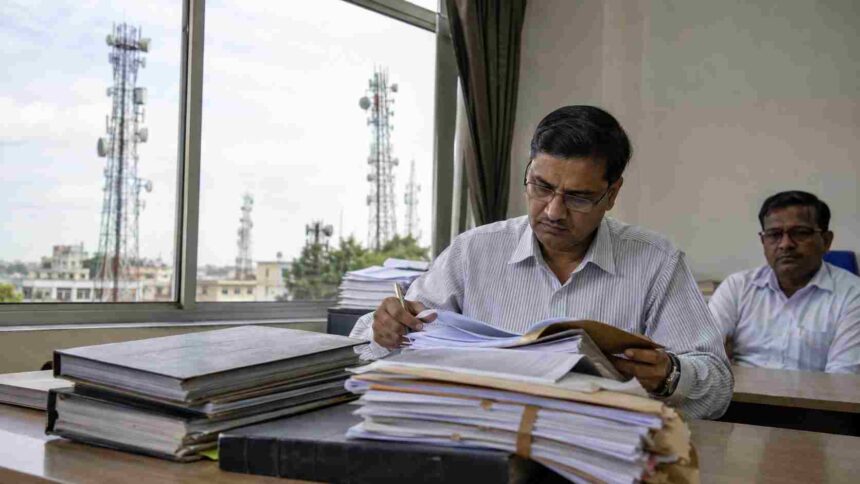

A Comptroller and Auditor General report tabled in Parliament recorded that Bharat Sanchar Nigam Limited did not bill Reliance Jio Infocomm for nearly ten years for the use of additional technology on shared passive infrastructure. The audit estimated the loss to the government exchequer at ₹1,757.76 crore plus penal interest for the period between May 2014 and March 2024.
BSNL and Reliance Jio had signed a Master Service Agreement for the lease of thousands of BSNL towers. Under the arrangement Jio installed its equipment on the state owned passive infrastructure. The CAG found that BSNL failed to enforce the clause relating to add on technology and therefore did not raise invoices for the additional usage over the entire decade. The result was a sustained free ride on public infrastructure for one of India’s largest private telecom operators.
The same audit noted further losses. BSNL failed to deduct the licence fee share from revenue paid to telecom infrastructure providers between 2019-20 and 2021-22 amounting to another ₹38.36 crore. Short billing of infrastructure sharing charges under the agreement with Jio added roughly ₹29 crore more. Taken together the cumulative impact of these lapses was placed at nearly ₹1,945 crore. During this period the government continued to invest heavily in BSNL with cumulative equity support exceeding ₹38,000 crore by March 2023.
When the CAG findings became public the official response was measured. The Ministry of Communications later told Parliament that the auditor had misinterpreted the add on technology clause. Revised invoices had been raised and there was no revenue loss according to the minister. The clarification came months after the report and after the non billing had already continued for a full decade. The sequence raises a basic question of institutional vigilance. A public sector company failed to collect what was contractually due from a private giant for ten years and the corrective action was framed as a mere clarification of interpretation rather than a serious failure of oversight.
This fits a larger pattern in which public assets and public sector entities appear to operate with unusual flexibility when dealing with the country’s most powerful corporate groups. BSNL has struggled for years with losses declining market share and repeated government bailouts. Yet the same organisation allowed a clear contractual entitlement to remain unenforced for a decade in favour of Reliance Jio. The financial benefit of that non enforcement accrued to the private operator while the cost was absorbed by the public exchequer.

Even after the CAG report, the official reply emphasised that the matter had been resolved equitably and transparently. There was little indication of accountability for the prolonged failure to bill or of systemic changes to ensure that public sector contracts with dominant private players are monitored with the same seriousness that is applied to ordinary commercial relationships. The revised invoices may recover some of the amount. They cannot erase the fact that for ten years the rent was not collected.
The CAG is the constitutional auditor of public finances. Its finding of a ₹1,757 crore loss arising from non billing of a private telecom major for the use of government towers stands on the record. The subsequent claim of misinterpretation and the delayed corrective billing do not remove the underlying reality that a public enterprise failed to protect public revenue in a transaction with one of the most influential corporate houses in the country. That failure and the mild institutional response to it continue to invite scrutiny.