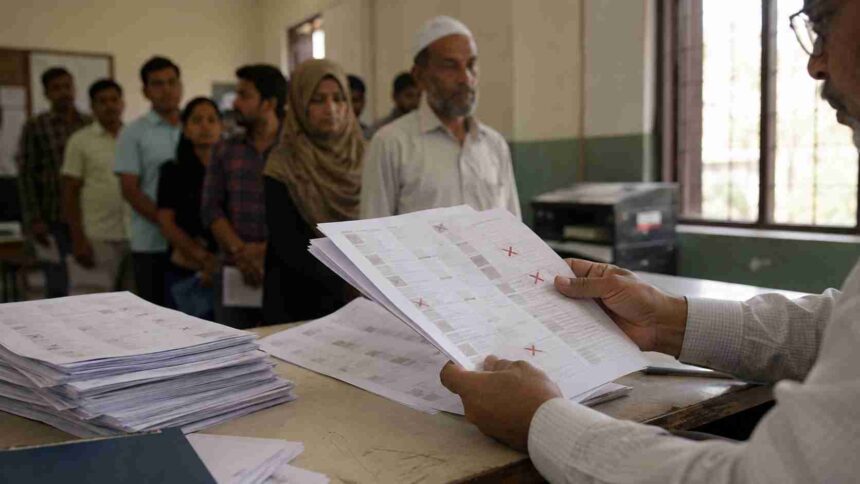

A detailed investigation into Uttarakhand’s ongoing Special Intensive Revision of electoral rolls has found that the five highest-volume objectors across the state’s 70 assembly constituencies are all linked to the Bharatiya Janata Party, and that every voter they sought to remove is Muslim. Together the five men filed approximately 6,500 Form 7 deletion objections.
In Kichha, BJP booth-level agent Rajesh Tiwari submitted 4,855 of the constituency’s 4,857 deletion requests. Nearly all of them targeted Muslim voters, including former state minister Raees Ahmad, a long-time resident of the area. Most of Tiwari’s applications cited the ground “already enrolled.” In Gadarpur, a seat the BJP won by only 1,120 votes in 2022, BJP leader Chankit Huria filed 670 objections, accounting for 49 percent of all deletion requests in the constituency. Every name on his list was Muslim.
In Khatima, the seat Chief Minister Pushkar Singh Dhami lost to Congress in 2022, BJP district vice-president Amit Kumar Pandey filed 392 of the 394 total objections, or 99 percent. In Nanakmatta, BJP booth-level agent Kishor Joshi submitted 353 of 391 Form 7 requests, using the blanket reason “shifted” against voters who have lived and voted in the area for decades. In Rudrapur, BJP SC Morcha leader Sunny Paswan filed 230 objections while four other BJP-linked individuals submitted batches of more than 100 names each. Once again every challenged voter was Muslim.
The scale of these filings became possible after progressive dilution of safeguards that were meant to prevent bulk objections. The Election Commission’s 2023 manual originally limited booth-level agents to 10 Form 7 applications a day and required personal cross-verification by the Electoral Registration Officer if any single applicant exceeded 30 objections. Ahead of the revision the daily cap was raised to 50 and later lifted entirely under a clarification originally issued for West Bengal that local officials applied in Uttarakhand. Form 7 rules place the burden of proof on the objector, yet thousands of names entered the system without preliminary substantiation. Many affected voters reported that they received no prior statutory notice and learnt of the objections only when contacted by journalists.
The draft electoral rolls published on 14 July already showed a sharp reduction in the state’s electorate, from 79.6 lakh names to 71.3 lakh. The bulk objections concentrated heavily in constituencies the BJP lost in 2022 or won by narrow margins. Separate analyses have noted that districts with higher Muslim population shares recorded higher overall deletion intensity, and that in 45 of the 70 assembly seats the number of deletions exceeded the 2022 victory margin.
More Read

Following the revelations a Congress delegation led by MP Selja Kumari and Pawan Khera formally approached the Election Commission to complain of targeted mass disenfranchisement. The claims-and-objections period ended on 13 August. Notices are to be disposed of by 11 September and the final roll is scheduled for publication on 15 September.
What emerges from the pattern is not the routine cleaning of electoral rolls. It is the use of an administrative process by party functionaries to generate thousands of deletion requests directed exclusively at one community in politically sensitive seats. The successive relaxation of quantitative caps on Form 7 filings removed the practical barriers that once limited such bulk action. The result is a revision exercise in which the highest-volume objectors are ruling-party workers and the entire set of voters they have sought to remove belongs to a single religious minority. The integrity of the final roll will depend on whether the remaining verification stage subjects these mass objections to genuine scrutiny or simply processes them as administrative routine.