
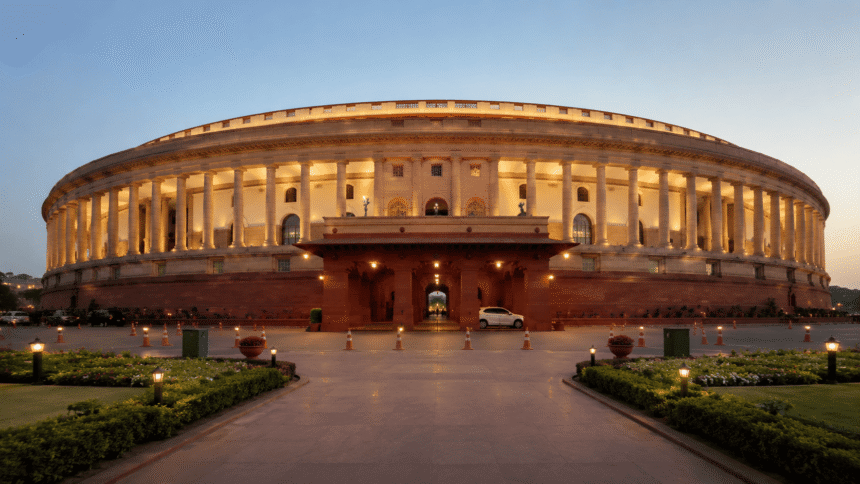

The Lok Sabha adopted a motion to refer the Foreign Contribution (Regulation) Amendment Bill, 2026, to a 31-member Joint Committee of Parliament today. The motion was moved by Minister of State for Home Nityanand Rai amid continuous protests from Opposition benches. The proposed committee will consist of 21 members from the Lok Sabha, to be nominated by the Speaker, and 10 members from the Rajya Sabha, to be nominated by the Chairman. It has been asked to examine the Bill in detail and submit its report by the last day of the first week of the 2026 Winter Session.
Opposition parties rejected the idea of a committee review and demanded that the Bill be withdrawn completely. Congress MP K.C. Venugopal said the legislation was clearly intended to target NGOs and minority organisations. He pointed out that the Opposition had received only last-minute information about the proposal to send the Bill to a joint committee and described the move as an attempt to tighten the noose around civil society. Samajwadi Party leader Akhilesh Yadav supported the demand for withdrawal and argued that the provisions could be used selectively against minority institutions. Parliamentary Affairs Minister Kiren Rijiju rejected the charge and challenged the Opposition to identify any specific clause that targeted minorities.
The Bill seeks to expand the Central government’s control over organisations that receive foreign contributions. One of its central features is the creation of a designated authority that can take over, manage or eventually dispose of assets created with foreign funds if an organisation’s FCRA registration is cancelled, suspended or not renewed. The vesting is described as provisional at first, but it can become permanent if registration is not restored within a prescribed period. Assets could then be transferred to a government department or sold, with the proceeds credited to the Consolidated Fund of India.
For larger, professionally managed organisations, the compliance burden may be manageable. For smaller trusts, local educational societies, community hospitals and minority-run welfare bodies the picture looks different. Many of these groups operate with limited administrative staff and depend on a mix of domestic and foreign support to run schools, clinics, skill centres and relief programmes in remote or underserved areas. A delayed renewal application, a technical shortfall in paperwork or an adverse finding under the expanded powers could place their long-built assets at risk. The fear is that the new framework shifts the balance from regulation of foreign funds to deeper executive oversight of the organisations themselves.
Earlier amendments and rule changes under the FCRA had already reduced the number of registered entities and increased reporting requirements. The latest Bill adds the possibility of asset vesting and widens the circumstances under which registration is deemed to have ceased. Critics argue that this creates a climate of uncertainty for grassroots groups that lack the legal and financial resources to contest decisions quickly. Minority institutions, in particular, have expressed concern that the combination of stricter renewal conditions and the threat of losing properties could shrink the space available for independent community work.

The government maintains that the amendments are necessary to prevent misuse of foreign money and to ensure transparency. By referring the Bill to a joint committee it has opened a formal channel for scrutiny. Whether that process leads to meaningful safeguards for smaller and minority organisations, or simply provides a procedural pause before a more restrictive regime is finalised, will become clearer when the committee begins its deliberations and the Winter Session approaches. For now, the referral has not quietened the apprehension that local, community-based and minority-run institutions may find their operational room further constrained.