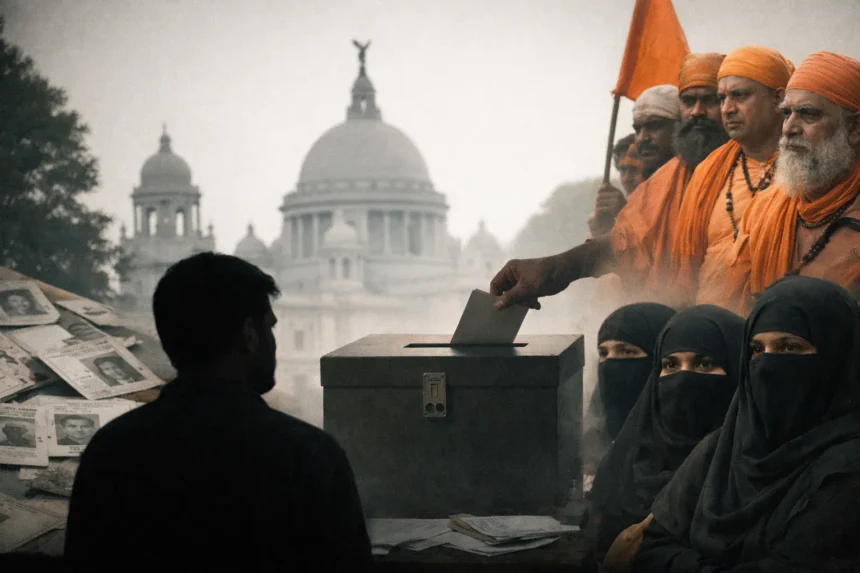

In the intricate and unpredictable West Bengal political arena, an electoral roll is far from being just a list of names; it is a document registering different political powers. Recently, an extensive analysis based on a Special Investigative Report (SIR) has shaken the whole political community of the state. The report discloses that a huge number of 9 million (90 lakh) voters have had their names removed from the electoral rolls. And be it the demographic composition of these deletions that has been the main cause of launching the political debate.
The SIR reveals that 63% of the voters removed are Hindus whereas 34% are Muslims. The social and politically important Dalit Matua community amongst the Hindus is said to have suffered most from the deletions. Now, while different political parties try to translate these figures for (and against) themselves, the state faces a very heated argument along the lines of electoral integrity, minority rights, and democratic representation.
Breaking Down the Numbers
Understanding how big this event is, one needs to relate the numbers. West Bengal total electorate is about 70 to 75 million people. Deleting 9 million names is over 10% of the state’s voting population which is a large number enough to change elections in this closely fought battleground. Demographic breakdown – 63% Hindu and 34% Muslim – roughly reflects the demographic composition of West Bengal where Hindus constitute around 70% and Muslims around 27% to 30%. From a simple statistical angle, one might say the deletions correspond to the state’s demography. But in West Bengal, data hardly ever stand alone.
The sheer scale of the deletions prompts not only immediate questioning the administrative processes of the Election Commission of India (ECI) and the state electoral machinery but also the situation itself. Electoral rolls are updated to remove deceased voters, duplicates, or those who have migrated. However, suddenly mass deleting of 9 million names has been followed by accusations of politically-motivated disenfranchisement from different sides of the political spectrum.
The Matua Factor: The Eye of the Political Storm
The most mind-blowing disclosure in the SIR analysis is the extent and intensity of the impact on the Dalit Matua community. The Matuas are part of the Namashudra sect and their ancestral origin is in the East Bengal region (which later became Bangladesh). They fled religious persecution and many of them arrived in India not only at the time of Partition but also during the 1971 Bangladesh Liberation War. They have now emerged as a huge, concentrated voting bloc, especially in the border districts of North 24 Parganas and Nadia. For the Matuas, being citizens is a matter of survival.
More Read
They have been the ones who have been the face of the debate surrounding the Citizenship Amendment Act (CAA) that offers a path to Indian citizenship for persecuted religious minorities from neighboring countries. A community that is burdened daily by the fear of having to prove their citizenship will see the deletion of their names from the voter list as more than just an administrative hiccup; to them, it will be a direct threat to their legal existence in India.
The Matua leadership has leaked the fury inside, saying that the lack of voter identification might lead to their being subjected to the National Register of Citizens (NRC) or their sudden disenfranchisement. This fear is based on reality because historically, voter identification cards have been used as the main, and sometimes the only, evidence of residency and civic participation by the marginalized communities in border areas.
Political Fallout and Allegations
Not surprisingly, the results of the SIR have led to a heated dispute among the ruling Trinamool Congress (TMC), main opposition party BJP, Left Front and Congress. After some election, the BJP has successfully broken into the Matua community by strongly backing the CAA. Therefore, the BJP Mai has accused the deletion of records as a part of the state machinery’s intention to suppress the Hindu voter turnout and the areas of the community that support the saffron party.
More Read
They have criticized the state government for manipulating the data collection at the street level to deprive the Dalit Hindu community, which is already vulnerable, of their right to vote.
However, the TMC has strongly denied these allegations. The ruling party argues that the Election Commission of Indiaa central authoritycontrols the electoral rolls. Moreover, TMC leaders have expressed their anxieties over the fact that 34% of the deleted voters are Muslims, which is a community that forms the main support base of the ruling party. In addition, TMC claims that BJP is creating a scare among the Matuas in order to grab their votes, whereas the ECI’s voter cleaning operations are typically faulty and carried out without proper ground verification by central authorities.
Also, civil rights groups and local observers are doubting the transparency of the whole process. When 34% of the removed names are from Muslims, it causes fears among the minorities who have been most suspicious of nationwide citizenship campaigns. For both Hindus and Muslims in West Bengal, the voter ID card serves as the main protection against being labeled as an “illegal immigrant.”
Administrative Reality: Purification or Flawed Process?
Beneath the political talk is the bureaucratic reality of the electoral system in India. The Election Commission (ECI) conducts a Summary Revision of Electoral Rolls from time to time. Form 7 is the official document used for protesting an incorrect inclusion or for requesting the removal of a name in case of death, change of residence, or duplication. It is theoretically possible to attribute a 10% decrease in an electoral roll to years of accumulation of “deadwood”voters who have died or moved to other states for work but were never taken off the lists.
West Bengal has a very high level of labor out-migration which may explain some of the legitimate deletions. On the other hand, the Election Commission has rules which require that before a voter is deleted several steps must be taken to ensure the integrity of the process.
A Booth Level Officer (BLO) is required to do a physical verification, the voter is sent a notice and is also given a chance to be heard. The West Bengal episode shows that this regulated working procedure was almost completely ignored. It is said that where millions were removed without knowing, the only time they found out that their names were struck off was when they checked online or when they had their first attempt to vote.

Conclusion
The SIR’s disclosure that 9 million voters were removed from West Bengal’s electoral rolls63% Hindu and 34% Muslim, with the Dalit Matua community suffering the mostsignals a serious crisis in democratic participation. It is a hotly debated issue whether this is due to a major administrative mistake, the electoral purification over-enthusiastic by the ECI, or a local demographic engineering conspiracy. The human tragedy however is evident and cannot be denied.
Voting for the Matuas and border Muslims specifically is not simply a matter of voting; to them, it is a matter of their existence. West Bengal ought to take steps to restore the rightful voters, besides carrying out a C.V.P that is transparent and independently verified, as these two will form the main pillars through which the state’s democracy will be supported in the future elections.