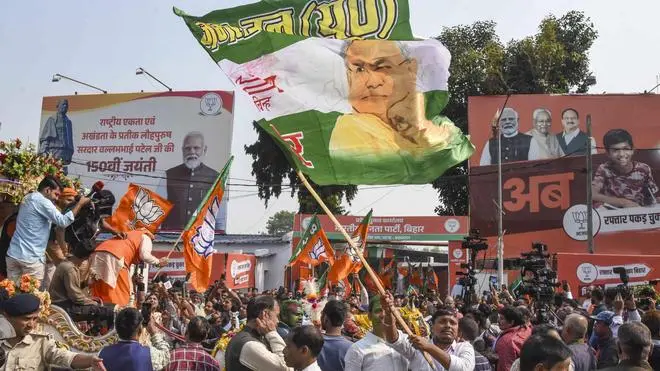

The controversy over dynastic politics has once again gained attention due to the impending Bihar Legislative Council (MLC) election. Across party lines, well-known surnames and political heirs are emerging as political parties select candidates for the ten seats up for election in June. The seeming contradiction between the ruling NDA’s public criticism of dynastic politics and its own increasing reliance on political families, however has sparked heated political debate.
BJP leaders have long presented themselves as opponents of family-based politics, regularly criticizing rival parties like the Congress and RJD on the subject. However, it appears from the current MLC election process that NDA’s own political calculations still heavily rely on dynastic politics.
Political Heirs Move to the Center Stage
Reports about the Bihar MLC elections states that a number of candidates connected to the powerful political families are anticipated to be nominated. The names being canvassed include Deepak Prakash, son of Rashtriya Lok Morcha leader Upendra Kuswaha, and Nishant Kumar, son of former Chief Minister Nitish Kumar. Relatives of prominent leaders are apparently being considered for Council positions by other alliance partners. The development has rekindled a broader discussion: why are parties in the ruling alliance increasingly endorsing political successors from powerful families if dynastic politics is detrimental to democracy.
The BJP’s Contradiction on Dynastic Politics
More Read

The BJP’s long-standing narrative against political dynasties is the target of one of the opposition’s most important complaints.BJP leaders have been accusing regional parties of establishing family enterprises in politics for years.Attacks on opposition leaders whose family held significant political positions were a common component of election campaigns.Dynastic politics was portrayed as a sign of poor internal democracy, privilege, and entitlement. But the Bihar MLC elections show that opposition parties are not the only ones who inherit political power. When it comes to electoral convenience, the ruling alliance itself seems prepared to elevate the relatives powerful politicians.
The opposition contends that political ancestry cannot abruptly become acceptable when it helps the ruling coalition if it unacceptable in one party.
Real Issues Being Overshadowed
More Read
Concerns about the issue being overlooked in Bihar’s political discourse are also raised by the increasing attention being paid to candidate families. Unemployment, migration, slow industrial growth, and educational disparity are only a few of the state’s ongoing major problems. While they wait for government hiring procedures to be finished, thousands of young people prepare for competitive exams for years. However, political discourse is increasingly focused on which political family will gain another position of power rather than on creating jobs, investment opportunities, healthcare changes, or educational advancements. Opposition parties contended that rather than engaging in never-ending debates for political succession, Bihar’s youth should have conversations about their future.
Dynastic Politics is Not Limited to one Side
The incident also draws attention to the weakness of internal party democracy, which is a larger issue in Indian politics. Political parties should ideally give opportunities to grassroots workers who dedicate years strengthening their organizations and interacting with local communities. Candidate selection should be heavily influenced by merit, political performance, and public service. However, detractors contend that family ties frequently offer quick access to power that regular party employees are unable to.
Dedicated political workers feel frustrated because they may serve a party for decades without being given the same opportunities as people with powerful surnames. Strengthening internal democracy, according to opposition, would enhance governance and boost public confidence in political institutions.
Conclusion
A paradox at the core of modern politics has been shown by the Bihar MLC elections. In actuality, politics families continue to have influence throughout the political spectrum, including inside the ruling NDA, despite the fact that dynastic politics is being utilized as a campaign topic. The lesson for the opposition is obvious: consistency is necessary for political credibility.Parties cannot support dynastic politics in reality while publicly denouncing it. More, crucially, the political discourse in Bihar needs to go beyond family histories and surname. People in the state are calling for answers to issues related to poverty, migration, unemployment, and governance. The future course of Bihar’s democracy should be determined by those issues rather than political heritage.