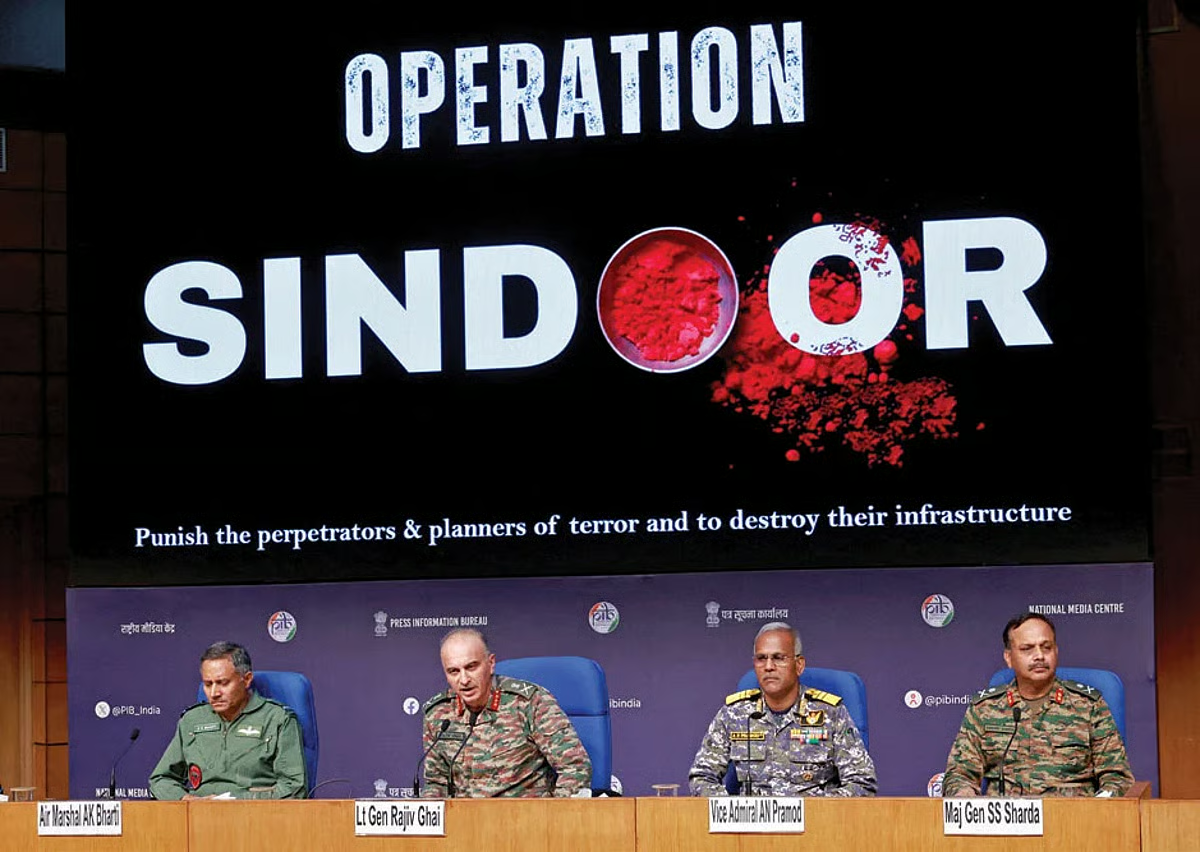

One of the most hotly contested military and political developments in contemporary Indian discourse is Operation Sindoor. The operation was portrayed by the government as evidence of India’s strong defence posture and strategic capabilities and as a resolute response to cross-border terrorism and security threats. Beyond the nationalist rhetoric and TV debates, though, the operation also raised important political issues with regard to accountability, transparency, intelligence readiness, and the politicisation of military operations.
The government’s management of national security narratives has drawn criticism from the opposition, especially the Indian National Congress. Simultaneously, a number of independent researchers and observers contended that passionate nationalism rather than an impartial assessment of policy results was influencing public discourse.
National Security and Political Messaging
The ruling Bharatiya Janata Party (BJP) projected Operation Sindoor as evidence of decisive leadership and a demonstration of India’s willingness to retaliate against threats. Government-aligned media outlets amplified this narrative, presenting the operation as a symbol of national pride and strategic dominance.
However, critics argued that the government attempted to convert a sensitive security matter into a political campaign tool. Opposition leaders questioned why every military development was immediately accompanied by political slogans, television branding, and highly coordinated media narratives favoring the ruling party.

According to Congress leaders, the armed forces belong to the nation rather than any political organization. They argued that military operations should not become instruments for electoral messaging or partisan advantage. Several opposition voices maintained that genuine patriotism requires both support for soldiers and accountability from governments.This narrative was reinforced by government-affiliated media, which portrayed the operation as a sign of strategic superiority and pride in the country. Critics countered that the government tried to use a delicate security issue into a vehicle for political campaigning. Leaders of the opposition questioned why political slogans, television branding, and well-coordinated media narratives supporting the ruling party followed every military development.Leaders of the opposition questioned why political slogans, television branding, and well-coordinated media narratives supporting the ruling party followed every military development. Leaders in Congress claim that the military forces are a part of the country, not any political party. They maintained that military actions shouldn’t be used as partisan or electoral message tools.
Congress Criticism over Strategic Failure
The Congress party targeted several areas with its criticism. It first questioned if intelligence shortcomings had played a role in the escalation that initially necessitated Operation Sindoor. Leaders of the opposition questioned why more robust preventive measures had not been put in place sooner to handle the ongoing security threats and instability in the region.
More Read

Second, Congress accused the government of avoiding parliamentary scrutiny. Critics argued that while dramatic announcements were made publicly, detailed explanations regarding operational goals, long-term outcomes, and strategic consequences remained limited.
Another major criticism was directed at media management. Congress leaders claimed that a large section of television media acted less like independent journalism and more like political amplifiers for the ruling establishment. Instead of encouraging balanced debate, many channels focused almost entirely on emotional rhetoric and hyper-nationalist framing.
The opposition also questioned whether the government was using national security issues to divert public attention from unemployment, inflation, economic stress, and social tensions. According to critics, national security should unite citizens rather than deepen political polarization.
Second, the government was accused by Congress of evading legislative scrutiny. Dramatic statements were made in public, but there were few thorough explanations of operational objectives, long-term results, and strategic implications, according to critics.
Media handling came under heavy criticism as well. Congressmen asserted that a significant portion of the television media functioned more as political amplifiers for the ruling classclass than as independent journalists. Many networks concentrated almost exclusively on emotive speech and hyper-nationalist framing rather than promoting fair discussion.
The opposition also questioned if the administration was distracting the population from social problems, unemployment, inflation, and economic stress by invoking national security concerns. Critics contend that national security should bring people together rather than exacerbate the political division.
More Read
Role of Godi Media
The propaganda war surrounding Operation Sindoor was one of its most important features. Social media efforts, internet influencers, and television debates all contributed to the perception that criticising the government’s approach was anti-national.
There were worries about the democratic space being reduced as a result of this climate. National security decisions must be subject to examination and debate in democracies, according to analysts. Over time, institutions may become weaker due to blind support without accountability.
Additionally, some observers pointed out that complicated geopolitical realities were frequently obscured by sentimental storylines. Dramatic images, catchphrases, and selective reporting moulded public opinion, making nuanced discourse more challenging.
The public’s perception of military developments has changed as a result of the emergence of extremely divisive political communication.Discussions sometimes turn into partisan battles between government supporters and detractors rather than strategic consequences.
Armed Forces and Domestic Politics
Another issue raised during debates on Operation Sindoor was the growing politicization of the armed forces in India’s electoral environment. Opposition parties warned that repeated political references to military operations risk damaging the traditional neutrality and institutional dignity of the military.
Governments should refrain from portraying military success as the accomplishment of a single political figure or party, according to critics. The armed services are a symbol of the national institutions that have been established over decades of sacrifice by members from a wide range of regional, religious, and political backgrounds.
Excessive politicisation could lead to long-term institutional problems, according to several former officials and analysts. When military operations are continually incorporated into party narratives, it becomes more difficult to unite the country on defense-related issues.
Conclusion
Operation Sindoor developed into a significant political and media event that revealed profound differences within Indian public discourse, surpassing its initial purpose as a security operation. Critics questioned the operation’s political intentions, strategic communication, and transparency while the administration presented it as evidence of strong leadership.
Accountability, intelligence readiness, and the perils of politicising military accomplishments were the main points of contention for the Congress party. In the meantime, more general discussions about democratic space, media polarisation, and the connection between nationalism and electoral politics surfaced.
In the end, the debate surrounding Operation Sindoor highlights a more significant issue facing contemporary democracies: striking a balance between democratic accountability and national security. Democratic oversight and strict security measures are not mutually exclusive. In actuality, both strong defences and the ability to question people in positions of authority are necessary for a robust democracy.