
Join us for today’s in-depth investigation of where we break down one of 2026’s most chaotic political battles. India has embarked on an extraordinary era of political protests fighting in the streets of the national capital, Bengaluru, and the tech sectors, raising slogans, clashing with authorities, and calling for fundamental accountability. Standing at the very heart of this political upheaval is an autonomous body that’s central to India’s democratic structure: The Election Commission of India (ECI).
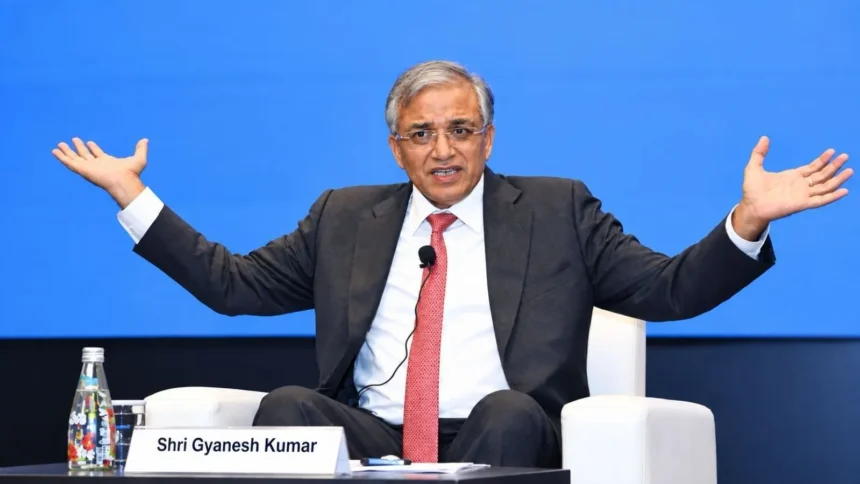
The INDIA group, mainly overseen by the congress party, has mounted an unrelenting nationwide protest against CEC Gyanesh Kumar. With Rahul Gandhi on the fields of Rajghat and talking to the media at the Constitution Club and the simultaneous youth mass protests plotted by the CJP sprouting in the South, the political Indian future is extremely uncertain.
Rahul Gandhi’s Frontline Role: From Rajghat to the Constitution Club
On the third consecutive day of high voltage drama, Leader of Opposition Rahul Gandhi ramped up the Congress’ fightback by taking the fight to the most iconic spaces in Delhi. The day began with the iconic image of Rahul Gandhi with Congress President Mallikarjun Kharge, Priyanka Gandhi Vadra and leaders of the INDIA bloc MPs at Rajghat, the memorial of Mahatma Gandhi. In a symbolic, peaceful satyagraha, Congress leaders and Rahul Gandhi also made their fight the moral fight to save Indian democracy.
After the visit to Rajghat, the political activity was shifted at the Constitution Club, New Delhi. Rahul Gandhi addressed the national media and held an important strategic meeting with leaders of 20 constituents of India alliance. The crux of the issue is that the Election Commission’s Special Intensive Revision (SIR) of electoral rolls. The opposition has strongly alleged that the SIR exercise has been used as a tool to suppress the votes and has massively corrupted and deleted genuine names to benefit BJP.
More Read
In his speech, Gandhi did not shy away from naming the Election commissioner. He stated that the CEC, Gyanesh Kumar is working under the directive of government, as he used the word “Vote Chori” (vote theft) to mention the election fraud. He further noted that the Election Commission has to work as the constitution of India and not as an accountant of Prime Minister Office (PMO). The meeting ended with a multi-point agenda in unanimous form with the first demand of immediate resignation of Gyanesh Kumar.
An Unprecedented Attack on an Autonomous Institution
What’s truly unprecedented about this wave of protest is the object. Opposition parties have in the past lodged protests against Election Commission decisions, or the reliability of electronic voting machines or the arbitrary timing of elections. But a continuous mass multi-city street protest demanding the resignation of a sitting Chief Election Commissioner is yet to be seen in India’s recent democratic experience. We are witnessing a new chapter in India’s political history of resistance against an autonomous constitutional authority.
More Read

The magnitude of the problem has constitutional and practical implications. Whereas the pressure on a cabinet minister might lead to resignation, it is much more difficult to use the instrument of asking the Chief Election Commissioner to resign. As per the Indian Constitution, the Chief Election Commissioner has a high security of tenure and legal immunity as Parliament’s intention was to make the office immune to political influence. Any removal of the CEC has to be by an elaborate process of impeachment in the Parliament only on proved misbehavior or incapacity, akin to the removal of a Supreme Court judge.
That’s why, the BJP-led NDA regime is on the backfoot. After the controversy broke in September, the Modi-led government consistently stood behind Kumar and the autonomy of the EC, calling out the Congress for indulging in “manufactured outrage”. The BJP is relying solely on the constitutional protections that the CEC enjoys and is aware of the negative implications that the removal of an independent CEC will have on the Indian Constitution.
In Which Direction is the Protest Heading?
The burning question on everyone’s mind is: In which direction is this protest against Gyanesh Kumar heading, and how long can the opposition sustain this momentum? The endgame of this agitation remains incredibly blurry.
Currently, the Congress and its allies are ensuring that the issue does not die down in the media cycle. The daily standoffs with the Delhi Police, the detention of senior leaders, and the visuals of MPs being blocked from marching to the Election Commission headquarters at Nirvachan Sadan are keeping the political temperature boiling. Internally, the INDIA bloc leadership is reportedly drawing up a draft notice to launch formal impeachment proceedings against CEC Gyanesh Kumar in both the Lok Sabha and the Rajya Sabha. Even if the motion fails mathematically, the opposition believes that initiating the process will force a nationwide debate on the ECI’s credibility and corner the government.
However, fatigue is a real risk in street politics. How long can MPs sit on dharnas without clear resolutions? Inside the NDA camp and the corridors of power, intense discussions are underway regarding how to handle the optics of these daily blockades. The government’s strategy seems to be one of attrition—letting the opposition tire out while maintaining a staunch defense of the CEC. Yet, the persistent allegations of “vote chori” risk seeping deeper into the public consciousness, which could force the government to rethink its communication strategy if public sympathy tilts toward the protesting bloc.
More Read

The CJP Uprising: Bengaluru Protests and the Road Ahead
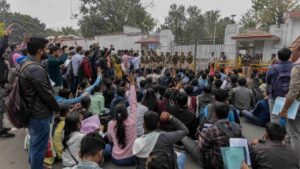
As the political heavyweights battle it out in the national capital, a parallel and equally potent civilian uprising is taking shape in the south. The Cockroach Janata Party (CJP), a rapidly growing youth-led movement that emerged earlier this year following controversial remarks against unemployed youthhas officially entered the fray, turning the SIR controversy into a mass public issue.Today, at Bengaluru’s Freedom Park, thousands of youngsters gathered under the CJP banner for a massive demonstration. The energy at the protest was palpable as the movement managed to rope in influential civil society voices. Prominent YouTuber Dhruv Rathee, known for his highly critical political explainer videos, and veteran actor-activist Prakash Raj took center stage alongside CJP founder Abhijeet Dipke.
The CJP held a unique ‘People’s Tribunal’ at Freedom Park to present data showing how the SIR exercise maliciously deleted more than 13 crore names from the electoral rolls in 20 states. Soon after the tribunal, the movement announced the most symbolic of the protests as their immediate next step: Chappal Protest (slippers). Dipke lashed out with an emotional speech in Hindi conveying his message to the Central Government about Gyanesh Kumar resignation. This Bengaluru protest is only the beginning of the mega-march of CJP to Delhi slated later in the week and shows that this agitation has finally begun to transcend traditional political parties.
Conclusion
The combined pressure from the INDIA bloc’s experienced politicians and the CJP’s younger activists poses a notable challenge for the current government. Rahul Gandhi is using locations like Rajghat and the Constitution Club to frame the issue as one of democratic survival, while digital influencers are rallying young people in Bengaluru. The protest against CEC Gyanesh Kumar is quickly emerging as a key event of 2026. It is uncertain whether this will result in a historic impeachment motion, a resignation, or if it will ultimately be halted by constitutional procedures. What is clear is that the credibility of India’s independent institutions is undergoing its most significant public scrutiny in recent times.