
Today the counting of votes is underway for the Datia Assembly bypoll in Madhya Pradesh and the Bankipur Assembly bypoll in Bihar. What began as two routine vacancies has drawn wider attention because of the timing and the political signals the early trends appear to carry in the aftermath of the recent student protests.
In Datia, Congress candidate Ghanshyam Singh has pulled ahead of BJP’s Ashutosh Tiwari after initial rounds in which the BJP held the advantage. Subsequent updates showed the Congress candidate widening the margin from a few hundred votes to roughly 1,700–3,000 as counting advanced. Azad Samaj Party’s Damodar Yadav has remained in third place. The seat fell vacant following the disqualification of former Congress MLA Rajendra Bharti. With a turnout of 71.44 percent recorded on 30 July, the contest has become a measure of whether local dissatisfaction can challenge the ruling party’s position in the state.
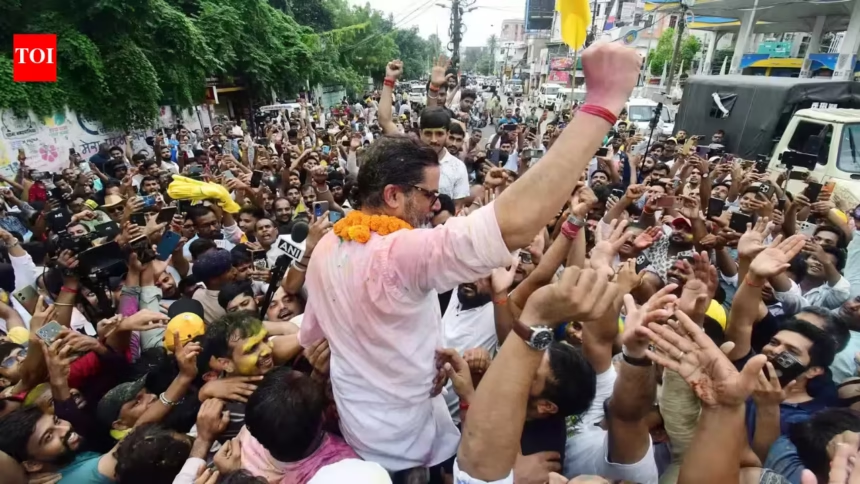
In Bihar’s Bankipur, Jan Suraaj Party founder Prashant Kishor has maintained a steady lead over BJP candidate Neeraj Kumar Sinha. Early rounds placed Kishor ahead by more than 1,000 votes, with the gap later stretching beyond 2,300 and in some updates approaching 6,000. RJD’s Rekha Kumari is trailing in third. The bypoll became necessary after BJP national president Nitin Nabin vacated the seat on his election to the Rajya Sabha. Turnout stood at around 34.3 percent. For Kishor the contest marks his electoral debut and a direct challenge to the BJP in a traditional urban stronghold of Patna.
These bypolls arrive at a moment when the aftershocks of the student protests still linger. The agitations had brought questions of education policy, job anxiety and the political establishment’s response to youth concerns into sharp focus. Against that backdrop, any setback for the BJP in either seat will be interpreted as evidence of residual discontent, while a strong showing will be claimed as proof that the protests left little lasting electoral impact.
Both the ruling party and its challengers have treated the seats with seriousness. The BJP has invested organisational energy in defending its turf. Congress and the newly assertive Jan Suraaj Party have sought to convert local grievances and the broader national mood into votes. Final results are expected later today. Whatever the eventual numbers, the trends already confirm that these bypolls have become a litmus test of the present political climate and will influence the narratives that shape the months ahead.