
India has the world’s biggest youth population, with an estimated 370 million people aged 15 to 29. More of them are studying than before, but many have found that hard-won, often expensive degrees offer no guarantee of a decent job. That opening observation from the Financial Times captures a quiet crisis that successive governments have preferred to paper over with slogans about demographic dividend and Atmanirbhar Bharat. Under the BJP’s long rule at the Centre, the mismatch between rising educational aspirations and the actual supply of quality employment has only grown more acute.
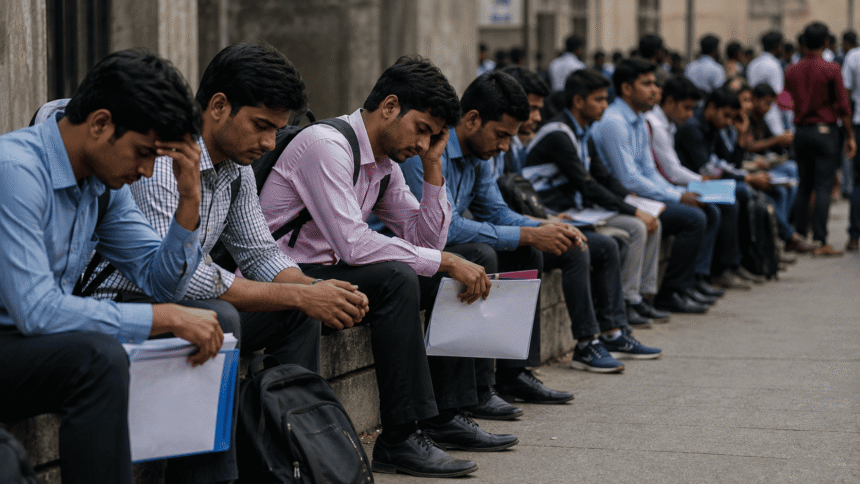
The numbers are no longer abstract. Research associated with Azim Premji University shows that between 2004 and 2023 roughly five million graduates entered the workforce each year, yet the number of those finding employment rose by only about 2.8 million annually. Of young people who report themselves unemployed, fewer than seven percent of graduates secure permanent salaried work within a year. Nearly 40 percent of graduates aged 15-25 remain jobless, a rate far higher than among the less educated. These are not the statistics of a country successfully converting its youth bulge into productive growth. They are the statistics of a system that has expanded the supply of degrees while failing to expand the demand for skilled labour.
The BJP government has repeatedly claimed credit for formalisation, digital public infrastructure and production-linked incentives. Yet the lived experience of young Indians tells a different story. Families mortgage land or take high-interest loans to send children to private colleges and coaching centres, only to watch them join the ranks of the educated unemployed. Many end up in precarious gig work, unpaid family labour or return to agriculture, the very sector the government claims is being modernised out of existence. The FT piece rightly notes that more young people are studying than before. What it also implies, and what Indian data confirm, is that the quality and relevance of that education remain uneven, and the labour market simply cannot absorb them at the scale required.
This failure is not accidental. It reflects policy choices that have privileged capital-intensive growth, corporate incentives and headline infrastructure projects over the harder task of generating mass employment. Manufacturing’s share of GDP has stagnated. Private investment has been hesitant outside a handful of favoured sectors. The much-touted Startup India ecosystem produces unicorns for investors but limited stable jobs for ordinary graduates. Meanwhile, the government’s own employment schemes remain fragmented, underfunded or geared more toward political visibility than structural change. When the official narrative celebrates falling headline unemployment rates, it often does so by counting self-employment and unpaid work that young people themselves do not regard as decent jobs.
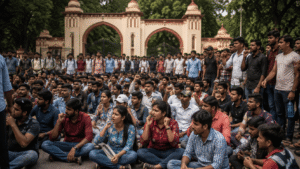
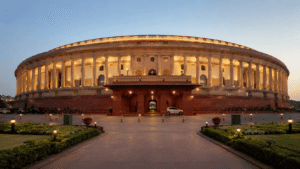
The political consequences are already visible. Student protests over examination integrity, paper leaks and recruitment delays are not isolated grievances, they are symptoms of a deeper anxiety that the system is rigged against those who play by the rules. A generation that was told education would be the ladder out of precarity is discovering that the ladder stops short of the formal economy. For the BJP, which has governed India for more than a decade and dominates most major states, this represents a profound failure of delivery. The party’s electoral success has rested in part on the promise of opportunity. That promise is fraying among precisely the demographic that was supposed to be its greatest asset.

It is argued that the problem is long-standing and predates the current regime. That is true in part. Yet after years of uninterrupted power, the BJP cannot credibly claim that the structural constraints are beyond its control. The demographic window is finite. India’s youth population is projected to peak around 2030. If the current pattern continues, degrees proliferating while secure jobs stagnate, the country risks converting a historic opportunity into a source of lasting social frustration. The Financial Times report has merely stated what millions of Indian families already know, a degree is no longer enough. The question for those in power is whether they are prepared to treat that reality as a policy emergency rather than a temporary inconvenience to be managed with rhetoric.