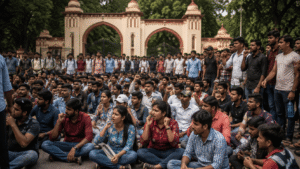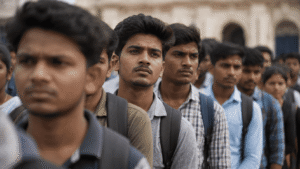
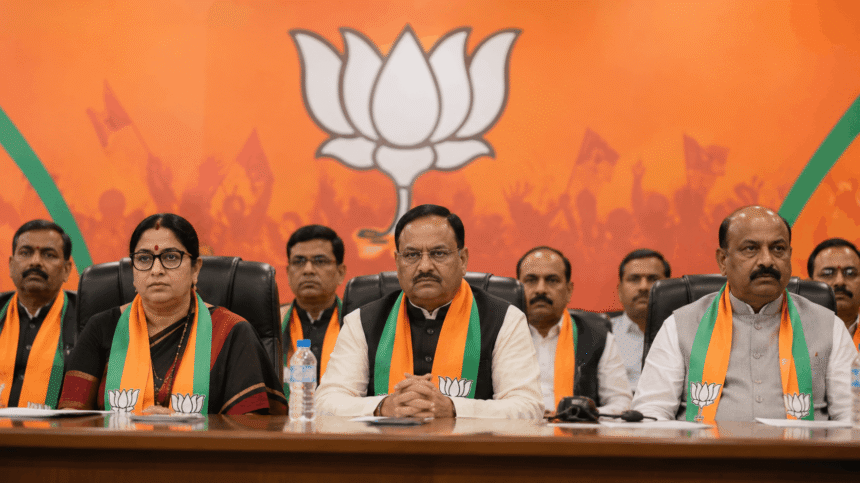

The Bharatiya Janata Party today announced its new national organisational team under president Nitin Nabin, placing several leaders from Uttar Pradesh in key positions. The appointments come as the party prepares for the 2027 Uttar Pradesh assembly elections and follow months of public discontent that included large scale student and youth protests across the country.
Among the 13 national vice presidents are Rekha Verma and Professor Tariq Mansoor, both from Uttar Pradesh. The list of eight national general secretaries includes Smriti Irani and Harish Dwivedi, also from the state. Irani has been given charge of Uttar Pradesh organisational matters. National secretaries from Uttar Pradesh include Bhola Singh and Sangeeta Yadav. In the morcha appointments Amarpal Maurya has been named president of the OBC Morcha while Kunwar Basit Ali heads the Minority Morcha. Mahendra Pandey from Uttar Pradesh has been appointed Central Office Secretary. Shivprakash from the state continues in the organisational structure as a joint general secretary.
The new team was finalised after a long delay. Nabin took charge as party president in January 2026 and the list of office bearers was reportedly ready months earlier. Its formal announcement came only after the monsoon session of Parliament and after a period marked by sustained student protests over examination integrity teacher shortages and related education issues. The Cockroach Janta Party led demonstrations and other youth mobilisations had drawn attention to the distance between government claims and the lived experience of many young voters.
Party leaders present the reshuffle as a routine organisational exercise aimed at strengthening the structure before a critical election cycle. Uttar Pradesh remains the largest and most decisive state for the BJP. The inclusion of experienced faces such as Smriti Irani alongside other state leaders is being read as an effort to tighten coordination and outreach in the Hindi heartland. The elevation of leaders associated with OBC and minority morchas is seen as an attempt to broaden the party’s social base in a state where caste and community equations remain central to electoral outcomes.
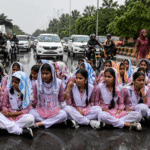
At the same time the timing is difficult to separate from the political atmosphere of the past year. Public anger over paper leaks recruitment delays and the quality of government schooling had forced the resignation of a Union education minister and produced repeated street protests. In Uttar Pradesh itself school students had recently demonstrated over teacher shortages. The party’s decision to refresh its national team with a visible Uttar Pradesh contingent comes against this backdrop of accumulated grievances.

The appointments take effect immediately. How effectively the new office bearers translate organisational responsibility into political recovery in Uttar Pradesh will be tested in the months ahead. For now the announcement signals that the BJP recognises the need to recalibrate its presence in the state that has long been central to its national success. The test will be whether the new team can address the issues that have driven sections of the public especially the young away from the party’s earlier narrative of delivery.