

Journalist Abhishek Upadhyay, who first reported alleged embezzlement of donations at the Ram Temple in Ayodhya, has moved the Supreme Court after Ghaziabad Police sought his complete digital footprint from the social media platform X. The request covers activity from 1 June 2026 onward, a period that coincides with the weeks in which he gathered material for those reports.
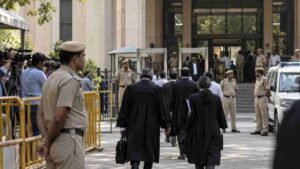
Upadhyay’s counsel told a bench led by Chief Justice Surya Kant that the investigating officer has asked X for the journalist’s full digital record. The lawyer argued that surrendering the data would place every confidential source who provided information on the donation irregularities at the mercy of the state machinery and expose them to harassment. The platform itself notified Upadhyay of the police request.
The digital demand Is linked to a road-rage FIR registered on 18 August that invokes provisions of the Scheduled Castes and Scheduled Tribes (Prevention of Atrocities) Act along with ordinary traffic-related charges. The data request begins more than two months before the alleged incident. Upadhyay has described the FIR as fabricated and intended to intimidate him. He has asked for local CCTV footage from the relevant stretch of road to be preserved so that his account of events can be verified.
On 25 August, the Supreme Court granted him interim protection from arrest. The bench directed the police to supply him a copy of the FIR and advised him to approach the High Court for quashing of the case. The court also extended the protection to any further FIRs that might be filed in the intervening period. It has listed the matter of the digital surveillance and source protection for further hearing on 7 September.
The sequence is straightforward. A journalist publishes reports on the alleged misappropriation of temple donations. Weeks later a criminal case is registered against him on an unrelated private dispute. The investigation then reaches back in time to the exact period of his reporting and seeks the electronic trail that would reveal who spoke to him. The stated purpose is a road-rage inquiry. The practical effect is the unmasking of sources who provided information about the handling of public religious donations.
More Read

Confidential sources are the backbone of investigative reporting on institutional wrongdoing. When a state police force can obtain a journalist’s historical digital activity under the cover of a later, unrelated FIR, the protection those sources rely on disappears. The timeline discrepancy between the data request and the alleged offence makes the connection difficult to ignore. The Supreme Court has so far prevented the journalist’s arrest and has agreed to examine the surveillance claim. The larger question is whether the demand for the digital record itself will be allowed to stand.