


The intersection of public faith and administrative finance is a highly sensitive frontier in any mature democracy. Millions of middle-class taxpayers recently contributed their life savings to a cultural monument, driven by pure, unquestioning spiritual devotion.
The rapidly escalating controversy over the Ayodhya Ram Temple donations has deeply fractured public trust. The “Mainstream State” that on one hand uses a religious place to garner electoral arithmetic and however does not provide a transparent financial ledger, is going beyond the limits of morality.
For the people of the Hindi Heartland, this issue has moved beyond just party politics. The dispute over the Ayodhya Ram Temple donation reveals a deep failure in the accountability of institutions, calling for an earnest and analytical civic check-up of the management of public capital by politically supported trusts.
The Anatomy of the Ayodhya Ram Temple Donation Controversy
Understanding just how big this institutional failure is, one has to look at the huge financial gaps that have only just come to light. The scandal started when it was claimed that a great part of public offerings had been stealthily taken away.

According to a detailed investigative, the Uttar Pradesh Police conducted a raid at the residence of a temple administrative employee, Lavkush Mishra.
The findings of this raid have sent shockwaves through the political and administrative establishment. The data paints a chilling picture of systemic embezzlement:
- An estimated ₹7 crore in public donation funds is allegedly missing.
- Police recovered between ₹10 lakh and ₹12 lakh in unaccounted cash from the employee’s rural residence.
- Two employees responsible for counting donations have been detained for intense interrogation.
The Mathematics of Corruption
More Read

The financial arithmetic surrounding these employees is mathematically impossible to justify. The detained individuals were officially entrusted with counting the daily cash offerings received at the temple.
For their services, they were paid a highly modest monthly salary ranging between ₹18,000 and ₹20,000.
Yet, local sources and early investigations indicate extremely rapid and large accumulation of wealth. Recently one of these low-paid workers bought a very expensive property for 1.5 crore, and the other one purchased a land worth 40 lakh. This type of accumulating assets in such an unjustified manner is strongly suggestive of a systematic siphoning of public wealth.
The Whistleblower and the Erased Evidence
What elevates the Ayodhya Ram Temple donation controversy from a localized theft to a profound institutional cover-up is the alleged destruction of critical evidence.
Mahipal Singh, a former accountant and an expert auditor who was reportedly recruited by the RSS, decided to blow the whistle. He openly accused the administration of making the theft of public offerings a “regular feature.”
More Read

The institutional response to his whistleblowing was terrifyingly swift. Instead of launching an internal probe, the administration reportedly terminated Mahipal Singh’s employment the very next day.
Things go from bad to worse when we talk about the digital security system. The temple has been under news spotlight accusing them of deleting the vital CCTV recording of 8 months that keep them under surveillance. If this was a real case, the “accidental” deletion of video evidence of such a long period would be the clearest indication of the involvement of the whole system.
The Political Storm and the Demand for an SIT
The absolute paralysis of the state’s accountability mechanisms has triggered a massive political and legal storm. The “Mainstream State” can no longer dismiss these allegations as mere opposition rhetoric.
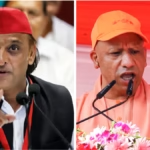
On June 7, ex-SP minister Pawan Pandey first stated that the amount of money cheating was from 5 crore to 7.5 crore. Later on, SP Chief Akhilesh Yadav called upon the judiciary to take suo motu notice of the financial irregularities.
The demand for transparency quickly crossed party lines, proving the undeniable gravity of the situation:
- Congress leader Priyanka Gandhi has explicitly called for a Supreme Court-monitored SIT probe to expose the larger scam.
- Even BJP leader Dr. Rajneesh Singh wrote a formal letter to the Prime Minister on June 9, demanding a CBI inquiry.
- A co-accused in the original Babri Masjid case has shockingly filed a formal complaint against the temple trustees alleging embezzlement.
Consequently, the Prime Minister’s Office (PMO) has sought a comprehensive report from the temple trust, signaling that the political elite can no longer ignore the administrative rot.
The Taxpayer’s Dilemma in ‘Digital India’
For the General Category, middle-class taxpayer, this controversy exposes a deeply uncomfortable institutional double standard.
On June 7, ex-SP minister Pawan Pandey first stated that the amount of money cheating was from 5 crore to 7.5 crore. Later on, SP Chief Akhilesh Yadav called upon the judiciary to take suo motu notice of the financial irregularities.
Yet, when huge amounts of public funds, running into billions of rupees, are collected for a very publicized cultural mega-project, the transparency of the administration totally disappears. How can a system that micro-manages every penny of the taxpayer allow 7 crore in hard cash to just disappear from a highly secured, heavily monitored facility?
The Commodification of Faith
Oftenly, this particular religious location is the main focus of the ruling government’s electoral public relations by a wide margin. That’s why, with the UP 2027 Assembly Elections coming near, the cultural capital that this monument generates is being turned into a commodity for accessing majoritarian vote banks.
Still, when political leaders tap into the public’s devotion to create political momentum, at the same time, they bear the whole moral responsibility of safeguarding the citizens’ provident money that is a financial contribution Payovich V. The first person is disconnecting a person who has been faithful to the belief of a citizen ruler and that person is bringing a malicious utilization of a political and financial extortion.
Conclusion: Public Trust Requires a Public Audit
The ongoing Ayodhya Ram Temple donation controversy is a critical stress test for India’s democratic and legal institutions.
A Public Interest Litigation (PIL) has already been filed in the Lucknow bench of the Allahabad High Court, demanding a thorough audit by the Comptroller and Auditor General (CAG). This is the absolute minimum standard of accountability required.
If the “Mainstream State” has nothing to hide, it should immediately welcome a fully independent, judicial probe. The administration must realize that true reverence for a cultural monument is demonstrated through absolute administrative purity, not through bureaucratic cover-ups.
Until the state provides a transparent White Paper on these missing funds, the grand promises of “Zero Tolerance” governance will remain a hollow, taxpayer-funded illusion.