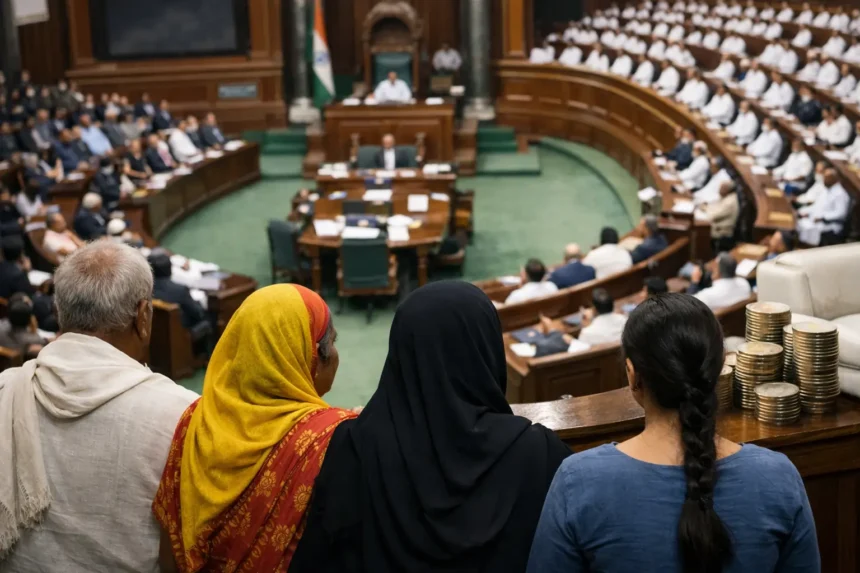

India was introduced by the cabinet with a proposal to increase the number of Lok Sabha seats to 850. Among them, 815 seats will be given to the States and 35 seats will be reserved for the Union Territories. The increased number of seats will help in representation of different localities of the country. This is the major delimitation exercise after the 1970s which is being touted as a democratic move to give people more representation. However, the most disadvantaged sections like Scheduled Castes, Scheduled Tribes, Other Backward Classes, women and other minorities do not receive new provisions or safeguards.
Moreover, the government does not propose implementing further constitutional amendments to ensure proportional representation of Scheduled Castes, Scheduled Tribes, Other Backward Classes, women or Muslims. It is glaring from the present statistics that these groups are still significantly under-represented even with the existing 543 seats in the house.
Current Representation Crisis for Marginalised Groups
The last delimitation in India was done on the basis of the 1971 Census. The population has increased from 550 million in 1971 to 1.43 billion today. However, the number of reserved seats has not changed and remained at 84 for SCs and 47 for STs, which is around 15% and 7.5% respectively. This is in contrast to the figures of these communities which are 16.6% and 8.6% respectively as per the latest 2011 Census. Dalits and Adivasis are still at the mercy of tokenism. According to NCRB data for 2024, the cases of atrocities against SCs increased by 7.6% and against STs by 12.5% year-on-year; however, there is still no political empowerment through higher guaranteed representation.
OBCs, who are estimated at 41-52% of the population according to various surveys including Mandal Commission and recent state caste censuses, have no reserved seats in the Lok Sabha. The new 850-seats proposal does not have any provision to rectify this.
More Read
Muslims, the second largest community forming 14.2% of the country’s population (over 200 million), have had their representation in the Lok Sabha at 4-5% for decades. In the 18th Lok Sabha, only 24 Muslim MPs were elected – the lowest number since 1952. The new expansion neither provides sub-quotas nor safeguards to address this chronic under-representation.
Women are no exception to this. Although the Women’s Reservation Bill was passed in 2023, it is still to be implemented due to delimitation delays and presently women have only 14.4% of seats (78 out of 543). The 850-seat plan that has been put forth does not even attempt to fulfill the promise of 33% women quota in the new constituencies.
No Constitutional Safeguards in the 850-Seat Proposal
More Read
The government’s proposal is silent on:
- Raising SC/ST reservation quotas in line with current population shares
- Introducing OBC reservation in Lok Sabha (a long-standing demand)
- Enforcing the women’s quota without further delay
- Creating mechanisms to ensure minority representation
This is a huge mistake. Constitution (106th Amendment) Act for women reservation is contingent upon the post-delimitation process but no corresponding protective measures for SCs STs OBCs and minorities have been publicly disclosed. Some experts are of the opinion that on purpose this is an addition that increases political seats without correcting the fundamental inequalities.
According to Parliament records, over the past 50 years, the proportion of MPs from Dalit, Adivasi and OBC communities has not grown at the same rate as the population. A 2024 report by the Trivedi Centre for Political Data found that as a result of only making up 15-20% of the population, the upper castes nevertheless occupy more than 40% of the general category seats.
Massive Taxpayer Burden: 850 Seats, 850 MPs
The financial costs of this are incredibly large. Every MP at present is paid a monthly salary of 1 lakh along with various allowances, housing without rent travel medical benefits, and staff support, which together can cost the taxpayers roughly 10-12 crore per MP over five years when the perks are counted.
There are 850 seats which means 850 MPs. Each of them is assured of a pension for life, entirely funded by the taxpayers, while the option to perform and have a clean criminal record is left open. Due to addition of seats, the estimated annual expenditure on salaries, pensions, and facilities alone will go over 1,200 crore. Furthermore, this does not cover election expenses for larger constituencies or additional secretariat staff. This is why India is considered the most expensive democracy in the world.
More Read
At the same time Dalits SCs STs OBCs, women and minorities, who are by far the majority of India’s poor population, continue to pay the burden of indirect taxes that finance this enlargement without receiving equal political power.
Selective Expansion
Official figures expose the gap:
- SC population share: 16.6%, current reservation: 15.4%
- ST population share: 8.6%, current reservation: 8.6%
- OBC population share: 41-52%, reservation: 0%
- Muslim population share: 14.2%, representation: ~4.4%
- Women population share: 48%, representation: 14.4%
This proposal is only providing additional seats without solving these problems. According to a PRS Legislative Research analysis of 2025, the delimitation that lacks simultaneous safeguards might dilute the political voice of marginalised communities in states like Uttar Pradesh Bihar Madhya Pradesh, and Rajasthan that have higher SC/ST/OBC populations.
Modi government has been continuously asserting their commitment to social justice. However, the lack of any references to sub-quotas, OBC inclusion, or minority safeguards in the official proposal points to a pattern: the expansion is for political arithmetic and not for genuine representation.
Political Optics Vs Ground Reality
The timing is very significant. The proposal comes just after the 2024 elections in which BJP’s performance in SC/ST reserved seats was reduced. By increasing total seats without guaranteed safeguards, the ruling dispensation will get more seats for the general category while the marginalized groups remain dependent on the existing quotas which are no longer in line with demographic reality.
Opposition parties including Congress and regional ones have condemned the proposal calling it “anti-Dalit, anti-OBC and anti-minority.” According to the Election Commission data, the voter turnout of SC/ST communities is generally higher than the national average however their legislative power remains limited.
This move can lead to a situation in India where democracy is all about numbers and at the same time 850 MPs get lifelong pensions and privileges at the cost of taxpayers, whereas Dalits SCs STs OBCs women and minorities still have to struggle for basic political rights.
Referring to a detailed article in The Hindu, the proposed delimitation is likely to favour bigger states which have experienced higher population growth but there is no mention of the safeguards for the historically disadvantaged sections.
Conclusion: Expensive Expansion Without Social Justice
The plan to increase the Lok Sabha membership upto 850 (815 for states and 35 for UTs) is portrayed as a measure for distant and strong federal representation. However, it only highlights even further the fact of Dalits SCs STs OBCs women and minorities who most probably got no new guarantees or protective measures from the expansion. It continues the pattern of the same inequalities and differences that have been going on for these many decades.
The government has to first bring in proportional safeguards for the most vulnerable sections of society if this enlargement by itself is going to be only political calculations and not a genuine democratic deepening. Taxpayers should not be paying for more than 850 MPs who get to enjoy lifelong benefits while the voices of Dalits SCs STs OBCs women and other minorities continue to be ignored.