
On 2 September 1994, the police and Provincial Armed Constabulary opened fire on a crowd of statehood demonstrators at Jhoolaghar in Mussoorie. The shooting came exactly one day after the Khatima killings and became one of the decisive turning points in the movement that produced the separate state of Uttarakhand.
Thousands of local residents, women, students and ex-servicemen had gathered near the Mall Road to protest the previous day’s police action in Khatima and to reiterate the demand for a separate hill state. The assembly was unarmed. According to accounts from the time and later inquiries, the force opened fire into the crowd without the usual sequence of warnings or non-lethal dispersal measures. Six demonstrators were killed, including Belmati Chauhan, 48, Hansa Dhanai, 45, Balbir Singh Negi, 22, Rai Singh Bangari, 54, Dhanpat Singh, 50, and Madan Mohan Mamgain, 45. Two of the dead were women leaders of the movement. DSP Uma Kant Tripathi also died in the confrontation. Contemporary reports noted that he had resisted orders to fire indiscriminately on civilians.
In the immediate aftermath, the authorities imposed a strict curfew across Mussoorie that lasted nearly two weeks. House searches, detentions and harassment of activists followed. The twin massacres in Khatima and Mussoorie did not crush the agitation. They unified Garhwal and Kumaon, transforming a regional demand into a mass civil-disobedience campaign that spread across both hill regions. The momentum generated by the bloodshed carried the movement forward to the Rampur Tiraha confrontation on 2 October 1994, and sustained unrelenting pressure on the central government until the new state was formally created in 2000.
The Mussoorie firing therefore stands as more than an episode of police excess. it became the crucible in which a localised struggle hardened into a statewide uprising. The deaths at Jhoolaghar converted grief into resolve and made it impossible for the political establishment to treat the statehood demand as a peripheral hill grievance. Without the shock of those six civilian deaths and the officer who died trying to restrain the violence, the subsequent mass mobilisation and the eventual carving out of Uttarakhand would have followed a slower and less certain path.
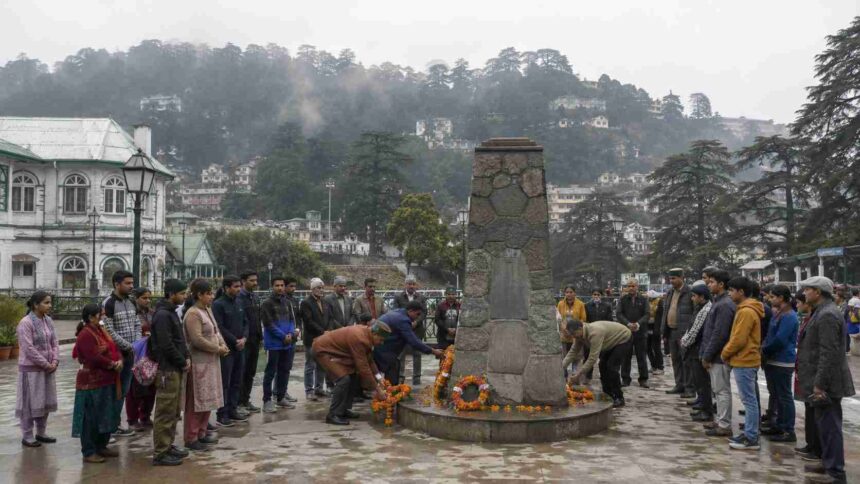
Every year on 2 September, andolankaris and ordinary citizens gather at the Shahid Smarak at Jhoolaghar to remember the six who fell. The annual observance keeps alive both the memory of the dead and the original aspirations of the movement, which were control over jal, jangal and zameen, an end to distress migration from the hills, and balanced development that would allow mountain communities to remain viable. Three decades after statehood those questions remain unresolved for many of the surviving participants. Out-migration continues, infrastructure gaps persist in remote valleys, and the practical meaning of resource rights is still contested.
More Read
The state of Uttarakhand exists because hill people absorbed the cost of the Mussoorie firing and refused to abandon the demand that had brought them to Jhoolaghar. The memorial on the Mall Road is a permanent reminder that the political map of the region was redrawn only after blood had been shed and the movement had been forged in that fire.