
India’s government school system continues to fail children on multiple fronts. Learning levels remain extremely low, infrastructure is crumbling, mid-day meals repeatedly turn hazardous, and those who document these failures continue to face risks.
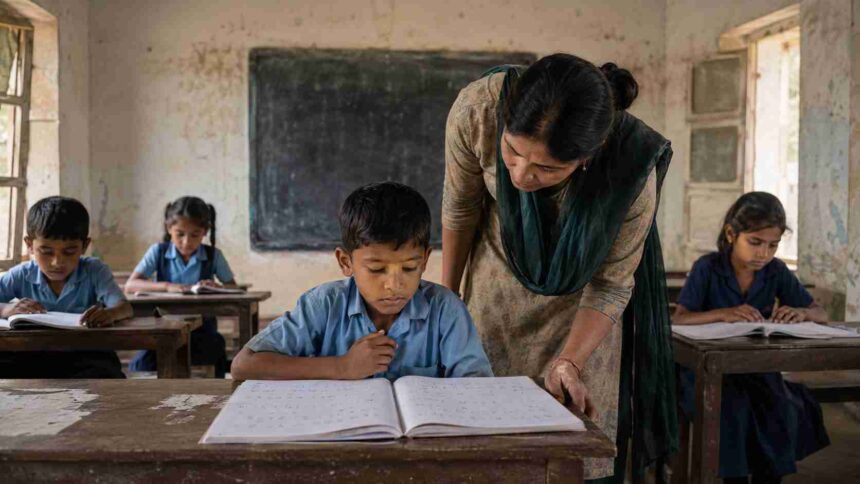
The ASER 2024 survey of rural India had already recorded that more than 70% of Class 3 students could not read a Class 2 level text. Nearly half of Class 5 students still could not manage the same basic task, and roughly 30% of Class 8 students continued to struggle with Class 2 level reading. In arithmetic around 70% of Class 3 children could not perform basic division or subtraction. Two years later, there is little evidence that these foundational gaps have been closed at scale. Large numbers of children still spend years inside classrooms without acquiring the skills the system claims to deliver.
Physical conditions inside many schools have shown no decisive improvement. Over one lakh schools across the country continue to be run by a single teacher. Nearly half of all schools still lack computers for students. The Navodaya Vidyalaya and Kendriya Vidyalaya systems reported more than 11,000 vacant teaching positions, and staffing shortages remain widespread. In tribal and remote regions schools continue to be closed or merged on the ground of low enrolment even as the child population grows. The result is longer distances to the nearest functioning school and higher drop-out risk for children who already have the fewest alternatives.
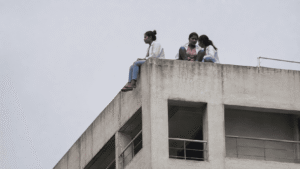
The mid-day meal scheme has produced a continuing string of contamination incidents. In July 2025 a school building collapsed in Jhalawar, Rajasthan, killing seven children and injuring 28. In April 2025 more than 100 students in Mokama, Bihar, fell ill after a dead snake was found in their meal. In February 2024, 184 children in West Champaran, Bihar, fell sick after kerosene was allegedly mixed into their food. In August 2026 detergent was found in a mid-day meal in Nalanda, Bihar, while 30 children in a Himachal Pradesh school fell ill after eating spoiled kheer. These are not isolated administrative lapses. They are recurring failures that place children in direct physical danger during the ordinary act of attending school.
Those who document such conditions continue to face institutional and physical consequences. In 2019 journalist Pawan Jaiswal reported that students in a Mirzapur school in Uttar Pradesh were being served only roti and salt. Instead of correcting the failure, authorities filed a case against him. He died in 2022. In August 2026 in Bankura, West Bengal, Sheikh Mohammad Mafik was killed after he was allegedly assaulted while trying to protect his son Abdul Hafiz. Hafiz had been documenting the poor state of a local government school as part of a public campaign demanding basic improvements. Eight people were later arrested. The sequence shows that the state’s response to exposure remains sharper than its response to the underlying neglect.

The learning deficits flagged in 2024, the persistent single-teacher schools, the repeated food contamination scandals and the risks faced by those who report them together describe a system that has not corrected course. It still cannot keep children safe, still cannot feed them without repeated contamination, still cannot teach a majority of them to read at grade level, and still cannot maintain enough teachers or open schools in the areas that need them most. Until the machinery of the state treats the condition of government schools as a genuine priority rather than a recurring public-relations problem, these failures will continue to define the education available to the majority of Indian children.