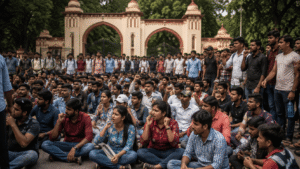
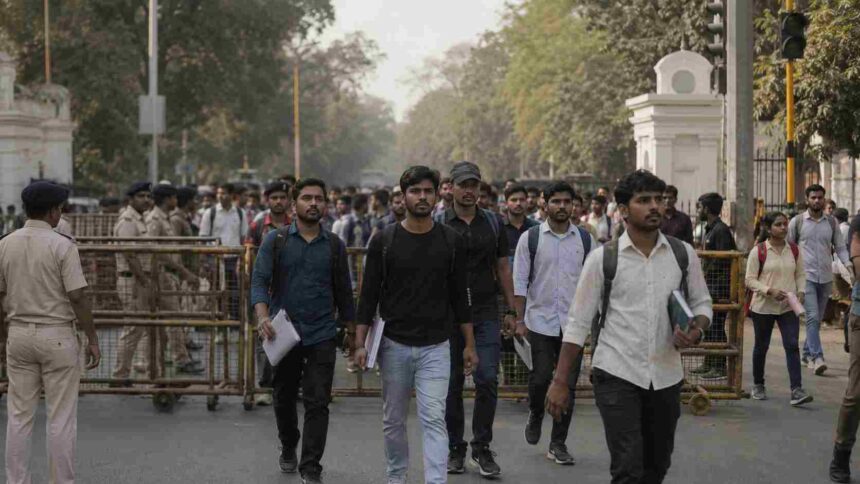

Students in Patna broke through police barricades today and marched from Gandhi Maidan towards Raj Bhavan demanding the complete cancellation of the 70th Bihar Public Service Commission examination. The protest which had been building for days at Gardanibagh spilled onto the streets as aspirants refused to accept another compromised recruitment process in a state where paper leaks and irregularities have become a recurring feature of public employment tests.
The demonstrators allege large scale malpractice in the 70th BPSC examination and are insisting that the entire process be scrapped and conducted afresh under stricter supervision. Alongside this central demand they have raised a wider set of issues including the removal of negative marking in the Teacher Recruitment Examination TRE 4 the holding of a single stage examination instead of a multi stage one and the initiation of long pending recruitments under the Bihar Staff Selection Commission. Several student and youth organisations including the Chhatra Yuva Sangharsh Morcha have backed the agitation.
Police attempted to block the route and warned that the march would not be allowed into the restricted zone around Raj Bhavan. The students pushed forward anyway. The determination on display reflected years of accumulated frustration. In Bihar as in much of India the path to a government job has been repeatedly undermined by leaks delayed results and opaque processes that leave genuine aspirants feeling that the system is stacked against them.
The BPSC examination is meant to select officers for the state civil services. When the integrity of such an examination is called into question the consequences extend far beyond a single paper. Thousands of young people invest years of preparation often at great financial and personal cost only to confront the possibility that the test they appeared for was compromised. The demand for cancellation is therefore not a casual call for convenience. It is a demand for a process that can be trusted.
India’s recruitment architecture has shown repeated vulnerability to exactly this kind of failure. From national level medical and engineering entrance tests to state public service commissions the pattern of leaks and subsequent damage control has become familiar. Each time the official response begins with denial moves to limited action against a few low level actors and ends with assurances that the system will be strengthened. The students on the streets of Patna have seen this cycle too many times to accept another round of the same promises.

The protest also highlights the absence of credible Institutional mechanisms that can respond quickly and transparently when allegations of malpractice surface. Instead of an independent inquiry that commands public confidence the default response remains administrative and political management of the crisis. The result is that students are forced to take to the streets simply to be heard.
By breaking barricades and marching towards Raj Bhavan, the aspirants have made clear that they no longer trust the usual channels of redress. Their action is a direct challenge to a recruitment system that has failed to protect the basic expectation of fairness. In a country that constantly speaks of demographic dividend and youth power the sight of those same young people forced to battle the state for a clean examination is a measure of how far the promise has drifted from reality. The students of Patna are not asking for special treatment. They are asking for an examination whose results they can believe.