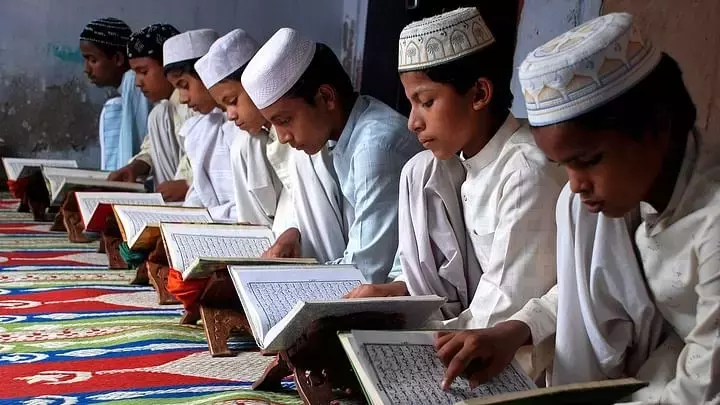

The Uttar Pradesh government is set to prohibit madrasas from awarding Kamil (graduate-level) and Fazil (postgraduate-level) degrees, restricting their academic offerings to the Class 12 level. A proposal to amend the Uttar Pradesh Madrasa Education Board Act, 2004, will be placed before the Yogi Adityanath Cabinet at its meeting tomorrow, on Tuesday.
Minority Welfare Minister Om Prakash Rajbhar confirmed that previously awarded Kamil and Fazil degrees will also be invalidated. Officials said the move is being taken to comply with a Supreme Court judgment. On 5 November 2024, the apex court, while upholding the constitutional validity of the 2004 Act, clarified that madrasas cannot confer formal higher education qualifications such as Kamil and Fazil because these fall outside the regulatory framework of the University Grants Commission (UGC).
Kamil has traditionally been treated as equivalent to a bachelor’s degree and Fazil as equivalent to a master’s degree in subjects such as Arabic, Persian, Islamic studies and theology. For decades, the Uttar Pradesh Madrasa Education Board conducted examinations and issued these certificates. The Supreme Court ruling created a legal vacuum, leaving thousands of students who were already enrolled in these courses in an uncertain position.
A senior official from the Minority Welfare Department said the Cabinet proposal is designed to bring the state law into line with the apex court’s directions. Once the amendment is approved, madrasas will no longer be permitted to run or award degrees beyond the senior secondary stage. The government has indicated that arrangements will be examined for students currently pursuing these courses so that their academic progress is not permanently disrupted, though concrete transitional measures have not yet been detailed.
The Cabinet meeting is scheduled for tomorrow morning at the Chief Minister’s official residence. Chief Secretary S.P. Goyal has listed 21 proposals on the agenda, with the madrasa amendment among the more significant items. Additional items may be added before the meeting begins.

Opposition parties have criticised the decision. Samajwadi Party leaders described it as part of a broader pattern of restricting educational institutions and limiting opportunities for minority students. Government representatives, however, have maintained that the step is purely a matter of legal compliance and not a policy choice of the state administration.
The issue has been pending since the Supreme Court’s 2024 judgment. In the intervening period, the Madrasa Board had already halted fresh admissions and examinations for the higher courses. Teachers’ associations and student groups had approached the courts seeking alternative arrangements, including the possibility of a recognised university conducting the examinations and awarding the degrees. Those petitions remain pending.
If the Cabinet clears the amendment, the formal process of changing the law will begin. The change will end a long-standing practice under which madrasas in Uttar Pradesh functioned as parallel providers of graduate and postgraduate qualifications in traditional Islamic disciplines. For students, parents and institutions, the practical consequences will depend on how swiftly transitional provisions are notified and whether alternative pathways through mainstream universities become available.
More Read
The government has said the decision Is driven by the need to respect the Supreme Court’s interpretation of the UGC Act and to ensure that higher education degrees are awarded only by institutions authorised under the national regulatory framework.