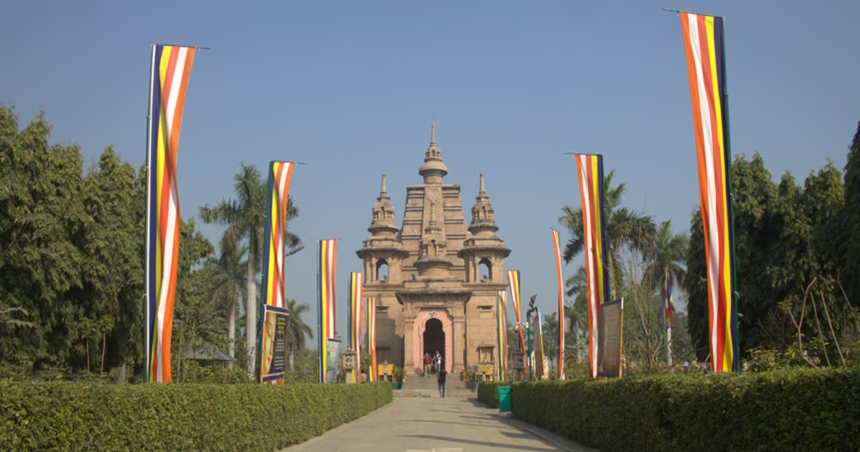

Sarnath has finally secured its place on the UNESCO World Heritage List after lingering on the tentative roster for 28 years since 1998. The ancient site near Varanasi where the Buddha delivered his first sermon now joins India’s roster as the 45th World Heritage property and the fourth in Uttar Pradesh after the Taj Mahal, Agra Fort and Fatehpur Sikri. Monuments such as the Dhamek Stupa, Chaukhandi Stupa, Ashokan Pillar and monastery remains have been recognised for their outstanding universal value as a cradle of Buddhist teaching that shaped Asia. Officials promise tourism gains, better conservation and local economic benefits.
Yet this long-delayed honour sits uneasily beside the lived reality of Buddhists in Uttar Pradesh. According to the 2011 Census the state recorded only 206,285 Buddhists, roughly 0.10 percent of its then 199.8 million population. Most belong to neo-Buddhist communities that emerged from Dalit conversions inspired by B.R. Ambedkar’s vision of escape from caste hierarchy. Their numbers remain tiny and their socio-economic indicators poor. Literacy rates lag, land ownership is limited and representation in government jobs or political institutions is negligible.
Conversion has rarely translated into security. Many Dalit Buddhists continue to face the same social exclusion they sought to leave behind. Reports from western Uttar Pradesh villages document ongoing caste violence, denial of basic amenities and pressure from dominant groups. In places such as Muzaffarnagar and Amroha families have described threats, blocked drainage and forced isolation after adopting Buddhism. Local administrations often treat these communities as residual Scheduled Castes rather than as a distinct religious minority entitled to specific cultural protection. The result is a community that remains economically marginalised, educationally disadvantaged and politically invisible.
The 28-year wait for Sarnath’s inscription itself reflects institutional priorities. While the Archaeological Survey of India and state tourism machinery mobilised for the UNESCO dossier, little parallel investment reached the small Buddhist settlements scattered across the state. Museums display the Lion Capital and excavated artefacts; living practitioners struggle for recognition of their festivals, educational institutions or even basic land rights. The contrast is stark. A global heritage label elevates stones and stupas while the people who still identify with the Buddha’s path remain peripheral to development schemes.
Greater tourism footfall may generate revenue, yet without deliberate inclusion the benefits risk bypassing local Buddhists. Guides, souvenir sellers and conservation jobs often flow to better-connected networks. Sustainable tourism demands that the community whose history the site embodies receives a tangible stake. Otherwise the inscription becomes another instance of heritage celebrated for international prestige while the minority that carries its living tradition continues to endure quiet discrimination and poverty.
More Read

Authorities now face a dual responsibility. Preserving the physical remains of Sarnath is essential. Equally essential is addressing the socio-economic exclusion of Uttar Pradesh’s Buddhist population so that the Wheel of Dharma turns not only for tourists but for those who still walk itspovert