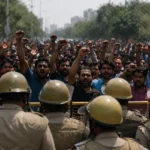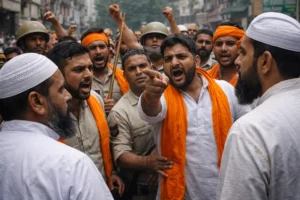
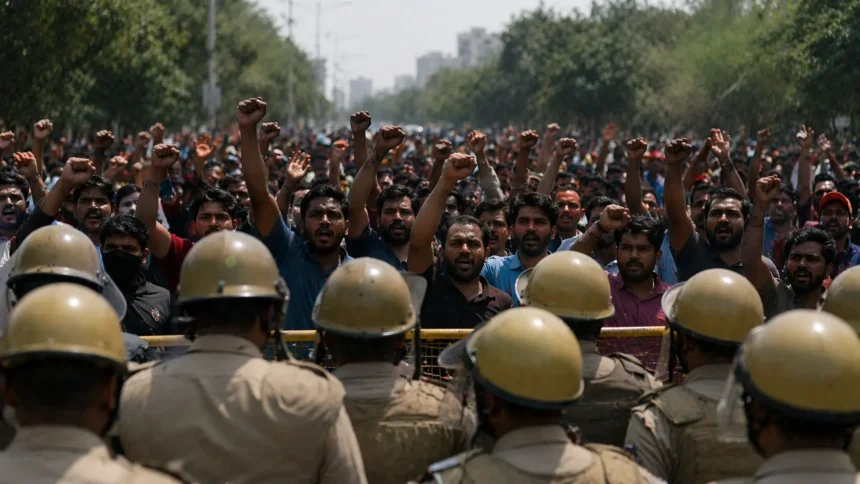


Recently, the Noida workers’ protest made a significant and huge impact on the corporate-political nexus in Uttar Pradesh. Following continuous strikes for several weeks, the Yogi Adityanath government has now been brought to the negotiation table.
Fearing the entire shutdown of the state’s industrial engine, the government made a formal statement to increase the pay of the protesting workers by 21%.
Nevertheless, this triumph is disguised in bureaucratic trickery. The government almost immediately came out with a “clarification” that was basically a strategic evasion of the workers’ non-negotiable demand for a minimum wage of Rs 20,000.
On the surface, the “Mainstream State” might want us to believe that the announcement of this welfare measure is a kind, generous gesture. However, the truth coming from the Noida Workers Protest is that the political class uses nationalism as a tool to shield the factory owners who are billionaires.
From ‘Terrorists’ to Negotiators: The State Surrenders
More Read

The hypocrisy of the Uttar Pradesh government during the last one week has been quite shocking. Only 48 hours before declaring this salary increase, the state attempted to criminalize the entire labor movement.
As previously reported, a senior UP Minister bizarrely claimed that the strike was a “Pakistan conspiracy” orchestrated by 4 suspected terrorists.
According to a breaking political report, the government abandoned this absurd terror narrative the moment the billionaire factory owners panicked over massive financial losses.
More Read

The Power of Unified Labor
If the working class stands together without any divisions, even the haughtiest regimes would have to submit eventually. The authorities came to their senses very soon that it was totally out of question for them to handcuff thousands upon thousands of starving under draconian laws.
- The Threat: The state initially planned to use the Unlawful Activities (Prevention) Act (UAPA) to jail union leaders.
- The Reality: The sheer scale of the massive crowd made police intimidation mathematically impossible.
- The Surrender: The fake “national security” narrative instantly collapsed, replacing police batons with a 21% pay hike offer.
The 21% Pay Hike vs. The Rs 20,000 Minimum Wage Demand
Although the headlines scream about a successful negotiation, we should unwrap the bureaucratic pitfall behind this announcement. The 21% pay raise is nothing but a typical trick of the state to play with math.
One crystal-clear demand of the labor striking in Noida Workers Protest was for a flat, assured minimum salary of Rs 20,000 per month each for the survival in the face of very aggressive inflation in the Hindi Heartland.
Instead of offering a fixed minimum wage, the government is more likely to protect the profit margin of its corporate sponsors by giving a percentage rise.
More Read
Why the Percentage Formula Fails the Poor
Let’s decide to look at the hard economic data. In Noida, hundreds of thousands of laborers are presently working tiresome 12-hour shifts for very low wages.
- If a factory worker’s base salary is a mere Rs 8,000, a 21% hike only adds Rs 1,680.
- Their new monthly take-home pay becomes Rs 9,680, which is not even half of the requested Rs 20,000 minimum wage.
- The worker remains trapped in extreme poverty, while the factory owner saves millions in labor costs.
For this reason, the government felt compelled to send out a last-ditch “clarification” on the demand for Rs 20,000. They are after good PR of granting a wage hike while at the same time not really helping the working class get out of poverty.
The Hypocrisy of the ‘Mainstream State’
This whole story is a perfect example of how the “Double Engine” government works in reality. The government and its machinery are not there to help the have-nots; they are there to safeguard the riches of big businesses.
When workers demanded a raise that would enable them to feed their children, they were immediately termed as “anti-nationals” and “Pakistani agents.” The political leaders, who were comfortably residing in their air-conditioned offices, considered it their right to degrade these workers.
Yet as soon as the corporate supply chains ground to a halt, the administration’s fake nationalism disappeared. They threw a 21% breadcrumb at the workers, expecting the starving masses to return silently to the factory lines.
Protecting Billionaire Profit Margins
The establishment regularly brags about India rising as an economic powerhouse. However, the riches produced from these large industrial centers hardly make their way down to the factory workers.
Rather than compelling the rich industrialists to disburse a proper minimum salary of Rs 20 000 the government uses police fences and the media to dishearten the workers.
The “Mainstream State” is scared stiff at the idea of opening a Pandora’s box. If the Noida laborers are given a flat Rs 20,000 wage, after them factory workers of UP, Bihar, and MP will also rise up and demand the very same rights.
What This Victory Means for India’s Working Class
Despite the government’s misleading percentage calculations, the Noida workers protest’s psychological victory cannot be ignored. The laborers have demonstrated effectively that the government is not invincible. They have exposed the government’s fraudulent use of “terrorism” as a pretext to mask the economic failure of the country. Yet giving in to the 21% wage increase and calling off the strike now would be a mortal error. The official “explanation” is nothing but a ploy to wipe out the union’s historic momentum.
The Path Forward for the Labor Movement
The working class should understand that they have the ultimate leverage. If their solidarity is able to make a government which is not only unwilling but even hostile, to officially take back its accusations of terror within 48 hours, they can force them to pay a living wage.
- Reject the Breadcrumbs: The 21% hike is a distraction from the core demand.
- Maintain the Unity: The state will attempt to divide the union leaders using bribes and threats.
- Demand Absolute Dignity: Human dignity in 2026 costs a minimum of Rs 20,000; anything less is state-sponsored exploitation.
To sum up, the government has revealed its cards. In fact, they are much more scared of a united working class than they are of any political opposition. Workers have to keep fighting and rejecting the bureaucratic illusions in order to get the real economic justice they have courageously fought for.