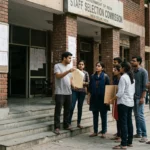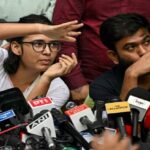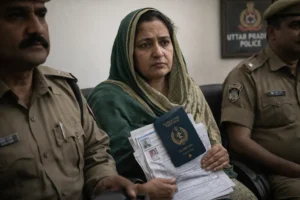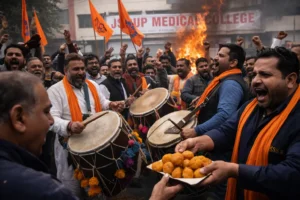
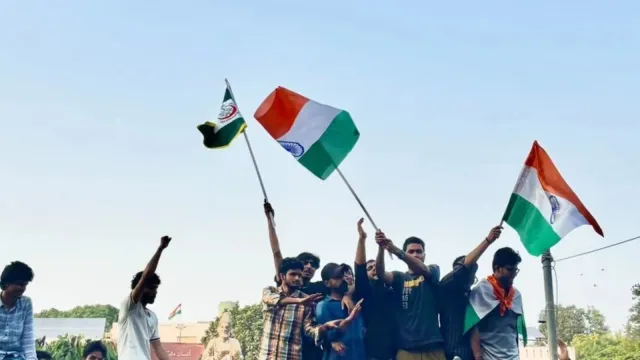

Ebin Basil is 23, a third-year law student, and he has not eaten since October 12. He has lost 7 kg, can barely walk unaided, and his blood tests show low sodium and glucose levels. His demand is not radical. He wants Jamia Millia Islamia to hold a students’ union election, something Delhi University and JNU do every year. The last Jamia union was dissolved in 2006.
The university’s answer to a hunger strike has been force and paperwork. On October 16, it suspended Basil for a year and banned two other hunger strikers from campus. On October 24, the gates were barricaded, classes were moved online and students in hostels were pressured to leave. Armed police and paramilitary forces were stationed outside, and a ban on gatherings of more than four people was imposed on campus. The university is now closed until January 13. Students trying to enter on October 25 were detained by Delhi Police and CRPF personnel, and Section 163 of the BNSS remains enforced around the campus. A university does not need paramilitary forces to hold a vote. It needs them to prevent one.
The administration’s concession is built to run out the clock. It has announced elections within 15 days of a union constitution being approved, with a drafting committee due by December 20, but no deadline for approval. The drafting period runs into the winter break and then Ramzan, when many students will be fasting. A promise without a date is a refusal with better manners. A notice issued at 4:15 am, alongside a letter bearing student signatures timestamped 3:08 am, was rejected by the protesters, who said they had been pressured to sign in the middle of the night. A “final notice” at night then threatened disciplinary and legal action.
The administration has also tried to use the teachers. At 10:38 pm on October 23, the vice-chancellor emailed all permanent staff, making attendance at a meeting the next morning mandatory, with no agenda shared. More than 1,500 teaching and non-teaching staff, along with Vice-Chancellor Mazhar Asif and the registrar, gathered and later marched to the protest site. The faculty’s own statement condemned what it called “deceptive and manipulative conduct” by the administration, saying teachers were used as a show of force against their students. When a vice-chancellor has to be rebuked by his own faculty for turning them on students, the problem is not misunderstanding.
The more important question is why. Jamia is a central university, and its vice-chancellor is chosen through a process the Union government controls. What the sitting administration has done with that power is on the record. Students say an RSS centenary event was held discreetly in Ansari Auditorium last month, with the vice-chancellor and registrar present and the event unadvertised, and that speakers from Sangh-affiliated organisations have been invited in place of academics. The vice-chancellor has also said all Indians share a common DNA of Mahadev. Students say restrictions on activism have tightened since he took charge in October 2024. Taken together, these are not the choices of a neutral administrator. They are the choices of someone who understands whom he answers to.
More Read
The pattern matters most for the people it targets. Students say a union would give them a voice on hostels, fees and restrictions imposed on joining the youth-led anti-government protests across the country. That is the real fear. A campus union is an organised room full of young people who can host speakers, pass resolutions and issue statements. For a government whose moves against protest leaders this month have been relentless, an organised Muslim student body at the capital’s best-known minority university is a risk it would rather not take. Delhi University’s Apoorvanand, speaking about Jamia and AMU, says the government and administrations are unwilling to encourage “emergence of Muslim leaders.” The data fits, AMU agreed to hold union elections on November 5, without any concrete steps towards it, but that too only after a 19-day hunger strike. Muslim universities have had to starve to be allowed what other universities take for granted.
The vague graffiti storyline follows the same script. Police increased security after “Free Kashmir” and “Free Sharjeel Imam” slogans were found on the walls, and students were frisked before entering departments. The students say they do not know who wrote them. A protest over a union election has been turned, in the public’s mind, into a security matter. It is an old tactic, and the memory of the 2019 police crackdown on this campus makes it more effective, and more cynical.
Jamia was founded in 1920 as an institution of self-reliance and independent thought. The state now treats thought as an act that needs a permit, and a hunger strike as a breach of order. If the vote is held, it will be because students refused to leave. If it is not, the barricades will have done their job.