

Justice Pankaj Bhatia rocked the country’s judiciary on February 24, 2026. Requesting to be taken off the bail roster, Justice Pankaj Bhatia, one of the fastest dispensing judges of Allahabad HC did just that. But why? Did judges get tired laying down bails? Of course not! Because what happened further sheds light on a matter of utmost seriousness.
Justice Pankaj Bhaita stepping down from the bail roster is setting precedence for how Judicial Independence is being crushed to an all-time low in UP under the current regime. If a judge of a constitutional court steps down after being incessantly attacked & criticised publicly by none other than the Supreme Court for one bail order, that’s no longer a technical issue. That’s a calculated attack on the very concept of human liberty.
The Crisis of Judicial Independence
To comprehend how a judge favouring citizen rights is being targeted, let us revisit his past verdicts. Justice Bhatia happens to be the very judge who spoke up against the state’s callous bureaucratic apparatus.
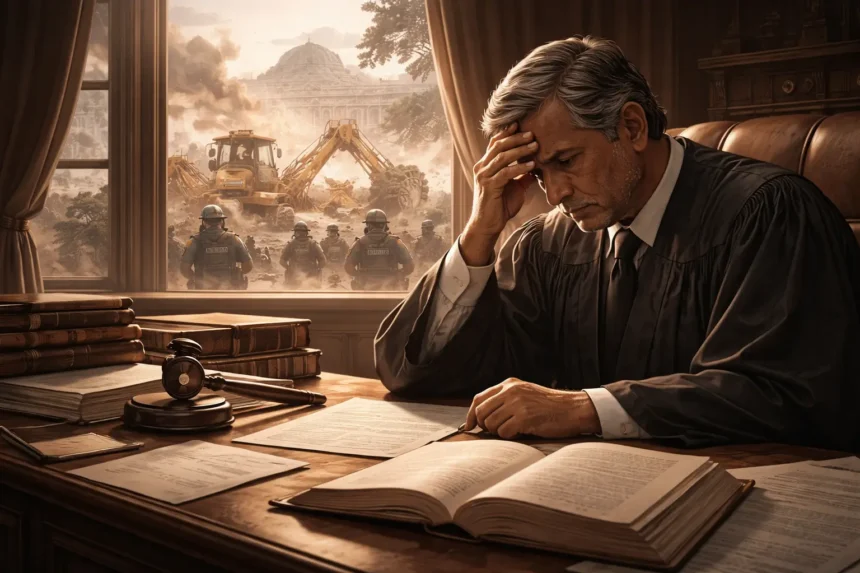
In January this year, he issued an important order staying the UP govt.’s violent bulldozing drive in Akbar Nagar. He stood by thousands of poor citizens whose houses were demolished by state tyranny.
His judicial philosophy is simple:
- Robust defense of the basic rights of the downtrodden and the destitute.
- Challenging the state’s mass-incarceration policies by granting bails.
- Strict emphasis on the due process before the state can confiscate private property.
One report indicates that the Supreme Court’s very public and harsh rebuke of his recent bail order has had a “chilling effect” on the morale of the judiciary.
How the “Bulldozer Raj” Was Weaponized
If one wants to understand the severity of institutional crisis, we need to look no further than the political atmosphere in Uttar Pradesh. The government is pushing “Bulldozer Justice” as a sign of good governance.
More Read

In the past 4 years alone, 100+ houses belonging to opposition, critics, and minorities have been illegally razed to the ground. This instant justice model completely bypasses the due process with the state acting as both jury and executioner.
Justice Bhatia dared to uphold the rule of law. When an upright judge like Justice Bhatia asks everyone to play by the book and stop extrajudicial killings, he directly challenges the political strongman image. He makes enemies with the “Shadow State”.
What is the message behind this public humiliation?
Justice Bhatia has been publicly admonished by the higher court. It is a reckless and a very clear signal that the top judiciary is sending down to the subordinate judiciary. I call it the “Mainstream State” blackmailing its judges and magistrates: You do not obstruct the political wishes of the government.
More Read

If you want to do so, if you as a judge advocate for the downtrodden, if you want to release political prisoners on bail or question police atrocities, we will pick you apart, your work and your reputation will be attacked relentlessly until you’re broken. Bow down; or we will crush your morale.
This intimidation creates a toxic judicial environment:
- Judges will default to rejecting bail applications to avoid controversy.
- Lower courts will rubber-stamp police requests out of sheer fear.
- The fundamental principle of “Bail is the Rule, Jail is an Exception” will be permanently erased from practice.
A Blow to Institutional Integrity
This incident is not just about the career of one judge from the Allahabad High Court. It shows how the independent justice system in the Hindi Heartland has completely broken down.
The machinery of the state has successfully created an environment where upholding fundamental constitutional rights now brings serious personal and professional risks.
This is proof of the system’s bias towards “Bulldozer Governance,” which is literally crushing the judiciary into submission. The separation of powers, a basic tenet of the Indian Constitution, is being systematically destroyed.
Why the Common Citizen Should Be Worried
A compromised and frightened judiciary is the death knell of a functional democracy. The cost of this capture will be paid for dearly by the poorest and most marginalized citizens of the Hindi Heartland.
At present, the prison population data in the state is a terrifying reflection of a dysfunctional legal system. More than 77% of the prisoners in Uttar Pradesh jails are undertrials.
More Read

These are not convicted offenders. They are poor, marginalized citizens, largely from the Dalit, Adivasi, and minority communities, who are desperately awaiting a fair bail hearing.
If judges are intimidated, the consequences for the public are fatal:
- Police brutality will reach an absolute, unaccountable peak, resulting in more custodial deaths.
- Innocent citizens will languish in overflowing jails with no hope of bail.
- Minority homes and businesses will be reduced to rubble without any legal recourse or stay orders.
Institutional Capture?
A judiciary which intimidates its own judges when they perform their constitutional duty is broken beyond repair. Justice Pankaj Bhatia’s sidelining today is a win for state-authoritarians. It shows that the “Double Engine” government doesn’t want fair, independent umpires. What it wants is loyal, sycophantic lackeys dressed in black robes. When those in white are scared to take a stand against the power of the state, where will the common man turn? The Constitution will no longer be his armor, but just another piece of old paper.