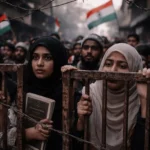
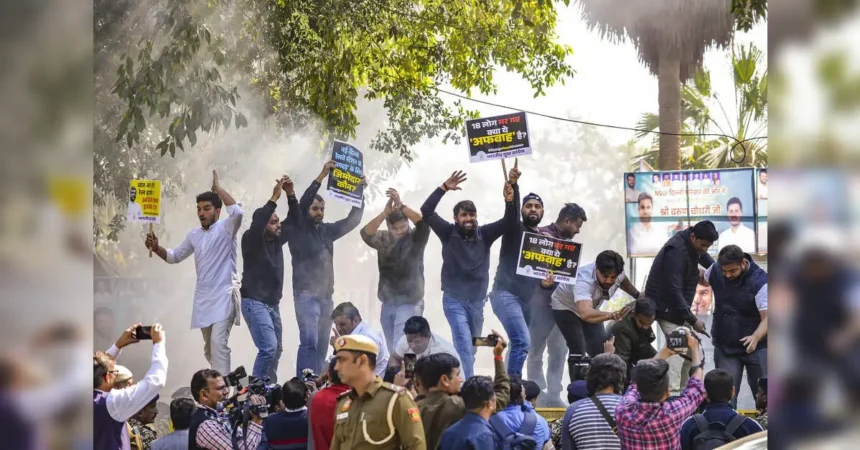


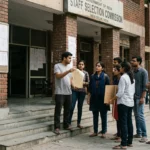
The General Caste Protest of 2026 will be remembered as the day when the “Mainstream State” not only showed but even revealed its fear of granting equal rights. On March 8, 2026, a huge number of General Caste (GC) students and activists were ready to have a quiet protest at Ramlila Maidan in Delhi. Rather than an open talk in a democratic way, these youngsters were generously offered heavy police barricades, random detentions, and illegal house arrests. The state apparatus reacted so quickly, almost as if it were a nightmare, to totally eradicate a movement that only asked for equality under the constitution and the safeguard of merit. Such a harsh measure taken against the General Caste Protest 2026 is not only an administrative lapse; it is an outright killing of democratic rights.
What Triggered the General Caste Protests?
For a long time, the General Caste youth have been the unheard sufferers of the divisive vote, bank politics. The anger has been simmering because political parties keep disregarding the Supreme Court’s 50% reservation limit. The youth behind the General Caste Protest 2026 did not request freebies or political appeasement from the Government. Their main points were quite simple and totally within the Constitution:
- Equal protection under the law for all categories.
- An end to vote-bank appeasement in educational institutions.
- Strict minimum cut-offs to stop the mockery of merit.
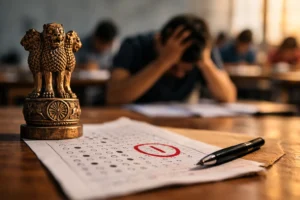
Not long ago, a bench of the Rajasthan High Court was quite taken aback to find that the reserved category cut-offs for government jobs had fallen to as low as 0.0033 marks. In a situation where negative marking is rewarded, and hardworking students scoring 85% are being penalized, one cannot help but expect such a vehement reaction from the public.
A Mockery of Democracy and the Constitution
The harsh police crackdown at Ramlila Maidan brings up serious constitutional concerns. The Constitution of India is equally for the General Castes as well as for the SCs, STs, and OBCs. By detaining non-violent students, the government totally ignored and went against the fundamental democratic principles.
Articles 14 and 15: The Death of Equality
Article 14 ensures the Right to Equality, and Article 15 completely bans discrimination. The problem is that the state’s actions contradict its words. While the government is giving in to a few communities, it is controlling by force those GC who raise their voices and, in this way, practicing discrimination endorsed by the State. If the governmentmuzzles GC students through house arrests, then from where could equality come?
More Read
Silencing Free Speech: Articles 19 and 21
The most horrific piece of the crackdown was the blatant disregard for Article 19(1)(a) (Freedom of Speech) and Article 19(1)(b) (Right to Peaceful Assembly). The ability to protest peacefully is one of the main foundations of Indian democracy. Taking away this constitutional right of GC students is equivalent to killing the very essence of democracy. Besides that, the detention of young activists in their homes is also a violation of Article 21, the Right to Life and Personal Liberty.
Vote Bank Politics vs Meritocracy
Why is the “Mainstream State” so scared of General Caste youths? The upcoming electoral equation will reveal the answer. Politicians, in the mad race for marginalized vote banks, have converted universities and government recruitments into political experiments. Think of the recent disagreements that sparked the protests:
- State governments are unilaterally pushing local reservations to a totally unconstitutional 75% cap.
- The contentious 2026 UGC Equity Regulations are tantamount to campus surveillance.
- Reserved category students are getting zeros or even lower marks than the cutoff.
To maintain their caste equations, the political class doesn’t mind losing India’s best doctors and administrators. When a rich and privileged student from a reserved category gets admission to a top medical college with 400 marks, while a hard, working middle, class GC student is left sobbing at 650 marks, the system is not just failing to deliver social justice. Instead, it’s perpetrating institutional theft.
More Read
The Mainstream State’s Fear of the GC Youth
Extensive detentions carried out in an aggressive manner on March 8 clearly indicate that the ruling elite’s narrative of “Hindu Ekta” (Hindu unity) is far from being cohesive, RSP says. It is very disheartening to find that the political class wants the General Caste to vote silently in the name of religion but abandon them totally in education, jobs, and representation. At last, the youth have become aware that the political elite are using them as mere collateral damage. The General Caste Protest 2026 was designed to highlight this particular double standard. By arrests of the organizers, the state has, in a way, strengthened the message that was to be spread throughout the Hindi belt. House arrests cannot kill an ideology, especially when that ideology is based on hard work, merit, and constitutional fairness.
The Road Ahead for Equal Rights
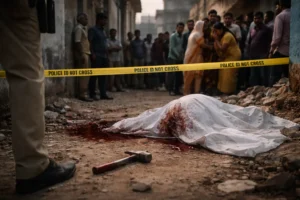
The violent incidents at Ramlila Maidan are a grim testimony to the modus operandi of the “Mainstream State”. The state in a knee-jerk moment, stands up and grants “backward” status to dominant castes or radical groups when they block highways and burn trains. But conversely, when General Caste students, educated and tax-paying, try peacefully to assemble, they are faced with the police and security forces. The General Caste Protest 2026 to struggle is not the final chapter; it is simply the first one. If the authorities think that they can continue in power by relegating the General category to second-class citizens in their own country, they are seriously misreading the situation. The voices calling for a meritocratic system cannot be drowned out by police sirens. Democracy at its core is about standing up against such fears and arbitrariness, which is exactly what the young generation is gearing up for: the assertion of their constitutional rights.