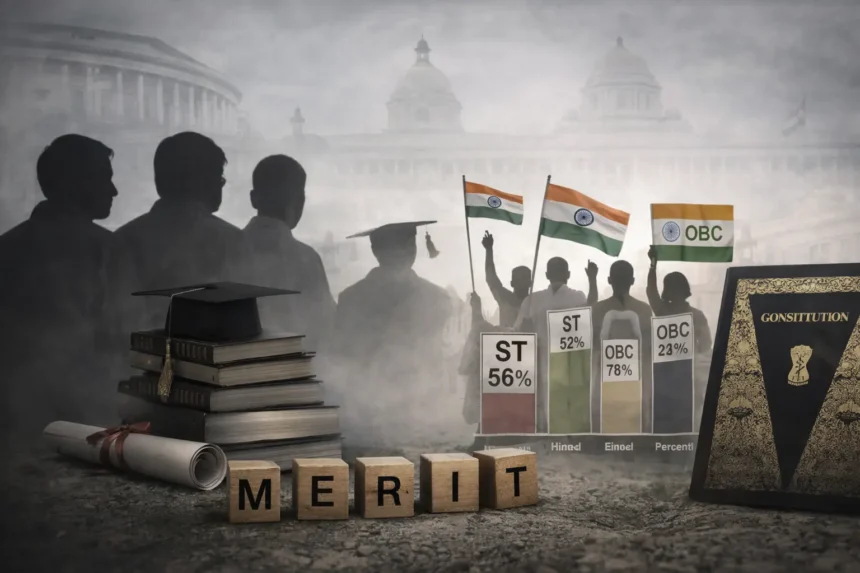

UGC policies in India have been heavily criticized for placing caste-based favours over meritocracy. Controversy has surrounded the UGC mandating reservation quotas in university-level education. Bias is embedded through policy when you look at the data released by the government itself. According to government statistics, categories such as SC, ST, and OBC are given precedence over merit as well as the majority Indian population. Keep in mind the caste Hindus make up approximately 80%+ of India’s 1.4 billion citizens.
This policy structuring is derived from provisions in India’s constitution. These provisions have been stretched far beyond their purpose by the BJP government to a point where they are hindering growth. The Indian Government pushes policies that go against quality education to pander to their vote banks. We’ll take a look at some of the stats that highlight how UGC policies unfairly benefit the SC/ST/OBC communities at the general candidates’ expense.
Background of UGC Reservation Framework
Across all central universities and institutions, the UGC enforces reservations in faculty recruitment and admissions. Mandatory quotas are as follows:
- SC: 15%
- ST: 7.5%
- OBC: 27%
- EWS: 10% (Economically Weaker Sections, primarily general category)
According to the Central Educational Institutions (Reservation in Teachers’ Cadre) Act of 2019, this is applicable to student admissions and teaching positions. Recent 2026 UGC regulations guarantee implementation.
Equity laws that specifically target anti-discrimination measures for students who are SC, ST, or OBC. 4.33 crore students were enrolled overall, according to the All India Survey on Higher Education (AISHE) 2021–2022. However, the framework has come under fire for selectively lowering entry barriers.

Key Statistics:
- SC population (2011 Census): 16.6%
- ST population: 8.6%
- OBC estimated share: 41-52% (various surveys)
- General category (including upper-caste Hindus): ~25-30%
Despite close to proportional enrolment (SC 15.3%, ST 6.3%, OBC 37.8%, others 40.6%), the real issue lies in the elite institutions where quotas always override merit.
How UGC Policies Oppose Merit and Academic Quality
UGC Policies in India enforce significantly lower qualifying standards for reserved categories, directly impacting quality. In JEE Advanced 2024, the qualifying aggregate marks were:
- Common Rank List (General/CRL): 35%
- OBC-NCL/EWS: 31.5%
- SC/ST: 17.5%
As a result, SC/ST candidates can qualify with approximately half the marks needed by general category students. NEET, UPSC, and other exams have similar disparities. Students who receive reservations secure seats 40–60 percentile rank below that of general category students on average, using data from top universities as evidence. A study of IIT admissions in 2024 found SC/ST cutoffs ranged from the 50–60 percentile, whereas cutoffs for the general category were often in the 90+ percentile. Critics have also highlighted higher drop-out rates for reserved category students at top universities. Thousands of SC/ST/OBC students dropped out of central universities and IITs in 2025, Parliament data shows, partly due to poor preparation resulting from lowered standards.
More Read

- Dropouts in Central Universities (recent period): Over 4,500 OBC, 2,400 SC, and 2,600 ST students.
- IITs/IIMs: Nearly 2,000 OBC, 1,000 SC, and 400+ ST dropouts reported.
These figures suggest UGC Policies in India compromise institutional standards. Studies, including those referencing diminished returns on education for SC students in wealth accumulation, indicate long-term inefficiencies. Quality suffers as faculty and peer benchmarks dilute.
Disproportionate Favoritism Towards SC/ST/OBC Categories
Despite of comprising roughly 50%-60% of the popular combined, these groups receive 49.5% reserved seats in admissions and faculty. GC Hindus which are the majority, only compete in the remaining 40% open seats plus 10% EWS .
AISHE 2021-22 data confirms:
- SC enrolment: 66.23 lakh (15.3% of total, up 44% since 2014-15)
- ST: 27.1 lakh (6.3%, up 65%)
- OBC: 1.63 crore (37.8%, up 45%)
Although the access has improved, the over-representation in programs persists. Over 60% of SC and 75% of ST students enroll in arts, and humanities subjects, in comparison to engineering and medicine for general category.
In faculty positions, UGC data (2023-2025) reveals persistent under-filling of reserved posts:
- 30-38% of reserved teaching positions vacant across central universities as of 2024.
- SC faculty vacancies: Over 2,389 in 45 central universities (2021 data, trends continue).
- ST: 1,199 vacant.
- OBC: 4,251 vacant.
Yet senior positions remain dominated by the general category (82% professors in central universities are upper castes). This selective enforcement favours reserved entry without ensuring proportional outcomes, burdening the majority which is only merit-based.
More Read
Bold Reality: Muslims and other minorities face no such structured quotas, yet the focus remains on Hindu sub-castes, pitting communities against each other.
Impact on Majority Hindus and Quality Erosion
Majority Hindus, especially the upper-caste groups (~25% of the population) bear the consequences. There are limited seats but they all compete for them, while finding the system through taxes.
Research reports like Pew Research and CSDS surveys indicate upper-caste Hindus from the core support base for nationalist policies, yet they face systematic suppression. For example, in Delhi University and JNU, unreserved posts are overfilled while reserved remain vacant.
Academic quality metrics suffer:
- Lower average performance in reserved cohorts.
- Increased complaints of reverse discrimination post-UGC 2026 equity rules, which protect only SC/ST/OBC from “caste-based” bias.
A 118.4% rise in the reported caste discrimination complaints (173 in 2019-20 to 378 in 2023-24) per UGC data which was presented to the Parliament, yet guidelines exclude general category protections.
This erodes excellence in IITs, AIIMS, and other central and national universities. India’s global rankings in higher education lag, partly due to diluted merit pools.
BJP’s Political Shift: Appeasement Over Core Hindu Base
The BJP has positioned itself since the beginning as the party representative of caste Hindus and cultural nationalism. Its leaders emphasised merit and Hindutva unity. Under Modi however, especially in his third term, the party has expanded reservations and equity measures for vote gains.
Data on BJP’s Caste Politics:
- 2024 Lok Sabha: BJP won only 29 of 84 SC-reserved seats (down from 46 in 2019). Congress improved to 20.8% vote share in SC seats.
- Upper-caste support remains high (~79% NDA in key surveys), but OBC/SC outreach intensified with more non-dominant OBC tickets and EWS quota (2019).
- Post-2024 losses in UP (vote share down to 41%), BJP pushed caste census talks to regain OBC/Dalit support.
They set aside aggressive reservation quota enforcement and 2026 Equity Rules. By promising Hindutva, the Modi government is playing nice to the groups its governance always talked against. However, this is purely political expediency, as these communities are the primary swing voter in the Hindi belt. This move antagonises the Modi government’s traditional support base of upper castes. The opposition has attempted to paint this as a deliberate manipulation of the judicial system. Claiming the government grants parole to some convicts, while dragging its feet on cases against protestors. We can see these appeasement costs at the national level too:
- OBC Representation: Record 31% Hindi-belt MPs from OBCs in 2024.
- Upper Caste MPs in NDA: Still ~33%, but diluted influence.
This strategy raises questions over the “party of Hindus” narrative, because it prioritises electoral support over merit and majority interests.
Societal and Long-Term Impacts of UGC Policies
Displacement of merit has broader effects:
- Brain drain: Talented general category students migrate abroad.
- Polarization: Rising protests against UGC 2026 rules by general category students.
- Economic Loss: Sub-optimal human capital in critical sectors like STEM.
V-Dem and others indicate more democratic backsliding, alongside social engineering. Carnegie Endowment analyses highlight the contradictions of ethnic nationalism.
Consequences:
- GER Disparities: SC GER 25.9%, ST 21.2% vs national 28.4% (AISHE 2021-22) — improvements but quality questionable.
- Faculty Skew: 91% Vice-Chancellors upper caste (RTI data); reserved posts unfilled at 38%.
- Vote Gains: BJP’s OBC/SC ticket surge post-2014, yet 2024 reverses show limits.
- Reconstruction of education prioritizes inclusion over excellence, eroding India’s competitive edge.
Reforming UGC Policies for True National Interest
UGC guidelines after 12 years of Modi government are a classic example of injustice happening in India. Against merit, dumbing down standards, unfair advantage to SC/ST/OBC through reservation/quota/guarantees, end up in the disadvantage to rest majority Hindus. This article from The Hindu breaks down the representation of OBC faculty positions in HEIs. Detailed numbers telling the truth. BJP wanted us to believe they are coming Hindu party. They are just after vote bank politics through appeasement. AISHE stats, JEE cutoffs, faculty vacancies, and Election surveys proves this appeasement.
Real reform through empowerment of merit can be the only way to progress. The focus should be on economic upliftment schemes specifically targeted to help those in need. Democracy and India’s reputation as a nation is at stake here, because quotas don’t contribute in the development, merit does.