

From algorithmic glitches to the tragic suicide of a Booth Level Officer, the deletion of 18.7% of the state’s electorate has triggered a crisis of democracy. Are we witnessing an administrative cleanup, or is the 2027 election being rigged in the database?
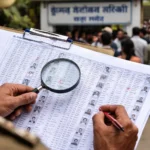
Lucknow: Democracy is in the Hindi heartland is a complicated affair. Its health is measured not just by the fervor of its rallies but also by the sanctity of the Matdata Suchi (Voter List) which serves as the foundational document of our land. Its significance is quite straight-forward: if your name exists on it, you are a citizen in the eyes of the states. If it is not, you are a ghost.
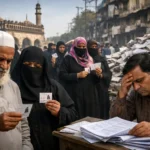
Following the months-long Special Intensive Revision (SIR), the Election Commission of India (ECI) published the Draft Electoral Rolls for Uttar Pradesh. The released figures were nothing short of a socio-political earthquake. A staggering 2.89 Crore names, equal to entire population of Australia, and nearly 18.7% of UP’s total electorate, have been flagged as “uncollectable” and deleted.
Termed as the “Great Cleanup” by the administration and dubbed as a necessary surgery to rid the system of duplicates and ghosts, the details reveal stark disparities. Algorithmic profiling, specific demographic targeting, and immense bureaucratic pressure are the hallmark of this exercise which poses a chilling question: Is this a correction, or a calculated demographic re-engineering ahead of the 2027 Assembly Elections?
The Anatomy of the Purge
To understand the crisis, one must first look at the official justification. The Chief Electoral Officer (CEO) of UP claims these 2.89 crore voters fall into three main categories:
More Read

- Permanently Shifted: Approximately 1.3 Crore voters who migrated.
- Deceased: Around 45 Lakh voters.
- Absent, Untraceable, or Duplicates: Over 1 Crore voters.
Geographically, the axe has fallen heaviest on urban centers. In Lucknow, the state capital, a shocking 30% of registered voters (roughly 12 lakh people) were flagged as unverified. Ghaziabad and Kanpur saw similar trends (upwards of 25-30% deletions).
While urban apathy and rental movement explain some of this, they do not explain the scale. Tens of thousands of working-class migrants in these cities—daily wagers, rickshaw pullers, factory workers—live transient lives. By rigidly defining “residency” through algorithmic filters, the system is essentially penalizing mobility, disenfranchising the very workforce that builds these cities.
Targeted Demographic Engineering?
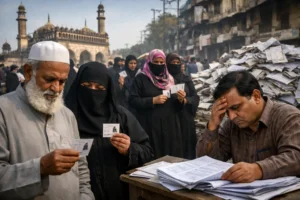
This seemingly administrative controversy took a sharp communal turn quickly with the release of granular data. A detailed analysis of the Draft Rolls by the Indian Express highlights an alarming trend: Constituencies with a high density of Muslim populations have witnessed a significantly sharper decline in voter numbers compared to the state average.
More Read
For instance, specific urban centers in Rohilkhand and Western UP which house significant minority populations observed drops as low as 25% to 30% while the statewide average stood at 18.7%.
This empirical chargesheet provided political ammunition to the to Samajwadi Party (SP) Chief Akhilesh Yadav who has come forward with explosive allegations. Accusing the ruling BJP of orchestrating “Venezuela-style” poll fraud, his charge is two-pronged. First being the systemic deletion of voters from the core base of the SP (PDA – Pichhda, Dalit, Alpsankhyak), and second the alleged pressure on district Magistrates to compensate for the lost numbers by inserting “Fake Votes” in BJP-heavy booths.
Yadav has threatened to file FIRs against the administrative officers, marking a complete breakdown of trust. In UP, the District Magistrate (DM) and the Superintendent of Police (SP) are largely seen as independent and neutral empires of democracy. When the Opposition accuses the umpires of fixing the match, the integrity and legitimacy of the upcoming 2027 election is already compromised and tarnished.
Interestingly, Chief Minister Yogi Adityanath had earlier claimed that “85-90% of the missing voters are ours (BJP supporters).” This creates a political paradox where both the ruling party and the opposition lack faith in the list. However, critics argue the CM’s statement was a preemptive smokescreen to justify the eventual addition of favorable votes in the final list.
The Ghost in the Machine: Deleted by Algorithm
If 3 crore people were deleted, how was it done so fast? The answer lies in the “Black Box” of electoral technology.
A recent investigative report by The Reporters’ Collective exposed the invisible hand behind this purge. The ECI utilized a software algorithm to identify “clusters” of suspicious voters. The software scanned the national database for “Demographically Similar Entries” (DSE)—matching names, relations, and ages across constituencies. Nationwide, this code flagged a massive 3.66 Crore voters as “Suspects.”
More Read
This is the danger of Technocratic Disenfranchisement. Algorithms do not understand the cultural nuances of the Heartland. In rural UP, families are large, names are common (e.g., Ramesh Kumar s/o Ram Lal could yield thousands of hits), and official birth dates are often standardized to January 1st. A machine learning model will easily misidentify genuine citizens as duplicates.
Instead of treating the algorithm’s output as a “suspicion,” the administration treated it as a target.
Blood on the Ballot: The Human Cost
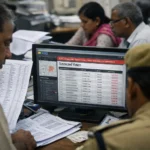
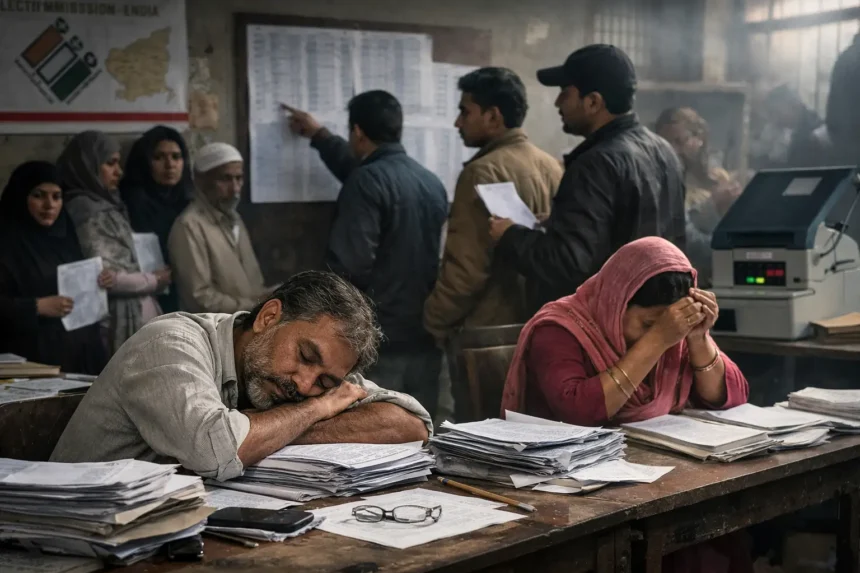
While the ECI’s software generated the controversial lists, humans had to execute them. The task was assigned to Booth Level Officers (BLOs) who are often overworked Anganwadi workers and government school teachers, The deadlines for “verifying and clearing” the flags were nothing short of rigid and difficult to meet.
This collision between soulless technology and human was a tragedy in waiting. It materialized in December 2025. A BLO in Sitapur allegedly committed suicide, with his family citing “intense mental pressure” due to the impossible workload of the Special Intensive Revision (SIR). This is one the several such haunting stories of the human cost emerging from the Doab.
This tragedy lays bare the fundamental flaw in the process. What do the BLOs do when they are threatened with suspension if they fail to meet the software-generated “verification targets” by a specific deadline? The answer is simple but disturbing. They simply sit at their desks and mark “Shifted” or “Untraceable” without ever knocking on the voter’s door. The algorithm demands a cleanup; the human provides it, regardless of the truth. The suicide in Sitapur wasn’t just the death of a worker; it was a symptom of a system that prioritizes numerical compliance over the citizen’s right to vote.
The Road Ahead: The Final Lifeline
The realization that the system buckled under its own weight forced the ECI to blink. The deadline for publication was extended, but the damage is already visible in the January 6 draft.
Is there a way back? Yes, but the window is perilously small. The Election Commission has opened the period for Claims and Objections until February 6, 2026. For the 2.89 Crore citizens whose names have vanished, this is the last lifeline to file Form 6 and reclaim their identity before the final list is published in March.
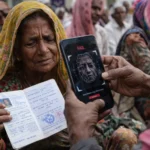
But the onus of proof has now been shifted from the State to the Citizen. The poorest of the poor—those without the means, the internet access, or the literacy to check a PDF document online—will be the ones permanently erased.
As Uttar Pradesh marches toward the 2027 Assembly elections, this voter list revision will be remembered as the moment the mechanics of Indian democracy were put to the ultimate test. It is no longer just about who wins the election. It is about who gets to participate in it.
If an algorithm and a biased administration can erase 18% of the electorate, the concept of “One Person, One Vote” in the Hindi Heartland is no longer a constitutional guarantee; it has become a privilege.
Pragya Mishra is a political analyst and senior editor at ChaupalTimes.in, focusing on governance, democracy, and social justice in the Hindi Heartland.