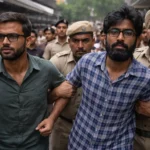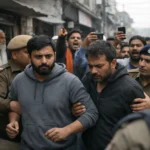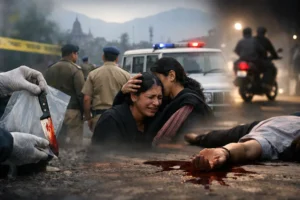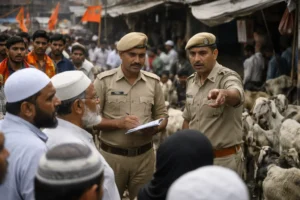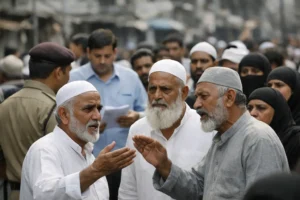
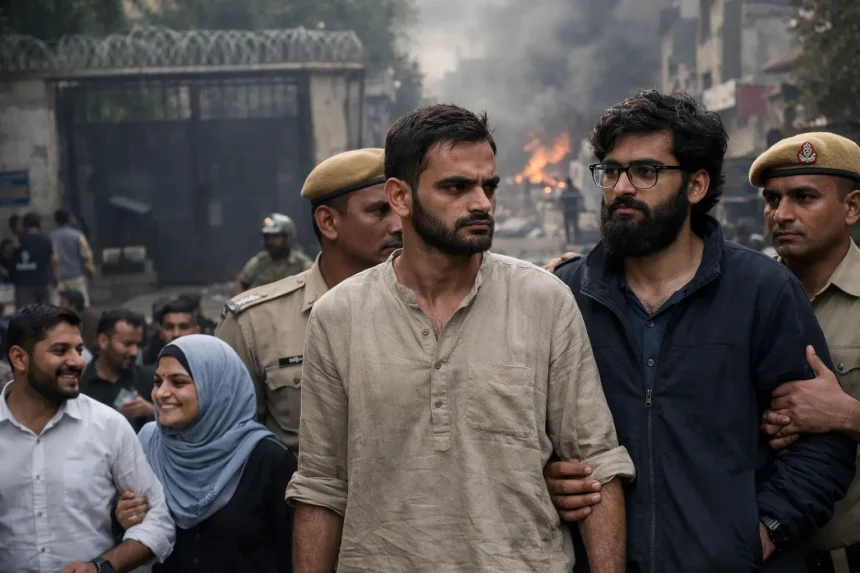


5th January 2026 marked a pivotal moment in India’s judicial history that will be studied by legal and political experts for decades to come. In a split verdict, the apex court granted bail to five accused of a “larger conspiracy” behind the 2020 Delhi riots including Meeran Haider and Gulfisha Fatima. This ended their nearly 6 years of imprisonment without a trial. However, the two most prominent faces of the anti-CAA movement, Umar Khalid and Sharjeel Imam, were denied relief by the same court.
The court’s observations in the case need to be critically evaluated ,because they validate the Delhi Police’s theory, at least at the bail stage, that Khalid and Iman were the “masterminds” guiding a coordinated attack aimed at destabilizing the nation as they stood on a “qualitatively different footing” compared to the others. As these young scholars return to Tihar jail to await a trial that has hardly moved in half a decade, this verdict compels us to reconsider a haunting warning from the annals of history.
The Ghost of 2020: Riot or Pogrom?
Just five years ago, interviewing violence had only just begun. The then CPI(M) leader Sitaram Yechury was being interviewed in real time, who sat in front of a camera in a manner that confronted state use of language. The use of a word by a police officer, who stated that an event was a “riot”, means antithetical as an event took place in which two opposing mobs fought in a spontaneous manner. Yechury stated that he would not use that word.
“What they call the Delhi riots were not really riots… it was a pogrom”, Yechury stated. Defined as an attack in which violence is employed by the state against a particular minority, Yechury had every right to his claim as having the word “pogrom” was an appropriate documented act. His evidence was not observation of a stated ignored “Chronology of Silence”. The police did not focus on a “student leader” activist imposition while they “auforized” hate speeches attacking the ruling party head of state Anurag Thakur and Kapil Mishra days prior to the violence.
The image of Yechury stating that the investigation has been “politically mastered” by the Union Home Ministry of India has been grievable in the current state of law. If indeed there is some sense to it, then the waiting time of both Khalid and Imam is not a triumph of justice, but an accomplished victory for a violent narrative where victims and dissenters are forged into perpetrators.
More Read

The Process is the Punishment
Kapil Sibal and A.M. Singhvi, two distinguished lawyers, presented their case to the Supreme Court and stated that the case for keeping the accused jailed for six years with no trial is a form of “pre-trial conviction.” In any good democracy, the rule is that a person is presumed innocent; bail is the rule, and jail is the exception.
This logic is entirely flipped under the Unlawful Activities (Prevention) Act (UAPA). UAPA sets such high standards for qualifying for bail that a prosecution’s ‘prima facie’ case is enough to keep the accused incarcerated for an unlimited amount of time. The Hindu has stated that the release of the five co-accused recognized that their particular roles did not warrant further detention. The “leaders,” however, are actually being denied bail. This continues the disturbing trend of holding that the state views the act of even organizing dissent to be terrorism.
Institutional Persecution?
International observers have viewed this case as a barometer for India’s sliding democratic indices. A recent analysis by Al Jazeera (January 2026) terms the Delhi Riots conspiracy case as “emblematic of the institutional persecution of Muslims.”
More Read

The distinction drawn by the Supreme Court—isolating Khalid and Imam as “central” to the conspiracy—plays into a specific political utility. Umar Khalid, a PhD scholar from JNU, and Sharjeel Imam, an IIT graduate, represent a demographic that the current political dispensation finds most challenging: the educated, articulate Muslim who asserts Constitutional rights rather than religious ones. By branding them as “Masterminds” and denying them liberty, the system effectively criminalizes the agency of young Muslim leadership.
The Verdict of History
The 2026 verdict offers a temporary resolution to the bail petitions, but it leaves the core wound of 2020 open. We are left with a justice system where a student can spend six years in jail without being proven guilty, while political leaders captured on video calling for violence (“Goli Maaro”) have not faced a single day of interrogation.
Sitaram Yechury warned us that the narrative was being manipulated. Today, as five walk free and two remain behind bars, his words serve as a reminder that in the court of law, the process is often the punishment. The trial may eventually decide who is guilty, but history will decide whether justice was served or silenced.