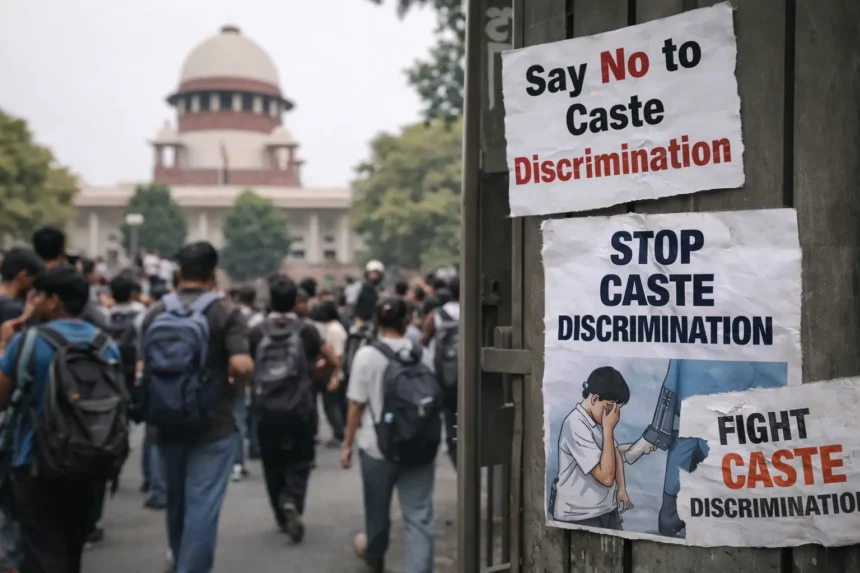

The Supreme Court of India has put a temporary halt to the University Grants Commission (UGC) regulations from 2026, which aimed to prevent caste-based discrimination in higher education institutions. During a hearing on Thursday, January 29, a bench led by Chief Justice of India Surya Kant raised concerns about the clarity, scope, and potential misuse of these new regulations. The court described the regulations as “prima facie unclear” and warned they might deepen divisions on college campuses instead of fostering equality.
The regulations, introduced on January 13, 2026, require all higher education institutions to form Equity Committees. These committees must investigate claims of caste-based discrimination, harassment, and exclusion faced by students from Scheduled Castes (SC), Scheduled Tribes (ST), and Other Backward Classes (OBC). The goal is to address long-standing issues related to discrimination in educational settings and to mitigate severe outcomes, such as student suicides, which have gained national attention over the years.
The UGC regulations of 2026 replace policies set in 2012. The UGC stated that the new framework aims to improve accountability and institutional mechanisms at universities. However, these regulations sparked controversy almost immediately after their announcement, especially among upper-caste (savarna) students and institutions that argue the rules are discriminatory and unconstitutional as they are written.
Several petitions challenging the new policies have been submitted to the Supreme Court. Petitioners include Mrityunjay Tiwari, Vineet Jindal, Rahul Diwan, and advocate Vishnu Shankar Jain. They argue that Rule 3(c) defines caste-based discrimination only concerning SC, ST, and OBC groups, leaving upper-caste students without similar protection. This means they cannot file complaints even if they experience harassment, bullying, or ragging.
The petitioners claim this classification violates Article 14 of the Constitution, which guarantees equality before the law. They argue that by assuming discrimination can only occur against certain groups, the regulations unfairly imply that students from the general category are guilty until proven innocent. This undermines the principle of equal treatment and could lead to selective enforcement and victimization.

During the hearing, Chief Justice Surya Kant and Justice Jaymalya Bagchi made important observations. The Chief Justice noted that the language of the guidelines lacks precision and clarity, allowing for arbitrary interpretation. He stated, “the UGC regulations are prima facie unclear, and there may be every chance of misuse.” He added that poorly drafted rules can cause more harm than well-crafted ones.
The court expressed serious concern about the broader social implications of such policies. The Chief Justice compared it to racial segregation in American universities, warning that overly institutionalizing identity-based grievance mechanisms could divide campus communities. He questioned how society outside could remain united if divisions exist within campuses and emphasized the need for India to work toward a casteless society instead of reinforcing divisions through administrative measures.
The bench also noted the lack of provisions addressing discrimination within reserved categories. The court pointed out internal divisions among Scheduled Castes in Haryana, where some groups discriminate against each other. The regulations fail to recognize these complexities, oversimplifying the reality of caste dynamics.
More Read

The judges raised practical questions about campus life. For example, they asked what remedies would be available if an upper-caste student was victimized by a senior from a reserved category. The current rules offer no clear solution, and such gaps could lead to injustice rather than resolution.
In response, the Supreme Court issued a notice to the central government and paused the implementation of the UGC regulations of 2026 until further notice. The next hearing is set for March 19, 2026. The court intends to consider petitions filed by the mothers of Rohith Vemula and Payal Tadvi, students whose deaths became significant symbols of alleged caste-based discrimination in higher education.
While suspending the regulations, the court acknowledged the issues the UGC sought to address. It highlighted the need for a more thorough and well-structured framework. The bench suggested revisiting and revising the policies after consulting legal experts, educators, sociologists, and other stakeholders to ensure effectiveness and constitutionality.
During the hearing, the Ministry of Education and the UGC defended the regulations. They claimed the rules do not specify any particular community and that Equity Committees would operate fairly. These committees are expected to have diverse representation and follow proper procedures when investigating complaints. The government argued that the guidelines are necessary for creating safer, more inclusive educational environments.
Despite these assurances, opposition to the regulations has increased. Protests and demonstrations have occurred on many campuses, with students expressing concerns about biased procedures and potential damage from unproven allegations. At the same time, student organizations and activists from reserved categories have warned against weakening protections against discrimination, noting that caste-based exclusion remains a reality in many institutions.
Legal experts following the case agree that the Supreme Court’s involvement aims to find a constitutional balance. While many recognize the need to prevent discrimination and support student welfare, there is also acknowledgment that any policies must uphold equality, fairness, and due process for everyone. Overly broad or poorly defined rules could be counterproductive.
More Read

As the discussion continues, the case highlights ongoing tensions around caste, equality, and social justice in India’s higher education institutions. The Supreme Court’s final decision, expected after more hearings, will likely have significant implications for university governance and how the country balances affirmative action with constitutional equality.