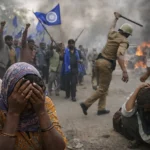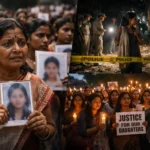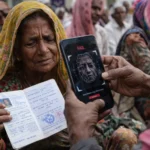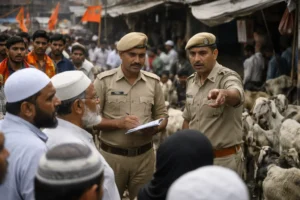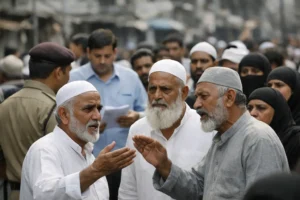
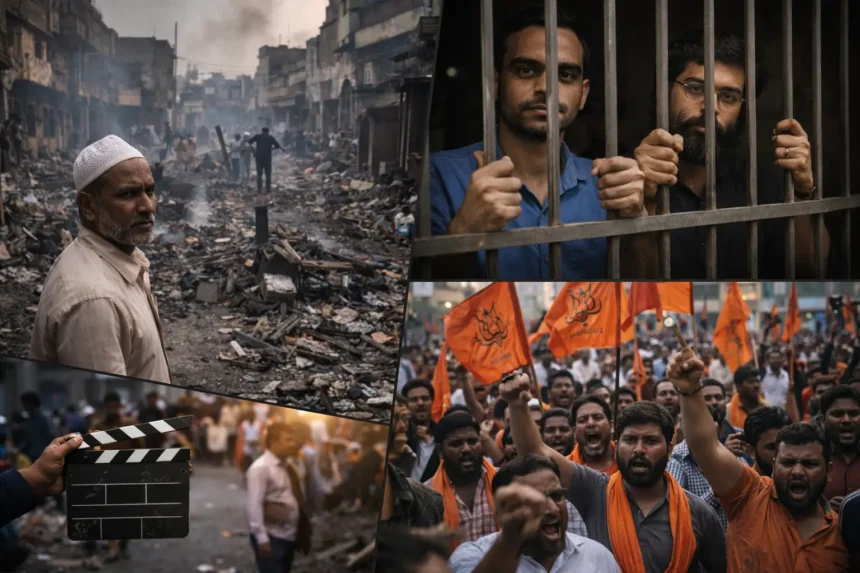


The Delhi Riots of 2020 was a dark period in the history of India. Since then, six years have passed when North East Delhi witnessed brutal violence and communal clashes, amid anti-CAA protests. These clashes resulted in the death of at least 53 people according to the official data, while many deaths happened without being reported. Among those 53 people, 38 were Muslims. Reports by Amnesty International highlight that over 1700 Muslim homes and businesses were damaged and vandalised during the state-sanctioned riots.
This anniversary underscores the ongoing injustices and communal hatred. Anyone who dares to go against any Hindutva-driven ideas faces persecution, while the mobs and criminals are given free hand without consequences under the Modi government.
OVERVIEW OF 2020 DELHI RIOTS
The Delhi Riots began on 23rd February 2020. The clashes originated from the tensions and protests over the discriminatory Citizenship Amendment Act (CAA). Over days, the tensions evolved into violence. It resulted in widespread destruction, which was mainly focused on targeting the Muslim community, who was protesting against the CAA. Fact-finding reports confirm that at least 80% of victims of the killings were Muslims. This points to the reality of minorities in India, that they are always under existential threat by the Hindu majoritarianism.
THE CAA & ITS CONTROVERSIES

The CAA itself is a manifestation of this very Hindu majoritarianism. It was enacted in December 2019, ensuring to fast-track citizenship for non-Muslim refugees from Pakistan, Bangladesh, and Afghanistan. Muslims are explicitly excluded. This is discrimination based on communal hatred by a majority. The problem isn’t just that, the enactment of the CAA gave a ground to question the nationality of the Indian Muslims themselves, trying to frame them as outsiders and illegal immigrants in India. This was a state attempt to eradicate Muslims from India in order to homogenise and Hinduise India.
Legally speaking, the CAA violates the Article 14 (equality) and the Article 15 (non-discrimination) of the Indian Constitution itself. Combined with the proposed NRC, the CAA fuels fears of Muslim statelessness.
ANTI-CAA PROTESTS & THEIR IMPACT
More Read
Because of this discrimination, massive protests erupted nationwide, especially the capital city of Delhi because of its state importance. The most prominent of these protests was the one led largely by Muslim women in Shaheen Bagh. They demanded the CAA to be repealed, despite facing violence by the police.
These demonstrations highlighted the law’s anti-Muslim bias. CPI(M) leader Sitaram Yechury called such discrimination and violence a pogrom incited by Hindutva hate speeches. According to Human Rights Watch (https://www.hrw.org/news/2022/02/21/india-biased-investigations-2-years-after-delhi-riot), bias by the authorities contributed to the unrest and massacre.
UMAR KHALID’ S PROLONGED DETENTION
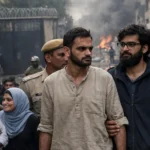
Umar Khalid was affiliated with the JNU when these protests occurred. He was vocal against the CAA, and called for the law to be repealed. His activism brought state action against him. He was arrested in September 2020 under the UAPA. Since then, he had been in jail, for over five years now without trial. The Supreme Court denied bail on 5th January this year, citing evidence of involvement in riots. Five co-accused received bails recently, and according to many human rights and legal experts, the detention of Umar Khalid is unlawful and purely motivated by politics of hate. His speeches show no direct link between his activism and violence.
The imprisonment of Umar Khalid is just another example of his the state deals with its insecurities whenever a Muslim figure raises to political prominence.
SHARJEEL IMAM’S CASE
More Read
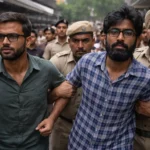
Another prominent figure still under arrest is Sharjeel Imam. Being a young Muslim activist in the ongoing anti-CAA protests, his speeches called for Muslim mobilisation against such state-driven injustices. Arrested in January 2020, his bail too was rejected by the SC on 5th January this year. The narrative of BJP government? Sharjeel’s voice was a force which motivated many young people to dissent against the discriminatory laws of the state.
The 2025 hearings in Delhi High Court revealed weak evidence against him, yet without conviction, he has already spent more than six years in custody. The arrest of Sharjeel Imam is a fresh example of how the ideological Hindutva government actively tries to repress any Muslim leadership in the country.
RIOTERS FREE, PROTESTERS JAILED
Of the 2108 arrests, 95% have received bail. However, 108 protesters, mostly Muslims, remain jailed under UAPA. BJP-linked mob face no convictions. To have a clearer idea of the matter, only one such case was reported by 2026, whiles videos show them inciting violence with repercussions.
The opposition highlights selective justice. For instance, convict in another case Gurmeet Ram Rahim has received 15 paroles since 2017, while Muslims see no hope of justice. The data from Pew Research 2021 shows that around 64% of Hindus view such events through a nationalist lens, increasing polarisation. Remember, in this particular case, of 2108 arrests, 1400 were Muslims as per 2025 reports.
EVIDENCE OF INSTITUTIONAL BIAS
V-Dem Institute reports that India’s autocratisation index dropped from 0.57 in 2013, to 0.34 in 2023. As per PUCL, the misuse of UAPA post-2014 rose 33%. Muslims who are 14% of the population comprise 20% of the undertrials per NRCB 2024. Another report by Carnegie Endowment notes that BJP’s ethnic nationalism prolongs detentions for those who dissent, while shielding Hindu perpetrators.
- Key Stats: Muslims overrepresented in prison undertrials at 20%.
- Trend: Rise in targeted arrests under anti-terror laws.
SOCIETAL IMPACT
The Delhi Riots displaced around 20000 people. The reconstruction programs favoured non-Muslims. Because of the riot rhetoric, BJP’s 2024 vote share in Delhi rose by 5%. This erodes India’s secular fabric. Injustice prioritises Hindutva agendas over accountability. Democracy suffers in the country because dissent is being criminalised by the government.
PERSISTENT INJUSTICE UNDER MODI
Six years on, the legacy of 2020 Delhi Riots persists. Protesters like Umar Khalid and Sharjeel Imam languish without trial.
Rioters walk free.
According to the BBC report on the riots (Read More), policy impunity guided by the government’s policy majorly responsible for this. State response targets dissenters disproportionately. This exposes Hindutva-driven persecution undermining democracy. Even after six years of the Delhi Riots, the victims still await justice. Such communal hatred and incidents have become a norm throughout the country nowadays. Until safeguard measures are taken and enforced without any discrimination, the inclusivity and secularity of the Indian state will continue to be challenged.