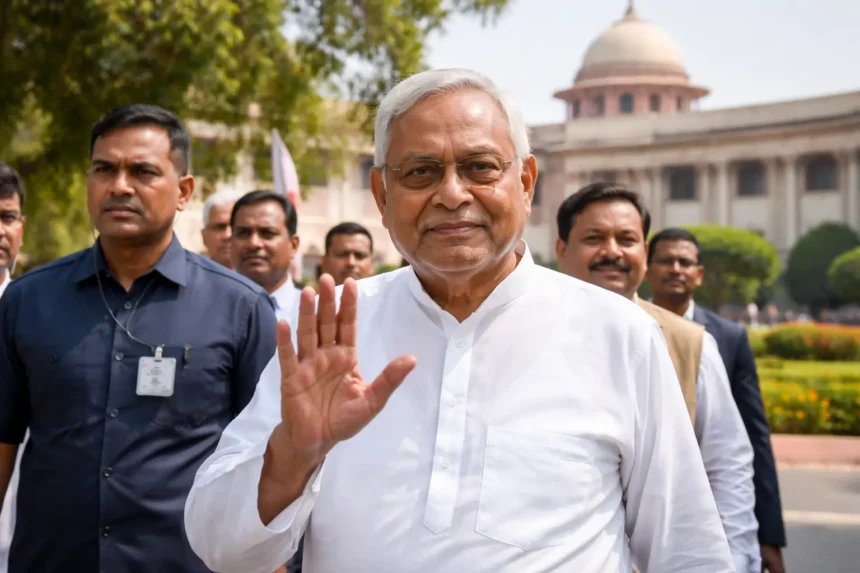

Today, the veteran Janata Dal (United) leader Nitish Kumar formally resigned from the Bihar Legislative Council, triggering his exit as Chief Minister after guiding the state through multiple terms since 2005.
At 75, Nitish Kumar, popularly known as “Sushasan Babu,” cited a long-held personal desire to serve in Parliament. He was elected to the Rajya Sabha on March 16, just weeks after leading the NDA to victory in the December 2025 Bihar Assembly elections.
The move ends an unprecedented 21-year dominance in state politics and clears the path for Bihar’s first BJP Chief Minister.
Nitish Kumar’s Long Political Journey
Nitish Kumar first became Chief Minister in 2005, ending 15 years of RJD-Congress rule marked by caste politics and lawlessness. He focused on infrastructure, education, and women’s empowerment, introducing prohibition in 2016 and building over 1.2 lakh kilometers of rural roads.
More Read

His governments delivered consistent power supply, improved school enrolment, and targeted Extremely Backward Classes (EBCs) and Mahadalit communities. Official data from the Bihar Economic Survey shows poverty reduction from 33.7% in 2011-12 to 25.7% by 2022-23 under his tenure.
Yet Nitish Kumar earned the nickname “Paltu Kumar” for multiple alliance flips, first with NDA, then Mahagathbandhan, and back to NDA in January 2024 and after 2025 polls. He won a record 10th term as CM in early 2026 after the NDA secured 175+ seats in the 243-member Assembly.
The 2025 Bihar Elections and NDA Victory
More Read

In December 2025, JD(U) and BJP together defeated the RJD-led Mahagathbandhan. NDA’s vote share crossed 45%, with JD(U) retaining core EBC and Kurmi support while BJP expanded in upper-caste and urban areas.
Nitish Kumar took oath for his 10th term in early January 2026. Barely three-and-a-half months later, today on March 5, he announced his decision to step down and contest Rajya Sabha polls.
JD(U) sources confirmed the party won 45 seats, while BJP emerged as the larger partner with over 80 seats, a key factor in the subsequent transition.
Timeline of Nitish Kumar Resignation
- March 5: Nitish Kumar publicly declares intent to move to Rajya Sabha and resign as CM.
- March 16: Elected unopposed to Rajya Sabha from Bihar.
- March 20: Bihar Minister Sharwan Kumar states Nitish can remain CM for six months under constitutional provisions but must resign from the Legislative Council within 14 days.
- March 30: Nitish Kumar submits resignation from Bihar Legislative Council (MLC), paving the way for formal exit as Chief Minister.
JD(U) MLA Anant Kumar Singh confirmed: “Everyone wanted the same (that he should not resign from the CM post), but he did not agree.”
Motives Behind Nitish Kumar Resignation
More Read
Health concerns top the list of reasons. Multiple reports, including those cited by BBC and Moneycontrol, confirm Nitish Kumar’s deteriorating health plagued his last term. At 75, the demanding role of managing a 12-crore population state became unsustainable.
Nitish Kumar himself wrote on X: “For more than the past two decades, you have consistently maintained your trust… based on that strength, we have served Bihar.” He assured the new government of his “full cooperation and guidance.”
Succession planning forms another core motive. His son, Nishant Kumar, is set to formally join JD(U) and begin active politics on March 8. Sources indicate Nitish wants a smooth handover while he remains influential at the national level.
Crucially, post-2025 election dynamics played a decisive role. BJP, now the senior NDA partner, sent clear signals for a leadership change. The Hindu reported senior BJP leaders insisted on a succession plan, pushing for the Chief Minister’s post to go to their camp.
This paves the way for Deputy CM Samrat Choudhary, a Kurmi leader aligned with JD(U) but backed by BJP, or another BJP OBC face as the likely successor. Bihar will witness its first BJP Chief Minister, ending two decades of JD(U) dominance at the top post.
Impact on Bihar Politics and Rise of BJP
Nitish Kumar’s resignation signals the formal end of the “Nitish era”. His departure hands BJP its biggest prize in Bihar since the NDA alliance began. The party which once played second fiddle, now controls the CM post in India’s third-most populous state.
JD(U) faces an uncertain future without its tallest leader at the helm. Critics within the opposition allege the move reflects BJP pressure rather than pure personal choice. RJD leaders, including Manoj Jha, called it a “scripted” exit orchestrated from Delhi.
Yet Nitish Kumar leaves behind a transformed Bihar, from power-deficit to surplus, from jungle raj to relative stability. Official NCRB data shows improved crime indices in several categories during his long rule.
The transition also highlights Nitish Kumar’s pragmatic politics by stepping aside to secure his party’s alliance with BJP while moving to a less stressful national platform.
Future Outlook: New Leadership and Challenges Ahead
Speculation now centres on the new Chief Minister’s announcement, expected within days. Samrat Choudhary remains the frontrunner, with BJP likely to field an OBC leader to maintain caste balance.
Nitish Kumar is expected to take oath as Rajya Sabha MP shortly and may even join the Union Cabinet under Prime Minister Narendra Modi, sources close to the developments indicate.
For Bihar, the change raises questions on policy continuity, especially prohibition, women’s reservation in jobs, and EBC-focused schemes that defined the Nitish model.
JD(U) workers protested outside Nitish Kumar’s residence after the announcement, reflecting internal unease. However, party leaders insist the move strengthens the NDA and ensures long-term stability.
A Calculated Exit in Nitish Kumar Resignation
Nitish Kumar’s resignation is not an abrupt collapse but a carefully timed, multi-layered decision driven by health realities, family succession, and political realism. After over two decades of shaping Bihar, building roads, enforcing prohibition, and mastering alliance arithmetic, the 75-year-old leader chooses Parliament over Patna.
According to a detailed report by The Hindu, the exit marks “the end of an era” and hands BJP its long-awaited chance to lead Bihar directly.
Bihar now enters a new chapter under fresh NDA leadership. Whether the development model Nitish Kumar built survives the transition remains the biggest test ahead.