

On the Republic Day, a confrontation in the town of Kotdwar in Uttarakhand revealed the sharpest fault line in contemporary Indian public life. It showed how communal intimidation is increasingly normalised while civic intervention is treated as a threat to order. What unfolded over the course of that afternoon and the days that followed was not an isolated disturbance but a clear illustration of how the state responds when ordinary citizens interrupt majoritarian pressure.
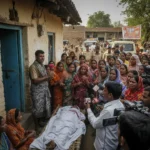
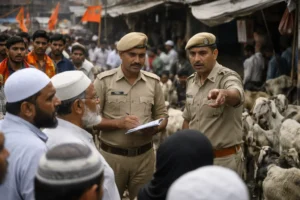
The incident started when a group of Hindu right-wing extremists confronted a 70-year-old Muslim trader in a Kotdwar market area. The argument made against him had nothing to do with public disturbance or licensing taxes. It had to do with the term “Baba” that appeared in the name of his store. The group demanded that the name be altered, claiming that a Muslim had no right to use the term. There was no formal complaint, no court order, and no municipal command. The pressure was purely ideological and unofficial.
Local reports state that the store had been running under the same name without any problems for decades. There was no change in law or policy that prompted the abrupt protest. It developed as a result of the increasing claim that cultural ownership may be upheld outside of institutions. Videos from the scene show a group of men questioning the shopkeeper’s identity and talking loudly while filming the interaction on their phones. The man looked obviously shaken. The audience grew. The air contained the well-known signs of escalation that have preceded bloodshed in numerous other Indian towns in recent years.
Deepak Kumar and Vijay Rawat, two locals, stepped in at this time. They were neither political party representatives nor protest organizers. They were onlookers who made the decision to speak up. They went up to the gathering and demanded that they cease bothering the old man. They made a direct and verbal intervention. It rejected the notion that religious identity could be monitored by a mob and questioned the validity of the demand itself.
In response to a provocation during the conversation, Deepak Kumar identified himself as Mohammad Deepak. Although the comment was quickly criticized, its context made its meaning evident. It wasn’t a conversion proclamation. It was an opposition to segregation between communities. It declared that citizens cannot be kept out of public life by using their names or identities. The intervention achieved its immediate goal. The altercation became less heated. There was no bodily harm to the shopkeeper. There was no violence.
That would have been the end of it in a working system. Public order had been restored, and a citizen had been shielded from intimidation. Instead, the underlying illness of governance under social pressure was revealed by what transpired.
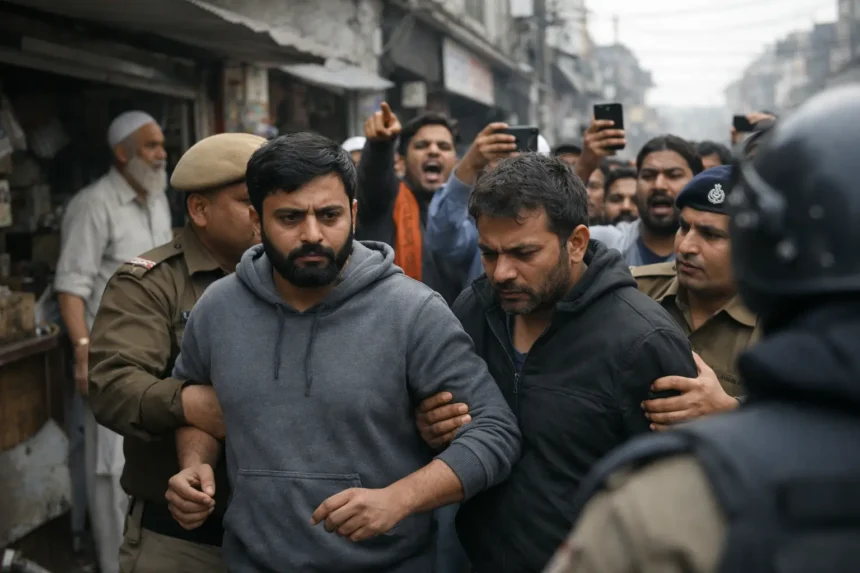
Based on allegations made by members of the same group that had assaulted the shopkeeper, police opened investigations against Vijay Rawat and Deepak Kumar. Assault, derogatory language, and disruption of public order were among the accusations. These expansive and adaptable clauses are frequently employed when authorities aim to resolve disputes without clearly allocating blame. The shopkeeper’s additional complaint of intimidation and harassment was only later acknowledged.
Members of the same group who had confronted the shopkeeper made complaints, which led the police to initiate cases against Vijay Rawat and Deepak Kumar. Assault, derogatory language, and disturbance of public order were among the accusations. These expansive and adaptable clauses are frequently employed when authorities aim to resolve disputes without clearly assigning blame. The shopkeeper’s additional complaint of harassment and intimidation was only later acknowledged.
More Read

Within hours, these videos of the incident became viral. The two men were commended by many viewers for intervening and averting damage. The intervention was presented as provocation by others. The tone and vocabulary of resistance quickly replaced the original act of harassment in the story. This change was essential. The institutional reaction followed a well-known pattern once the emphasis shifted from coercion to injured feelings.
Kotdwar is not the only place with this pattern. The trend of communal flashpoints is similar throughout India. A minority person or group is subjected to additional legal pressure. The state’s main goal when resistance arises is to bring about peace rather than justice. Under the heading of “maintaining peace,” FIRs are filed against several parties. It flattens responsibility. It dissolves moral clarity.
Cases reported under public order rules have progressively increased over the past ten years, especially in instances involving communal tension, according to data available from civil rights organizations. Authorities can act swiftly thanks to these sections, but they can also avoid dealing with the conflict’s underlying causes. Official crime statistics do not show vigilante intimidation as a separate category. It falls under general topics. It is impossible to confront what is not named.
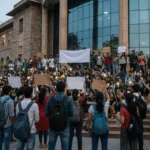
Protests calling for action against Deepak Kumar were held in Kotdwar after the cases were registered. He was accused of insulting religious sensibilities with slogans. To stop the situation from getting worse, police were called in. The visuals were striking. A man who had stepped in to save an old storekeeper now needed to be protected. There were no similar protests calling for responsibility for the first abuse. The disparity was obvious and revealing.
There wasn’t much consistent focus on the shopkeeper’s safety. The public was not given any guarantees regarding protection from intimidation in the future. Instead of addressing the root cause, the institutional approach concentrated on controlling the reaction. Once more, this illustrates a larger trend. Aggressors are viewed as stakeholders whose emotions need to be controlled, while those who are resisting pressure are forced to maintain composure during communal conflicts.
The Kotdwar episode needs to be viewed in the broader perspective of India’s growing practice of vigilante enforcement. The claim that cultural norms may be upheld through social pressure rather than the legal system unites disagreements over everything from eating habits to clothing to store names. Such pressure sets precedent when it is exerted without opposition. It turns into instruction when it is contested and the person who does so is disciplined.
More Read
Freedom of occupation and equality before the law are guaranteed by the Indian Constitution. A group’s objections do not make a store name that has been used legally for decades illegal. However, enforcement is increasingly reacting to mood rather than the law on the ground. Vigilantism thrives in this space between administrative practice and constitutional promise.
In Kotdwar, the state’s response showed choice rather than incompetence. Authorities may have taken a firm stance against intimidation. Instead, they decided to assign blame. A message is conveyed by this decision. It is safer to remain silent than to intervene. Resistance is riskier than compliance.
It is important to consider the date’s symbolic meaning. A constitutional order intended to substitute legal equality for communal authority was adopted on January 26. It is not ironic that an event revealing the breakdown of such premise took place on Republic Day. It is evidence.
Modern governance increasingly treats harmony as the absence of visible conflict rather than the presence of justice. In this framework those who interrupt injustice are seen as disruptors. Those who enforce hierarchy informally are seen as maintaining order. This logic corrodes civic life. It teaches citizens to look away. It trains institutions to confuse neutrality with abdication.
Neither Vijay Rawat nor Deepak Kumar claimed to be heroes. They took immediate action. They decided to step in after witnessing an elderly man being mistreated. The repercussions they encountered show how civic bravery is punished in a society influenced by majoritarian pressure. Their case involves more than just two people. It serves as a diagnostic for the system they came upon.
The signal to society is clear when preventing harassment leads to criminal cases. In theory, there are rights. It is up to the crowd to decide what is safe. A republic that makes intervention illegal does not suffer from a dearth of legislation. It suffers from a lack of motivation to put them to use where it counts.
The name of a store won’t be remembered as Kotdwar. The state’s response to the most basic measure of justice will be remembered, as it prioritized order over equality and procedure over principle.