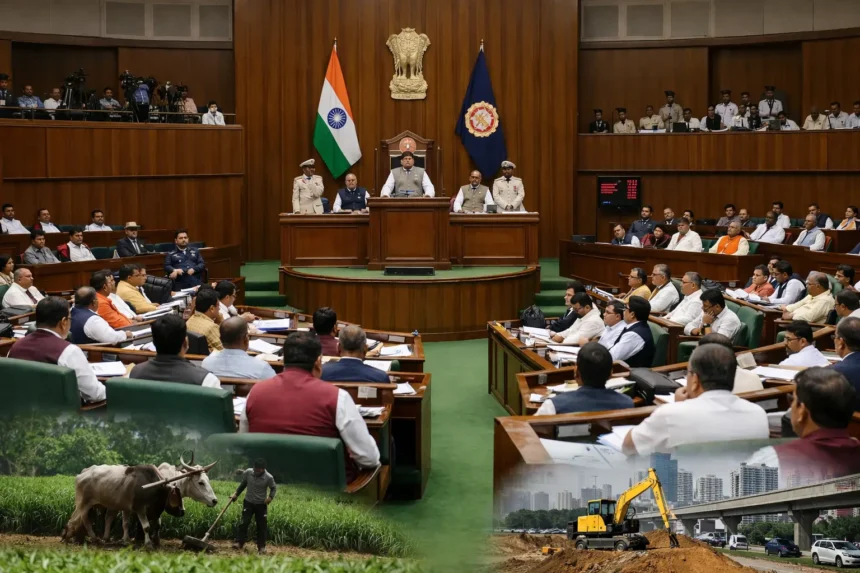

The Madhya Pradesh Legislative Assembly Budget Session, which commenced on February 16, 2026, is a pivotal moment in the state’s political and economic landscape. Held in Bhopal, this session is not merely about passing financial documents; it is a test of the governance, accountability, and political credibility of Madhya Pradesh’s ruling establishment.
With rising inflation, unemployment pressures, agricultural problems, and governance debates dominating public discourse, the 2026 Budget Session is of paramount importance. Legislators submitted over 3,400 questions, indicating a deeper scrutiny of the government’s policies and performance.
The Budget Session and its Democratic Role
In a parliamentary democracy, the Budget Session is the most important legislative function of the year. It determines how the state’s resources are mobilized and allocated, which directly impacts development outcomes and social welfare. For a state like Madhya Pradesh, with its predominantly agricultural character and young population, budget priorities have far-reaching implications.
The session begins with the Governor’s address, outlining the government’s vision and policy direction, followed by a debate, a question-and-answer session, and the presentation of the annual budget on February 18, 2026. These events provide an opportunity for both the government and the opposition to present their perspectives to the public.
The Government Under Pressure
The budget session is being held under the leadership of Mohan Yadav’s Bharatiya Janata Party (BJP) government. Despite holding a legislative majority, the ruling party is facing increasing political pressure due to economic difficulties, employment problems, and security and order issues.
More Read

For the government, the budget represents an opportunity to advance its development agenda, particularly expanding infrastructure, delivering social services, and encouraging investment. For the opposition, especially the Congress Party, this session provides a platform to highlight policy gaps, alleged administrative failures, and the social impact of economic decisions.
As a result, heated debates, frequent interruptions, and confrontational exchanges are expected in Parliament.
Key Issues Dominating the Session
Inflation and the Rising Cost of Living
Inflation, particularly food price inflation, is expected to be a central topic of discussion. Soaring prices for basic commodities have put pressure on household budgets in both urban and rural areas. Opposition MPs are likely to question the government’s effectiveness in controlling prices, managing subsidies, and the public distribution system. In response, the government is expected to defend its record by citing social welfare programs, food ration distribution, and financial management.
More Read

Unemployment is one of the most politically sensitive issues in Madhya Pradesh. Educated youth frequently express their dissatisfaction with the lack of job opportunities, delays in recruitment processes, and alleged irregularities in competitive examinations.
During the budget session, allocations for skills development, education, industrial growth, and job creation will be closely scrutinized. The budget’s ability to meet the aspirations of young people could significantly impact public perception of the government.
Agriculture remains the backbone of Madhya Pradesh’s economy, and farmers’ concerns are sure to be raised during the session. Questions regarding minimum subsidy prices, irrigation facilities, crop insurance, and compensation for crop losses are likely to dominate the discussions.
Any neglect of the agricultural sector in the budget allocations could have serious political repercussions.
The list of over 3,400 questions reflects the opposition’s intention to hold the government accountable. The question-and-answer session is expected to focus on the following issues:
Shortcomings in the implementation of social welfare programs
Security and public order incidents
Financial transparency and public debt
Allegations of abuse of administrative power
This scrutiny is essential to democratic functioning, although it often leads to heated debates and procedural delays.
When budget is presented on February 18, several key areas will be highlighted:
Infrastructure: roads, urban development, housing, and transport projects
Social sector: health, education, and women’s and children’s welfare
Fiscal discipline: managing the deficit while funding social welfare programs
Balancing populist demands with long-term fiscal sustainability will be one of the biggest challenges facing the government
More Read
The Budget Session is not just about numbers and allocations; it is a reflection of the strength of democracy at the state level. Serious debate, transparency and accountability build public trust, while excessive rigour can alienate citizens from the institutions of the state.
For the public, the significance of the session lies not in the political rhetoric but in tangible outcomes, such as job creation, affordable livelihoods, support for farmers and improved access to public services.
The 2026 Madhya Pradesh Budget Session is a crucial turning point in governance, economics and politics. As the debate continues in the Bhopal Legislative Assembly, the government’s priorities and the opposition’s criticisms will shape the direction of the state’s policy for the year ahead.
Ultimately, the success of the session will not be measured by the intensity of the political confrontation but by the budget’s ability to address the real challenges facing the people of Madhya Pradesh. In this sense, the 2026 budget is more than just a financial statement – it is a reflection of the government’s political will and democratic responsibility.