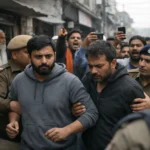
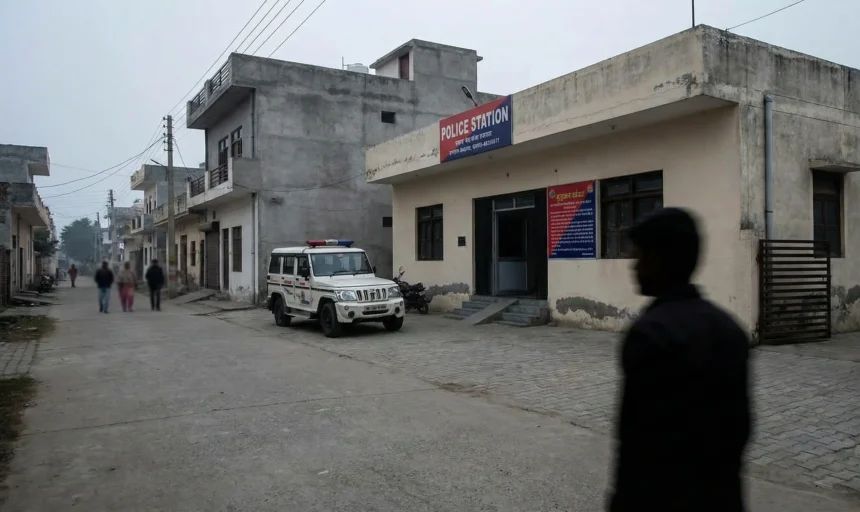

Kotdwar police recently arrested 32-year-old Roshan Pandey for allegedly raping his minor stepdaughter. The crime came to light after the girl went missing from her home. Her mother filed a missing person report at Kotdwar police station on February 6. Police located the girl, questioned her, and uncovered the sexual assault that had taken place the previous night.
Investigators were informed by the victim that the rape took place on the evening of February 5 by her stepfather. She left home early the following morning, at around 7 AM, traumatized by the incident. Her first visit was to her grandmother’s home on BEL Road. The girl, according to the grandmother, looked really afraid and wouldn’t go home. After that, the grandmother drove her to a relative’s home in the Sigaddi neighborhood. Using CCTV footage from several locations, police were able to track her movements, recover her safely, and get her statement.
Police filed a case against Pandey based on her testimony, citing pertinent provisions of the Protection of Children from Sexual Offenses Act and the Bharatiya Nyaya Sanhita. On February 7, they took him into custody from Najibabad Road. After being brought before the court, he was placed under judicial custody.
This case brings to light a significant and persistent issue in India. According to data from the National Crime Records Bureau, thousands of cases of child sexual abuse occur annually. Many of the offenders are members of the victim’s family or acquaintances. POCSO cases have surged in Uttarakhand in recent years. Because of embarrassment, fear, and pressure to preserve family reputation, many incidents go unreported. This pattern applies to the Kotdwar incident. A young girl fled her home rather than tell her mother because she felt so unsafe there.
Police response in this matter was prompt. Search operations were immediately directed by senior officers. The team followed the grandmother’s leads and looked over a lot of CCTV footage. In addition to saving the girl, their prompt action exposed the crime. In a subsequent statement, the Pauri police commended the team for their effectiveness in addressing the missing person report and identifying the underlying crime.

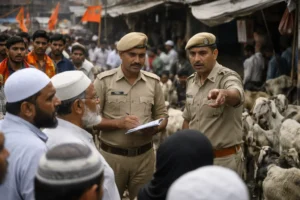
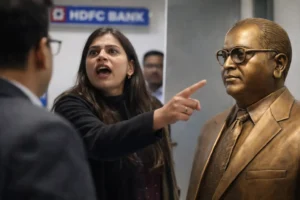
The notable aspect of this episode is the total lack of response from Hindutva organizations, which are typically quite outspoken in Kotdwar. Only a few weeks ago, Bajrang Dal activists caused a significant controversy in this same town. Members of the Bajrang Dal attacked a Muslim store owner named Muhammad Shoaib on January 26 because his store was called “Baba Dress.” According to them, the term “Baba” offends Hindu sentiments associated with the Siddhbali Hanuman temple, which is close by. The shopkeeper was confronted by a sizable group who insisted that he change the name. A public dispute resulted from the situation.
Deepak Kumar, a local resident, also helped the shopkeeper during the same event. He stood between the crowd and the shop in a video that went viral and said, “My name is Mohammad Deepak.” People on social media noticed what he did. Several political leaders praised his stand against intimidation. Bajrang Dal supporters responded strongly. Groups from Dehradun and Rishikesh arrived in Kotdwar on January 31. They protested outside Deepak Kumar’s gym, blocked roads, and raised slogans. Police registered multiple FIRs. One was against Deepak Kumar and his associate for alleged assault. Others were filed against Bajrang Dal members for promoting enmity and against unidentified persons for unlawful assembly.
The Bajrang Dal leaders said that the shop name was an attack on Hindu culture. They then mobilised hundreds of people and used social media as a tool to create more hatred. The entire plot was framed as a defence against the Muslim encroachment of Hindu civilisation. Yet when a Hindu man is accused of raping his minor stepdaughter in the same town, these same groups have shut their voices. No statements have been issued, no protests have been organised, no public demands for justice have appeared.
More Read
This contrast is striking. Organisations that claim to protect Hindu women and girls become active when they perceive an external threat, especially one involving inter-community issues. They remain inactive when the perpetrator belongs to their own community and the crime occurs inside a Hindu household. The pattern suggests that their activism is driven more by communal politics than by genuine concern for women’s safety.
Child sexual abuse within families is one of the most difficult crimes to address. Victims often face disbelief, blame, or pressure to stay silent. Perpetrators exploit their position of authority. In many cases, the family prioritises reputation over justice. Data from across India shows that conviction rates in POCSO cases are low. Witnesses turn hostile, evidence is difficult to collect, and societal attitudes discourage reporting. These problems exist regardless of religion or region. They require consistent condemnation and strong institutional response.
The Kotdwar rape case should have prompted the same level of public anger that the shop name controversy did. Instead, it has passed with almost no comment from the groups that dominate local moral discourse. This selective response weakens their claim to represent Hindu values. If the goal is truly to protect daughters, then crimes like this one deserve the strongest possible reaction. Silence in such cases sends a message that internal violations matter less than external ones.
The Incident also raises questions about priorities in Uttarakhand. The state government promotes policies aimed at cultural protection and social harmony. At the same time, mechanisms to prevent and punish crimes against children need more attention. Police efficiency in this case is a positive step. Long-term change requires better awareness, faster investigations, higher conviction rates, and community support for victims.
The girl In this case showed remarkable courage by speaking out. Her decision to leave home and eventually tell the truth allowed police to act. She deserves full protection, proper counselling, and justice. The legal process must hold the accused accountable without delay.
Kotdwar has now seen two very different episodes in quick succession. One involved aggressive mobilisation over a shop sign. The other involves the rape of a child inside her home. The first received widespread attention from Hindutva groups. The second has not. This difference reveals more about the nature of that activism than any statement could.
More Read
Until organisations that claim to defend Hindu society speak out against crimes like this one with the same intensity they show elsewhere, their credibility will remain in question. Protecting children from abuse should not depend on the religion of the perpetrator or the location of the crime. It should be a non-negotiable priority.
The Kotdwar rape case is a reminder that real threats to women and girls often come from within trusted circles. Ignoring those threats while focusing on symbolic disputes does nothing to make society safer. It only protects the status quo.