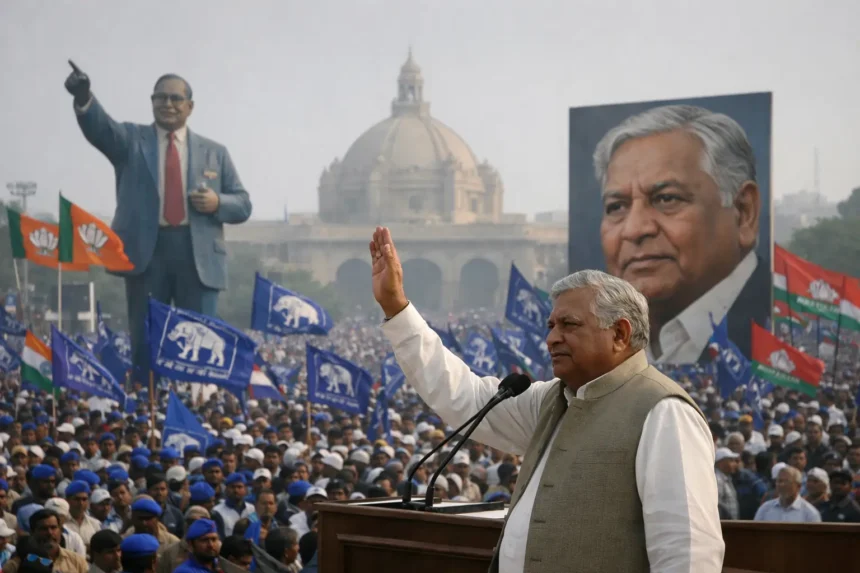

Lucknow Political parties are working hard to woo the Scheduled Castes (SC) in Uttar Pradesh. With the assembly elections due early next year, India’s most populous state is witnessing rapid political changes. Kanshi Ram, founder of the Bahujan Samaj Party (BSP) and the Dalit Shoshit Samaj Sangharsh Samiti (DS-4), is at the helm of this new effort.
The 15 March date marks the birth anniversary of Dalit leader Kanshi Ram. This date was used to be the sole domain of the BSP comrades. However, things have changed, and it became multi political event. As Scheduled Castes constitute 21 percent of the total voters in the state, no party can ignore this group. As a result, all political parties are taking all possible opportunities to communicate with the people to portray themselves as the true inheritors of Kanshi Ram’s legacy and the strongest friends of the Dalits.
The Enduring Legacy of Kanshi Ram
To understand the current political scenario, it is vital to realize the significant impact of Kanshi Ram in Indian politics. Kanshi Ram, who was born in 1934, transformed the political narrative in North India. However, his objective was to capture political power as well as to cater to the welfare of the Dalits. Coming from a grassroots organization BAMCEF (Backward and Minority Community Employees Federation) in 1970s to forming DS-4 in 1981 to forming BSP in 1984, Kanshi Ram made a huge social awakening (Ibid).
His rallying slogan, “Vote hamara, raj tumhara, nahi chalega” (Our vote, your rule will not last anymore) was a potent weapon for millions of Dalits, tribals and backward classes who felt neglected and sidelined by India’s traditional political forces in the post independence era. Kanshi Ram had envisioned a “Bahujan” society – a coalition of the oppressed majority – that would control power.
Kanshi Ram today, several years after his active political career is more than just a symbol for BSP. Now he got Dr. B.R. Ambedkar, who is considered one of the most respected Dalit symbol. For political parties to appeal to Dalit families, it is necessary for them to mention these names in UP.
More Read
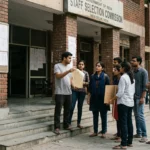
The Mathematical Imperative: Why the 21% Matters
If we look at the figures from Uttar Pradesh, it is easy to understand why every party is struggling to claim Kanshi Ram’s legacy. The state sends 403 MLAs to its assembly. Of those, 86 seats are earmarked for Scheduled Castes. And the thing is: the party that wins these reserved seats usually wins in Lucknow.
But you cannot keep all the Dalit voters together. Those 21% Dalit votes? It is divided into all types of sub-castes. For example, Jatavs constitute more than half of the state’s Scheduled Caste population. He has stood firmly behind BSP for years. The rest—Paasi, Valmiki, Kori, Khatik and others—have not stuck with one party. In the last decade, these non-Jatav Dalits have increasingly come forward and are supporting whoever they feel can make a difference. In the last few elections, a large portion of them switched to different parties, thereby shaking the political system.
Now, with the assembly elections coming, it is not just about keeping old supporters loyal. Every party is working hard there, trying to win voters from its rivals. It’s pure mayhem.
More Read
The BSP’s Battle for Survival and Supremacy
For the Bahujan Samaj Party, this assembly election is no ordinary contest, but a survival struggle. Mayawati, who has been chief minister four times, also knows that support for the party had been waning in the last few years. Now, with the founder’s birthday on 15th March, the BSP is trying to fire the tired and dejected workers.
They do not joke. Rallies, massive mobilization campaigns, training camps – BSP is seen in every district of Uttar Pradesh. The time has come, according to Mayawati, to go back to Kanshi Ram’s ways. BSP leaders keep telling people, that whereas other parties talk about Dalit symbols when it suits them, the BSP has actually fought and won for real respect and power for Dalits. This is their story and they are sticking to it.
But BSP is not looking back. He is reminding voters on the changes he did while he was in charge – how life really did get better. They warn further against the national and regional parties, saying that is where the upper caste dominance lies and that is where people will be taken back to if they vote for them (Thereafter, 2007). For BSP, this election is about maintaining the dignity that was earned and not letting history repeat itself.
The BJP’s Aggressive Inroads and “Labharthi” Outreach
The ruling Bharatiya Janata Party (BJP) knows that to really win over Hindu votes, it will have to win over Dalits. For years, the BJP dismantled the BSP’s hold on non-Jatav Dalits, but now it is directly targeting the Jatav community as well.
BJP’s approach is not subtle. It has two main steps: cultural outreach and targeted welfare. On the cultural front, the party bends over backwards to respect Dalit icons. You will see government events and schemes running on the birth anniversary of people like Dr. Ambedkar, Sant Ravidas and now even Kanshi Ram. BJP leaders make a point of visiting Dalit homes, having meals with families – anything to show a sense of belonging and respect.
Then there is the welfare perspective. The BJP relies heavily on its beneficiary, or “beneficiary” base. Free rations, new houses under the PM Awas Yojana, toilets, direct cash assistance – all this most affects Dalit communities who have often been left out. And the party does not let anyone forget who is responsible. Every benefit is directly linked to Prime Minister Narendra Modi and Chief Minister Yogi Adityanath. The message is clear: forget old caste identities, you are all “empowered”beneficiaries” now, thanks to us.
More Read
Samajwadi Party’s ‘PDA’ Strategy Pays Dividends
Akhilesh Yadav and the Samajwadi Party are making maximum efforts to attract Dalit votes this time. In fact, for many years, the party depended on its usual Yadav, Muslim alliance but this alliance is now insufficient to compete with the BJP juggernaut. Therefore, presently Akhilesh is advocating for a new formula PDA, which means Backward Dalit Minority (i.e. backward classes, Dalits and minorities).
You can see the change. SP is giving more space to Dalit leaders and supporting the call for a nationwide caste census. They are talking a lot about social justice and pushing for proportional representation, basically saying to SC voters, “Your fight is our fight, and we are in it with the entire Bahujan movement.”
As Kanshi Ram’s birth anniversary approaches, the party has been holding seminars and meetings, warning that the constitutional rights of marginalized groups are under attack. This whole “save the Constitution” pitch and protecting reservation policies is starting to appeal to many Dalit youth. Suddenly, the SP is in the race for a major share of the votes which, until recently, were almost entirely with the BSP.
Congress Looks to Reclaim Historical Ground
After independence for several years, Indian National Congress controlled Uttar Pradesh, a state that was governed by coalition of Brahmins, Muslims and Dalits. However, after three decades of Congress being sidelined, the party is finding it difficult to win back its old base. Currently, they are witnessing the Dalit vote moving away and in fact, they feel that there is a chance.
Party’s national leaders are making a big push to safeguard the rights granted by the constitution. By appointing senior Dalit leader Mallikarjun Kharge as president, Congress is hoping to demonstrate that centering Dalit voices is not just talk for them. His election campaign highlights the brutality faced by Dalits under the current regime and pledges to make social justice a genuine concern once more.
Congress goes on the road in Uttar Pradesh. They are demonstrating ‘Samvidhan Raksha’, which means “Protect the Constitution.” Associating these protests with Kanshi Ram’s birth anniversary, he is attempting to connect his legacy with Dr. Ambedkar’s more extensive vision of the Constitution. Congress remains to be the only party, they say, that can genuinely safeguard those ideals.
The Road Ahead
The conditions are hot in Uttar Pradesh and you can feel it everywhere. If you want to win in Lucknow, you have to win over Dalit areas – there is no way to avoid it. Big rallies and enthusiasm around Kanshi Ram’s birth anniversary on March 15? This is the first opportunity for a tough, bare-knuckle fight for power.
For Dalit voters, all this attention is like a double-edged sword. Of course, every major party is moving to woo him, which means he has more political cards than ever before. But here’s the thing: if the Dalit vote gets divided, they will lose the strength that Kanshi Ram had spent his life building. All that profit can be lost.
Will BSP succeed in saving its old stronghold? Or will BJP, SP or Congress create havoc in Uttar Pradesh and change the whole game forever? No one can say for sure right now. But one thing is clear as day – Kanshi Ram’s legacy matters more than ever. Their dream of real Dalit political power is at the center of this fight, and everything in this election is going to revolve around it.