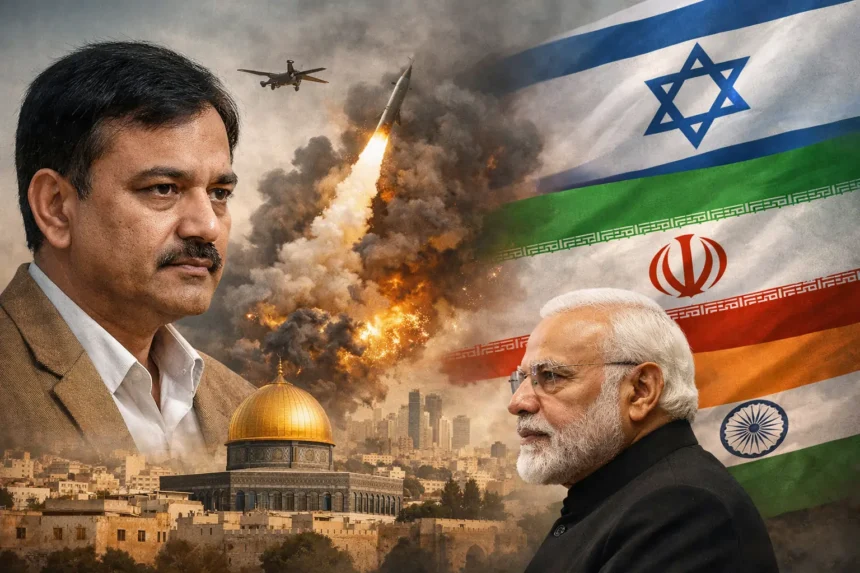

March 2016, Niyaz Khan, a former Madhya Pradesh Indian Administrative Service (IAS) officer
sparked controversy on social media by blaming Iran’s military actions on Arab
governments and raising concerns about Arab identities in light of Islam. His comments
immediately sparked controversy and were criticized by political figures and pundits of all
stripes. Meanwhile, Indian foreign policy decisions, especially those of Prime Minister Narendra
Modi’s recent trip to Israel has sparked a heated debate about the nation’s position on the
Islamic Republic of Iran and the larger Middle East conflict
Controversial Social Media Post by IAS Officer
On March 1, 2026, Niyaz Khan posted a scathing analysis of Middle East geopolitics on X .
His post swiftly circulated through Indian news outlets, claiming that Arab Sunni nations
were “enjoying sleep in America’s lap” and that Iran’s attack on them was a direct result of
these ties. He also made the startling claim that “ In my view, Arabs have nothing to do
with Islam.” Amar Ujala Khan’s framing combined political observation with
cultural judgments, drawing criticism from those who perceived it as insensitive to Muslim
identities and those who saw it as simplistic geopolitics. Critics contended that simplifying
intricate geopolitical problems to religious cultural assertions simply serves to increase
miscommunication. The incident occurred during one of the most turbulent periods in the
Iran-Israel conflict, which was brought on by military operations against Iran by both Israel
and United States of America that killed Iran’s Supreme Leader Ali Khamenei and raise
tensions throughout the region
Indian Middle East Foreign Policy and IAS Officer Remarks
Transition examining India’s changing West Asian posture under the Modi government is
essential to comprehending the context in which in which Khan’s remarks were heard. India
has historically taken a balanced stance in the Middle East, promoting peace and non-alignment while preserving relations. Critics counter that since Modi’s initial trip to Israel in 2017, relations with Tel Aviv have grown more prominent and contentious. Even as tensions with Iran increased, Modi formally reaffirmed India’s friendship with Israel during
a recent State visit in February 2016. The Thai partnership includes collaboration on security,
technology, and possible free trade deals. Although this visit was portrayed as
strengthening ties, it was met with harsh criticism both at home and abroad. Opposition
leaders said that timing seemed to indicate tacit support for one side in a dispute, calling it
“ill-timed” and a betrayal of India’s legacy of balanced diplomacy.
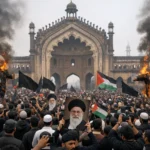
For detailed coverage of the protests by Indian Shia communities following the death of Ayatollah Ali Khamenei, see: HOW THE KILLING OF AYATOLLAH ALI KHAMENEI HIGHLIGHTS INDIA’S INTERNAL FAULT-LINES
Criticism of the IAS Officer by Indian Politicians
Jairam Ramesh, a senior Congress politician, called that visit shameful and moral
cowardice, claiming that Modi’s decision to visit Israel in spite of warnings of an impending
clash with Iran compromised India’s longstanding neutrality in international affairs. He
claimed that doing so would put India’s moral and geopolitical standing in Jeopardy and
alienate Middle Eastern allies. Asaduddin Owasi and other critics questioned the visit’s
timing and purpose, arguing that it sent the incorrect questinoned the visit’s timing and
purpose, arguing that it sent the incorrect message to countries with a majority of Muslims
and may jeopardize the well-being of millions of Indian expatriates residing in the Gulf.
More Read
Conclusion: IAS Officer Remarks Highlight Indian Foreign Policy Challenges
Deeper concerns about India’s position in the world and how internal political narratives
interact with international diplomacy have been brought to light by the impact of the
former bureaucrat’s one tweet. Even though Khan’s comments were viewed as provocative
by many, their significance highlights the larger discussions regarding India’s policy
priorities in a time of geopolitical unpredictability. The decision taken by India’s
leadership, as well as how it is interpreted and communicated at home, will have a big
impact on the nation’s standing and image in West Asia and beyond in a world that is
changing quickly.