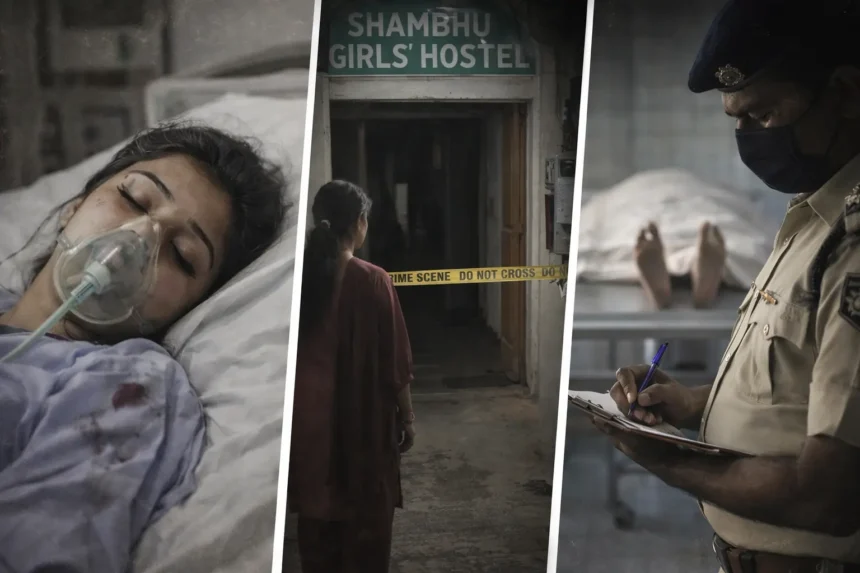

In the early days of January, Patna acquired another statistic, which is that another young woman was found unconscious, another hospital admission, another death that the state would prefer to catalogue as “unfortunate” rather than intolerable. Her name was Gayatri Kumari, eighteen years old, a student from Jehanabad preparing for the NEET examination, residing at Shambhu Girls’ Hostel in the Chitragupta Nagar area under the jurisdiction of the Patna police. What followed her discovery in a semi-conscious state on 6 January, and her death five days later on 11 January, has exposed not merely a crime, but a systemically choreographed indifference.
When a Place of Safety Became a Crime Scene
Gayatri was found unconscious within the hostel premises, a space meant to guarantee safety, discipline, and guardianship. Instead of alerting law enforcement immediately, the hostel management shifted her directly to a private hospital, Prabhat Memorial Hospital. The police were not called to record her statement while time still permitted clarity, or the police simply wasn’t there when needed, as is the norm. Either way, the fact is that she was conscious, yet her statement wasn’t recorded, either willfully, or due to negligence. Afterwards she got into coma, and remained that way until her passing. This single decision, however, would later prove fatal not only to Gayatri, but to the credibility of every institution that touched her case thereafter. In a society governed by law, this omission should have triggered scrutiny. Instead, it became the foundation upon which silence was built.
Injuries, Inconsistencies, and the Cost of Official Silence
When Gayatri died, her body reportedly bore twelve visible injury marks, a detail impossible to reconcile with the early insistence by the authorities that her condition was the result of narcotic or sleeping pill consumption. While official voices initially leaned towards this explanation, the post-mortem report, received by the police on 14 January, forced a recalibration. The SSP has since stated that sexual assault can no longer be ruled out. This concession, however, arrived only after days of denial, confusion, and narrative management, after the possibility of an uncontaminated investigation had already narrowed.
The contradiction is not procedural. It is moral. If narcotic pills were the sole cause, why the multiple injury marks? Why the recovery of sleeping medication under suspicious circumstances? Why the resistances, almost instinctive to even acknowledge the possibility of sexual violence in the initial days? These questions were not raised by the authorities entrusted with the investigation. They were raised by the family, by students, and by citizens who recognized that the language of delay often precedes the burial of truth.
Institutional Failure Disguised as Procedure
So far, only the hostel owner, Manish Ranjan, has been arrested. This isolated action has done little to restore public confidence. Ranjan is not an anonymous proprietor; he reportedly harboured local political ambitions, preparing for a Mukhiya election from Jagpura Panchayat in Makhdumpur block. That such an individual could continue unhindered until public pressure became unavoidable exposes the familiar architecture of impunity where influence cushions accountability, and arrests follow outrage rather than evidence.
More Read

Equally disturbing is the role attributed to Dr. Satish Singh of Prabhat Memorial Hospital. Protestors and the family allege that the doctor may have halted or distorted information regarding Gayatri’s consciousness, thereby obstructing the recording of a legally valid statement. Whether through negligence or intent, the consequence was the same: the silencing of the victim while she was still alive. In cases of sexual violence, time is not neutral. Each lost hour erodes testimony, memory, and the possibility of justice.
The hostel operators, Shravan Agarwal and Neelam Agarwal, have also come under sustained accusation. Protestors allege that they, along with the doctor, removed or destroyed as much as 70 percent of potential evidence. If even partially accurate, this claim transforms the case from one of individual criminality into one of organised erasure. Hostels, especially those housing young women, function as quasi-guardians. Their responsibility does not end at providing beds and meals. Any attempt to sanitise a crime scene is not administrative failure, it is obstruction.
A Chain of Delays, Denials, and Disappearing Evidence
Public anger, slightly delayed but ultimately inevitable spilled onto the streets. The Akhil Bharatiya Vidyarthi Parishad (ABVP) organised candle marches at Kargil Chowk, Patna, demanding justice for Gayatri. Yet the response from the state machinery remained conspicuously restrained. Statements shifted in tone, conclusions were softened, and responsibility diffused across institutions until it became difficult to locate. In a functioning system, such ambiguity would provoke inquiry. Here, it was permitted to settle.
More Read

Pappu Yadav visited Gayatri Kumari’s family in Jehanabad and demanded justice, adding to the growing public pressure. Beyond this, the facts required no amplification. The case indicts itself through contradiction alone.
What this episode ultimately reveals is the precariousness of young women living away from home, particularly students preparing for competitive examinations. Gayatri was not protesting, not defying social norms, not engaged in any activity deemed transgressive. She was studying. If such a girl cannot be guaranteed safety in a registered hostel in a state capital, then the rhetoric of protection rings hollow. The promise of “Beti Bachao” collapses under its own performative weight; repeated loudly, implemented selectively, and abandoned precisely where it is most needed.
The Gayatri Kumari case is not confined to one hostel, one hospital, or one arrested owner. It is an indictment of a structural ecosystem that absorbs violence and disperses responsibility, where police speak in conditional language, medical ethics bend under pressure, and private institutions operate with minimal oversight. The mechanics are familiar: delay, deflection, dilution.
Justice for Gayatri does not lie in a single arrest or in statements acknowledging what can “no longer be ruled out.” It demands an uncompromised investigation, accountability for every delayed decision, and consequences for every act that may have suppressed truth. Until that happens, Gayatri Kumari’s death will not be an isolated tragedy. It will remain a warning about what occurs when a place of refuge becomes a crime scene, and silence becomes an instrument of policy.