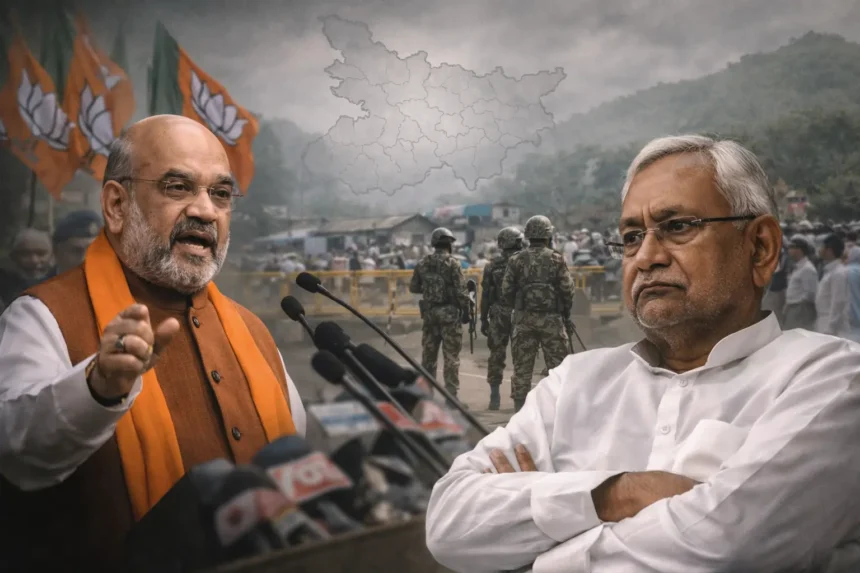

Bihar politics has continually been recognised for its complex equations and sudden twists. currently, a “double-engine” authorities comprising the Janata Dal United (JDU) and the Bharatiya Janata party (BJP) is in strength inside the kingdom. but, for some time now, the difficulty of infiltration inside the state’s border areas has come to be the middle of political attention. The most thrilling and striking component of this whole state of affairs is that Union home Minister Amit Shah seems to be extraordinarily aggressive and active on this trouble, while the pinnacle of the kingdom, chief Minister Nitish Kumar, has maintained complete silence. This mysterious silence is giving upward push to many critical political and administrative questions. Has the middle of electricity in Bihar shifted from Patna to Delhi?
Amit Shah’s direct interference and the Chief Minister’s absence
Union home Minister Amit Shah has been frequently traveling Bihar and turning in robust messages on the problem of infiltration inside the border regions. he is preserving direct conferences with senior IAS and IPS officials of the country. Border protection and law and order are being reviewed in these conferences. but the largest question is why Bihar chief Minister Nitish Kumar is absolutely absent from those conferences.
Nitish Kumar is neither participating in these conferences nor has he issued any legit assertion or ‘recommendation’ in this sensitive trouble of infiltration. Questions have all started to rise up in political circles: Is Nitish Kumar so sick that his presence on such critical topics is not possible? Or is he being deliberately sidelined?
at the same time as Bihar government spokespersons might also protect this by means of saying that Deputy chief Minister Samrat Chaudhary is gift at those conferences, political analysts sincerely consider that that is in addition proof of Nitish Kumar’s developing administrative and political irrelevance.
Is a ‘proxy government’ operating in Bihar?
Nitish Kumar is currently now not only the leader Minister of Bihar however also the country wide president of his celebration, the Janata Dal United (JDU). regardless of this, his birthday party does no longer appear to be actively participating in these conferences. Amit Shah’s direct meeting with kingdom bureaucrats (IAS/IPS) is being visible as a symbol of the lifestyles of a ‘proxy authorities’ run through leaders primarily based in Delhi in Bihar.
Such high-stage conferences function a means of conveying to the country administration who holds the actual reins of power and who, how, and from wherein the authorities is genuinely being run.
Demography of Seemanchal: Nepal’s Border and the Narrative of ‘Infiltration’
Another crucial issue of this politics is Bihar’s geographical location. Numerous districts of Bihar border Nepal, along with Supaul, Madhubani, Sitamarhi, and East and West Champaran. India shares an open border with Nepal, and the human beings on both sides share a centuries-old cultural and familial bond of ‘Roti-Beti’.
But Amit Shah has selected border regions for his meetings that don’t border Bangladesh. The purpose behind that is political. The Bharatiya Janata celebration and its determined business enterprise, the Rashtriya Swayamsevak Sangh (RSS), want to carry the message that there’s a huge infiltration of Muslims from Bangladesh into the border areas. Their implicit message is that “simplest Muslims are infiltrators; Hindus cannot be infiltrators.”
this is why Amit Shah and his affiliate groups so loudly raise the difficulty of “demographic trade” in Seemanchal. That is meant to instill in the minds of the humans of Bihar that the Muslim population is rapidly increasing because of infiltration and high delivery prices. high Minister Narendra Modi himself has expressed such worries about these areas in numerous of his election speeches. In contrast with Assam and JDU’s Double standards,
it is crucial to remember the fact that Bihar leader Minister Nitish Kumar has in no way taken the identical stance on the difficulty of infiltration as Assam chief Minister Himanta Biswa Sarma. other than the BJP, no different birthday celebration has mentioned infiltration as a primary hassle in Bihar.
it’s far genuine that some JDU leaders, including Sanjay Jha and Lalan Singh (who’re taken into consideration close to the BJP), now and again make hushed statements on the problem of infiltration. however, formally, neither Nitish Kumar nor his celebration has ever publicly stated the existence of infiltration in Bihar. moreover, Nitish Kumar has never stopped the BJP from playing the ‘infiltration card’.
More Read
Tejashwi Yadav’s counterattack: “Politics of polarization”
Chief of the opposition, Tejashwi Yadav, has released a scathing assault on the authorities on this difficulty. Tejashwi, without a doubt, alleges that the dialogue of infiltration in Bihar is in reality a part of the “politics of polarization.” He says that this trouble is being raised now because elections are about to be held in neighboring West Bengal. The competition alleges that each time elections technique, the BJP increases such sensitive issues to incite war among human beings.
Tejashwi Yadav also noted the affidavit filed through the Election Commission in the ideal court, which definitely stated that there is no infiltration in Bihar. Calling for duty, Tejashwi sharply requested: If infiltration is indeed taking location in Bihar, who is liable for it? The NDA authorities have been in strength in Bihar for the last 21 years. Amit Shah is the house Minister of the country. in the event that they have not prevented infiltration, he and Chief Minister Nitish Kumar need to take an ethical duty and renounce. Similar patterns of HEADLINE: Sweets, Dhols and Hate: Right-Wing Group Celebrates after J&K Medical College Loses Recognition have been observed elsewhere, showing how political narratives can be amplified to create social and communal polarization.
The West Bengal Excuse and the shortage of information in Bihar
Amit Shah often makes the excuse in West Bengal that the state authorities do not offer land for border fencing. But he can’t make this excuse in Bihar, because his own coalition is in power there.
The fact is that the Modi authorities at the center have not released any professional figures regarding Bihar, including the number of infiltrators who have entered, how many have been identified, and how many were prosecuted. Without any concrete, reputable records, this entire debate appears to be based on empty rhetoric instead of records.
Questions Raised on Cooperative Federalism and the Truth of the ‘Double Engine’
This entire incident has also sparked a major debate on ‘Cooperative Federalism’. According to the Constitution, ‘border management’ is a central subject, but ‘law and order’ falls under the jurisdiction of the states. When the Union Home Minister holds simultaneous meetings with state officials on both issues, the boundaries between the two become blurred.
More Read
Critics believe that these high-level meetings are not limited to security reviews but rather reveal who holds the final decision-making power within the coalition. Furthermore, it has been observed that during these official visits, Amit Shah and other BJP ministers also discuss the party’s organizational strategies. It is common to allege that the Prime Minister, Home Minister, and other senior BJP leaders use their official visits for party expansion and political gain.
Conclusion: The Meaning of Silence and Future Politics
The social fabric of Bihar’s border districts is extremely complex. India and Nepal have a historic treaty establishing an open border. Therefore, viewing every border through the same lens is oversimplifying the situation.
The silence within the Janata Dal United (JDU) can be interpreted in many ways. It could be a compulsion within the alliance, where open opposition could lead to political instability, or it could be a strategic distance from Nitish Kumar, who wants to leave the BJP to handle this contentious issue. However, maintaining such an ambiguous stance for a long time also poses a threat to the JDU’s independent identity.
Viewed in a broader perspective, this development reflects the changing nature of Indian federal politics. The question remains: is the issue of infiltration in Bihar truly based on a solid security assessment, or is it purely an electoral strategy? Unless both allies come together and issue a clear statement and provide concrete data, this debate will continue. Image and presence are crucial in politics; when the Chief Minister’s role is unclear on such a serious issue, it is entirely natural to raise questions about the balance of power and the effectiveness of leadership.