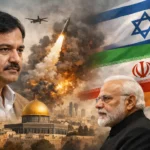

The Middle East is once against in turmoil. After a massive buildup of American war machinery in the Persian gulf, the much expected attack on Iran occurred on 28th February. The US and Israel reported that they have jointly struck dozens of important Iranian sites. Explosions were heard in and around Tehran, and the war expanded to other Iranian cities later on as well. This was just the beginning of a brutal regional war.
Assassination of Ayatollah Ali Khamenei
This war has harsh implications for India; the PM was in Israel just a day before this military campaign against Iran. Besides geopolitics, this war is exposing certain internal fault-lines in Indian society itself. These were not the kind of attacks that had happened against Iran before. These were special not only because of the scale and magnitude of the attacks, but also because of the assassination of the Iranian Supreme Leader, Ayatollah Ali Khamenei. He was slain on 1st March as the result of Israeli strikes on his office compound.
Role and Influence of Ayatollah Ali Khamenei
To understand the broader impacts of his assassination on the Indian society, it is essential to understand the role he played. The Ayatollah, although has been the leader of the state of Iran, was also a scholar of the highest rank of Shia Islam. He was a marja, a title used in Shia theology for the highest level of religious cleric, commanding Twelver Shia Muslims around the world. Because of this religious authority the Ayatollah possessed and exercised, Indian Shias, who are 30-50 millions in numbers, making up almost 16% of the total Indian Muslim population, considered him as their rahbar (leader).
Extent of Influence Beyond Iran
An important thing to consider here is the question regarding the limitations of Ayatollah’s jurisdiction and influence on non-Iranian, particularly the Indian Shias. The concentration of religious and political authority which the Ayatollah possessed, influenced non-Iranian Shias in both domains. The emergence of numerous Shia militant groups in several Middle Eastern countries prove that the post of Ayatollah wasn’t just limited to religious matters, it extended to the political domain as well. His teachings were naturally political in nature because of his status as the leader of a revolution, and have been a source of inspiration for political and social movements and organisations outside Iran.
Protests in India After His Death
After the confirmation of Khamenei’s death by the Iranian state, massive protests started erupting in numerous Indian cities, from Srinagar in Jammu and Kashmir to towns in the south. The most significant of these protests yet are the protests in Lucknow. Immediately after the news of the Ayatollah’s death broke out, crowds gathered in Old Lucknow, the historical centre of Shia Muslims of Awadh. Rallies were conducted at the Chhota Imambara, and candlelight marches were organised to the Bada Imambara. Thousands of people are participating in these ongoing protests.
More Read

The Lucknow Demonstration
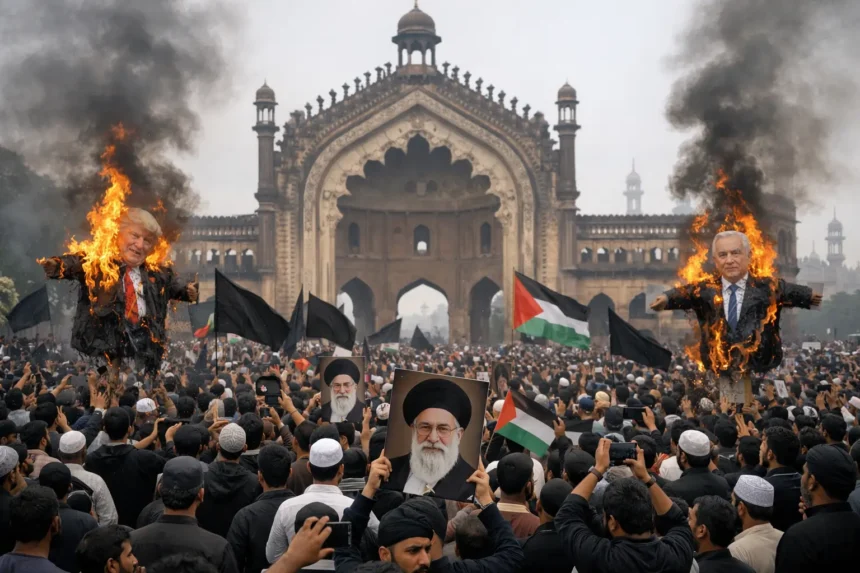
The most politically charged protest in Lucknow was seen at the Rumi Darwaza. Thousands of demonstrators occupied the entire stretch from the Chhota Imambara to the Rumi Darwaza, effectively bringing the entire area to a standstill. The participants chanted “long live Khamenei”, and slogans such as “if one Khamenei is killed, a thousand will rise”.
Political Nature of the Protests
The protests have a political angle too. Along with the aforementioned slogans, the Shia protesters were seen shouting anti-Israel and anti-US slogans as well. They were seen chanting “down with America and Israel”, and “curse of America and Israel”. The protests weren’t limited to just chants of these slogans. The demonstrators burned the effigies of the US President Donald Trump, and the Israeli PM Benjamin Netanyahu near the historic gate. The protesters carried black flags and portraits of the late leader, with many seen crying openly. Black flags were also hoisted atop local houses and shops.
Loyalty and Constitutional Concerns
Here raises the concern regarding the nature of these protests. The loyalty of Shia Muslims to the Iranian leadership is questionable, given the political aspect of it. The state requires all the citizens to be loyal to the constitution and the state itself, but Shias considering a foreign head of state as their leader is against the basic principles of the social contract between the state and the citizens. In a possible matter of confrontation between the two states, India would be vulnerable from within because of the conflict of loyalties of millions of Shias.
More Read
Religious Sentiments vs. National Interest
Religious sentiments are accommodated and are taken in consideration in the constitution, and the Shias being saddened by the unjustified killing of the Ayatollah is a natural reaction to the tragedy. That would have still been tolerable if it was not politically charged enough to have been potentially impactful on the national interests in the geopolitical arena. The anti-US and anti-Israel slogans, burnings of the portraits and effigies of Israeli and American leaders pose a direct threat to the relations between India and those states.
Communal Impact and Internal Division
Such actions are attempts to dictate the state to take emotional decisions, ignoring the national interests, while effectively being held hostage by a religiously charged mob. Such protests and organisation among people are extremist and fundamentalist in nature. They contribute further to the already increasing communalism in the country. Several Hindutva groups and leaders have issued statements and calls for protests against the Shias mourning the Ayatollah.
Need for Social Reconstruction
While the sentiments of Shia Muslims are understandable, using them to organize such protests serves the benefit of none. A social reconstruction is required among the Shias, in order to address the conflict within their loyalties. Mourning the death of the Ayatollah must remain apolitical, and in any other case, such protests are bound to be the factors contributing to further hatred on communal lines.
“The political fault‑lines in India were further exposed by the Youth Congress AI Summit protest at the India AI Impact Summit — an incident that sparked national debate over unemployment, dissent, and freedom of expression. Read full coverage of this protest and its implications here (Youth Congress AI Summit Protest)