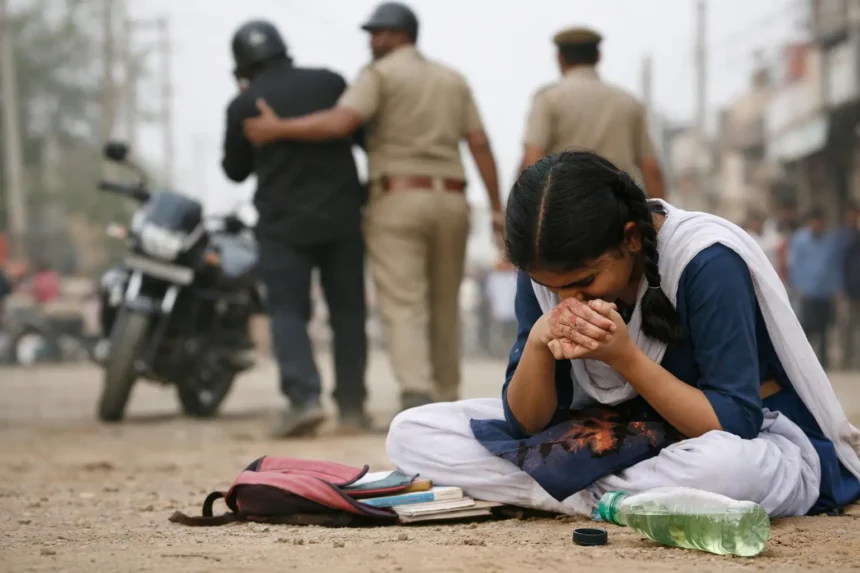

The acid attack in Kesari Singhpur, a town in Rajasthan’s Sri Ganganagar district, is not just a criminal incident, but a reflection of a social and state system that has failed to protect children, especially girls, despite repeated warnings. This incident did not happen in a deserted street, in the dark of night. It happened in broad daylight on a fourteen-year-old schoolgirl as she was walking to school, carrying books and dreaming of the future.
The victim is a student of class IX. She is of an age where the law calls her a minor, morality considers her a trust, and the state is obliged to protect her. But on that day, all these definitions had no validity. A nineteen-year-old youth, Om Prakash alias Jani, who was a photographer at weddings and functions by profession, threw acid on the girl simply because she refused to talk to him.
This refusal was not an outburst. No promise was broken, no relationship ended. A minor girl told a strange adult man to be quiet. That was unbearable for her.
This story does not begin where the acid bottle opens. This story begins with a wedding ceremony where an adult man’s gaze rested on a young girl, and where society did not stop that gaze or question it. Om Prakash allegedly saw the girl for the first time at a wedding. Seeing this, then seeing her again and again, then trying to talk, and finally getting mentally “sick” over her refusal all these stages indicate that the problem is not just one person’s state of mind, but a culture where the male ego is linked to a woman’s refusal.
When the girl refused to talk and rebuked him, Om Prakash took it as his humiliation. What happened next was planned. A cloth over the face, a helmet over the head, the motorcycle’s license plate covered. All this testifies to the fact that the attack was not the result of a momentary rage, but a premeditated crime. Against a minor.

The result of the acid attack, fortunately, did not prove fatal this time. The acid fell on the girl’s clothes and burned one of her fingers. The physical damage was limited, but to say that the damage was minor is a dangerous simplification. Acid does not just burn the body, it burns the sense of security, burns trust, and sends the message that there may be a price to pay for refusal.
The police arrested the suspect after about three days. CCTV footage, local information and technical means were used. After the arrest, the suspect was paraded through the local market, which the police presented as a “lesson” and “deterrence”. But the question remains: is the purpose of justice simply to teach a lesson, or to eliminate the causes that gave rise to the crime?
Taking the accused to the market may temporarily appease public anger, but it does not change the fact that there was no system in place to protect a fourteen-year-old girl from acid on her way to school. Neither were the school routes safe, nor was there an effective complaint system that could have prevented stalking or harassment if it had happened in the first place.
More Read

This incident once again brings to light the bitter truth that stalking is still not seen as a “serious crime” in India, and especially in North India, until it turns into a major tragedy. Often, girls are advised to ignore it, change their ways, keep quiet. But silence, as has been proven time and again, does not provide protection.
In this case, the police say that the investigation is ongoing, the motives are being examined. But the motives are clear. It is the same old, well-worn motive: a sense of male ownership, considering refusal as humiliation, and giving oneself the right to punish a woman.
This incident also requires us to question the availability of deadly substances like acid. How easily can these substances be obtained? How many attacks have occurred before, and how many laws remain on paper?
The most important question, however, is the future of the victimized girl. How will she go to school? How will she see the street? How will she judge every stranger? The state often talks about treatment, compensation and legal action in such cases, but rarely about psychological rehabilitation, rebuilding trust, and protecting childhood.
This case reminds us that violence against women and girls is not a “sudden” event. It is the result of a continuum of neglect, silence, trivialization, and failure to intervene in time.
This girl from Rajasthan is lucky to be alive. But luck cannot be made into a policy. If stalking had not been taken seriously even after this incident, if there had been no real monitoring of the sale of acid, and if the safety of minor girls had been limited to mere slogans, the next news story might not have been so “low-harm.”
More Read

This was not just an acid attack. This was a social failure, in which the perpetrator threw the bottle, but an entire system paved the way.