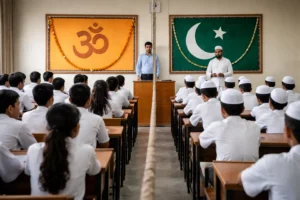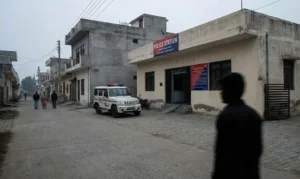

On February 4, Uttarakhand gave a lesson of its own in the modern world in subtle fashion, which India would do well to remember in recalling earlier cautions about the dangers of unchecked mass politics. In this context, it is relevant to note that in Uttarakhand, the Uttarakhand Madrasa Board has been dissolved in the hands of the state government, while in lieu of this, a Minority Education Authority has been established. In a nutshell, this is direct governmental control over the education of Muslims in the country.
Once the illegality of the teaching was established, over 250 madrasas have already been closed. Furthermore, no madrasa will be able to offer an independent curriculum from July on, and the government-authorized curriculum must be followed by all the madrasas, leaving no room for the development of a community-structured education system. This is certainly not housekeeping in the administrative arena. The objective behind this educational structure is the elimination of the concept of Muslim educational autonomy.
The government claims that what is at stake is a question of universal standards and quality control. Even the most elementary examination will prove this claim a falsehood. In Uttarakhand, many other private and religious educational institutions have been functioning independently to a large degree. There is no sense of general closure or abolition of the course curriculum of Sanskrit pathshalas, missionary schools, or religiously managed privately owned trusts. The government has not suddenly developed a keen interest in interfering. They have stumbled upon a useful pretext for selectively interfering.
Pushkar Singh Dhami, the chief minister, has posed as a hard taskmaster who has restored discipline. What he has achieved, however, is to fine-tune an old BJP strategy. Ideological intervention uses the language of neutral governance. It adds up to something collective. Muslims are singled out as a problematic group, an exception to the rule of institutional freedom that applies everywhere else.
That this is the intent is further confirmed by the composition of the just-constituted Minority Education Authority. Only two of its eight members are Muslims. A body that was to oversee Muslim education is dominated by individuals who are not from the very community it is expected to oversee. This is not inclusion. It is symbolic marginalization masquerading as representation. Not with Muslims, but over them, power is exercised.

It was promoted as proof of neutrality that a retired non-Muslim academic was appointed chairman. Yet in an environment of systemic inequality, neutrality is a myth. The message is crystal clear when Muslim institutions are routinely overseen by non-Muslims. Muslim organisations are not to be trusted. Muslims are not needed in the decision-making process. The presence of Muslims is to be managed, not empowered.
The issue is not an isolated one. Uttarakhand’s decision is part of a larger trend that is crystallizing in Hindutva politics: across India, society is increasingly perceiving Muslim institutions as suspect, in dire need of oversight and correction and assimilation. The state is not just regulating, but disciplining. Legal changes and administrative pressure are forcing Muslim identity out of the public sphere into a tightly controlled arena.
Education here plays a vital role, for it is a process of memory, tradition, and intellectual continuity. Forcing madrasas to restructure their curricula does not amount to modernizing education on the part of the state. It disrupts a civilizational transmission wherein Islamic intellectual traditions that have existed for centuries are being replaced by a uniform narrative reflective of the cultural priorities of the ruling ideology.
More Read
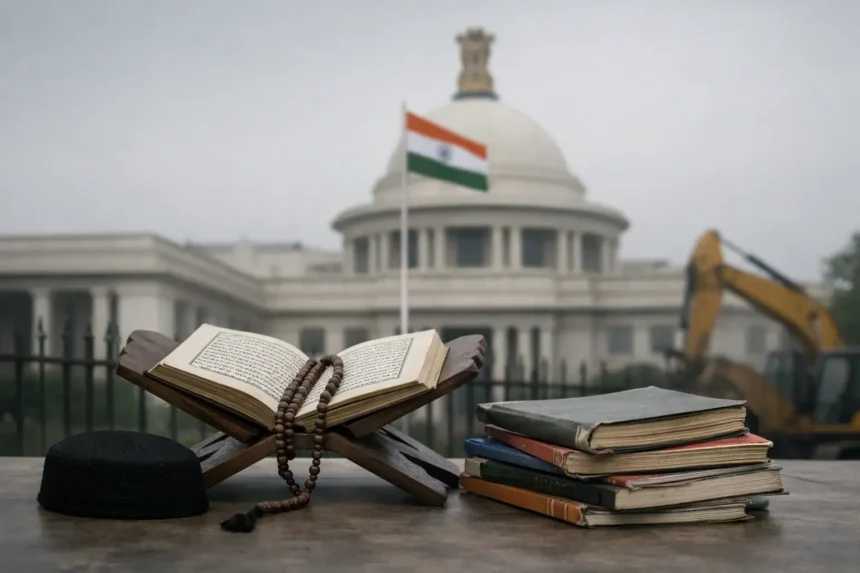
The government argues that nothing prevents religious instruction, apart from during formal curricula. This argument is misleading. When an institution loses the right to shape its own education, it stops being autonomous in any real way. What remains is an empty shell that shows compliance while its intellectual foundation is eroded.
The strength of Hindutva has always been its procedural manipulation. Bulldozers are branded as urban planning. Citizenship laws were framed as documentation drives. Now, educational takeovers are labeled as reform. Each act is justified on its own. Together, they show a stark structure of exclusion.
The influence of Chief Minister Dhami in this matter is considerable. As a matter of fact, the government led by Dhami has always been at the forefront in supporting the most extreme kinds of Hindu majoritarianism. The argument here is that when it comes to Muslims, they do not see them as equal citizens who have institutional interests. They believe that these interests have to be managed.
This policy of helping minorities is the most cynical of all. The concept of a Minority Education Authority which ignores the very minority for whose sake it is supposed to act is itself contradictory. It uses the rhetoric of protection to subdue. The state prescribes the curriculum to be taught to Muslim children, the manner in which they are to learn the subject, and the teachers to teach them.
Similar actions are advocated in countries surrounding India in the name of national integration. But what is meant by “integration” in this context is not coexistence, butblending into a culture to which assimilation is the only option because there is no room for difference. Diversity is acceptable as long as it is superficial. But as soon as it becomes institutionalized and autonomous, it poses a threat.
The long-term implications of this policy are far-reaching, extending well beyond the borders of Uttarakhand. It establishes a benchmark for other state governments to follow suit in abolishing Muslim systems through executive decisions, rather than fostering public debate or discussion. It makes the assumption of Muslims living in India by conditional terms acceptable, while the conditional terms of other communities are untouchable.
More Read
Most disconcerting is the unobtrusive ease with which this is being accomplished. There is no declaration of emergency. There is no change in the Constitution. Simply a procedural announcement of a change in the limits of citizenship. This is how democracy is falling now: not through any grand changes, merely through quotidian red tape.
Proponents of such a policy believe that Muslim populations should embrace the state’s supervision as a necessary step towards progress. This attitude is rooted in the colonial attitude toward the Muslim population as being backward and needing to be directed by the colonial state. Such an attitude does not give the Muslims the dignity to define themselves or to evolve by themselves.
Therefore, the decision of the Uttarakhand government cannot be seen in isolation. It cannot be confined to the context of education policy. This decision and its order are about who counts as a full political subject. They are about which institutions evoke trust and which evoke suspicion. They are, in fact, about whether India will be allowed to be a republic or whether its slide into majoritarianism will be enforced through administrative tools.
History is full of examples of where such paths have led. When states begin to see one of these groups as something to be governed, rather than as a partner in the advancement of democracy, the effects do not remain contained.
What needs to be seen is that the abolition of the Madrasa Board was, in fact, an act of control, an act of politics on the majority, and another move further along the long path toward creating an exception, rather than an essential component, out of the Muslim presence in the country.