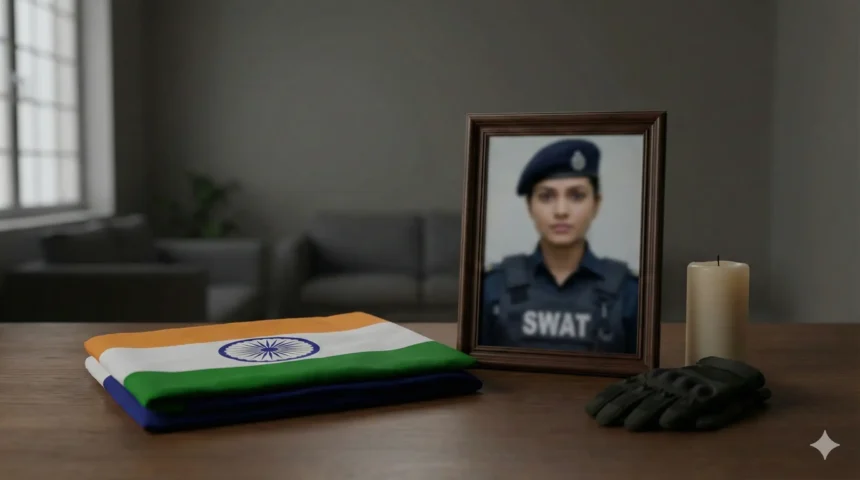


The Indian state lost one of its own. Not on a border, not in a covert operation, not in the line of duty. Kajal Chaudhary, a 27-year-old SWAT commando attached to the Delhi Police Special Cell, four months pregnant, died in a hospital bed in Ghaziabad on 27th January. She died five days after being assaulted inside her own residence in Mohan Garden. The man accused of killing her was her husband, Ankur, a clerk employed by the Ministry of Defence.
This is not a story of domestic violence alone. It is a story about how violence incubates comfortably within the state itself, inside its homes, its departments, its hierarchies, and how the same machinery that demands discipline from the public routinely fails to impose it on its own.
Kajal was not an ordinary civilian unknown to the state. She was trained to breach rooms, neutralise threats, and confront armed suspects. She belonged to one of the most elite operational units of the Delhi Police. And yet, when the threat was intimate, prolonged, and documented, the system around her remained inert.
According to statements given by her family, Kajal had been subjected to prolonged physical abuse and dowry harassment. She was forced to perform all household chores despite her pregnancy. She was slapped, assaulted, apologised to, and assaulted again, a cycle so familiar that it barely registers as exceptional. Her father, Rakesh, states that nearly ₹20 lakh was spent on the marriage which included a Bullet motorcycle, gold, cash, and later even a car. None of it bought safety. The price only escalated the entitlement.
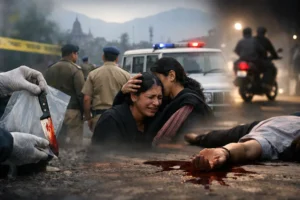
The brutality culminated on 22 January. Police say that following arguments over loans, expenses, and financial stress, Ankur allegedly slammed Kajal’s head into a door frame and assaulted her with a dumbbell. She was rushed to hospital. She lingered for five days. On 27 January, she died. These details matter because they establish intent and intensity, not loss of control.

What makes this case impossible to dismiss as an isolated domestic crime is the conversation that preceded it. Nikhil, the victim’s brother, has stated that Ankur called him during the assault. He was told to record the call “for the police.” Then came the words that should have activated every alarm within the system: “I am killing your sister.” Nikhil heard Kajal’s screams before the line went dead.
Moments later, another call followed. He was told that she was dead and that the family should come to the hospital. By the time Nikhil arrived with the police, Ankur and his family were already present. This sequence alone dismantles any claim of impulsive violence. It points instead to awareness of procedure, anticipation of response, and confidence in how institutions react after harm has already been done.
Initially, the case was registered as attempted murder at Mohan Garden police station, based on a complaint by Nikhil. Following her death, police announced that charges would be upgraded to murder. This procedural escalation is now being presented as evidence of responsiveness. It is not. It is the bare minimum, triggered only after death foreclosed all other possibilities.
More Read

Only after Kajal’s death on 27 January did police state that charges would be upgraded to murder. This upgrade is being cited as evidence of due process. In reality, it reflects a familiar pattern where legal seriousness follows fatality, not warning.
This detail matters. Not emotionally, but institutionally. It speaks to preparedness, not panic. It suggests that even in the act of killing, the accused understood how systems move, how narratives are managed, how presence precedes accountability.
It also exposes a deeper contradiction. Kajal was part of the coercive apparatus of the state. Her husband worked within its administrative wing. Between the Delhi Police and the Ministry of Defence lies an ecosystem that prides itself on discipline, hierarchy, and control. And yet, within this ecosystem, prolonged torture of a pregnant woman went uninterrupted, unflagged, and uncorrected. This absence is not accidental. It is structural.
Police forces and defence establishments routinely project discipline outward while treating the domestic lives of their personnel as private, beyond scrutiny. Domestic violence is framed as a personal matter unless it spills into public scandal. Women in uniform are expected to embody empowerment publicly while absorbing violence privately.
The language of women empowerment collapses completely in cases like this. Kajal was economically independent, professionally trained, and institutionally empowered on paper. None of that translated into protection. Empowerment here functioned as a slogan, not a safeguard.
Domestic violence in such cases is not a failure of awareness. It is a failure of will. Laws exist, helplines exist, campaigns exist. What does not exist is a system that forces accountability before death occurs, especially when the accused is a salaried employee of the state.
More Read

The involvement of dowry further exposes the hollowness of institutional claims. Despite decades of legislation and public messaging, dowry remains deeply embedded and selectively ignored. That a Ministry of Defence employee could continue dowry harassment without consequence indicates not social backwardness but bureaucratic indifference.
Police statements citing financial stress as a factor behind the assault deserve scrutiny. Financial stress does not explain repeated abuse. It does not explain entitlement. It does not explain torture of a pregnant woman. Such framing shifts attention from responsibility to circumstance and reduces violence to a byproduct of economic pressure rather than a deliberate assertion of control.
Kajal’s death also exposes the limitations of internal solidarity within the police. Her brother was himself a constable. He did what the system instructs citizens to do. He contacted the police. He followed procedure. The result was not prevention, but documentation after the fact.
After Kajal’s death, her one and a half year old son was sent to live with her parents. This transfer is not merely familial. It marks the final withdrawal of the state from responsibility. The same system that trained Kajal, deployed her, and benefited from her service now limits its role to prosecution, not introspection.
What is missing from official responses is any acknowledgement of institutional complicity. There has been no announcement of departmental audits, no examination of how domestic violence complaints by women in uniform are handled, no commitment to reform internal reporting mechanisms. The case is being treated as an isolated crime rather than a predictable outcome of systemic neglect.
Justice in this case cannot be limited to conviction alone. It would require confronting how state institutions protect their own from scrutiny while demanding compliance from everyone else. It would require admitting that women empowerment without structural enforcement is cosmetic. It would require recognising that domestic violence is not external to the state but embedded within it.
Kajal Chaudhary was trained to neutralise threats. The threat that killed her was not unknown. It was tolerated.
Her death should not be remembered as a mere tragedy, the kind of which are just a norm at this point in the country. It should be recognised as a failure of the very institutions that claim to stand for law, order, and protection. Until that failure is addressed, empowerment will remain a word, and women like Kajal will continue to pay for its emptiness with their lives.