
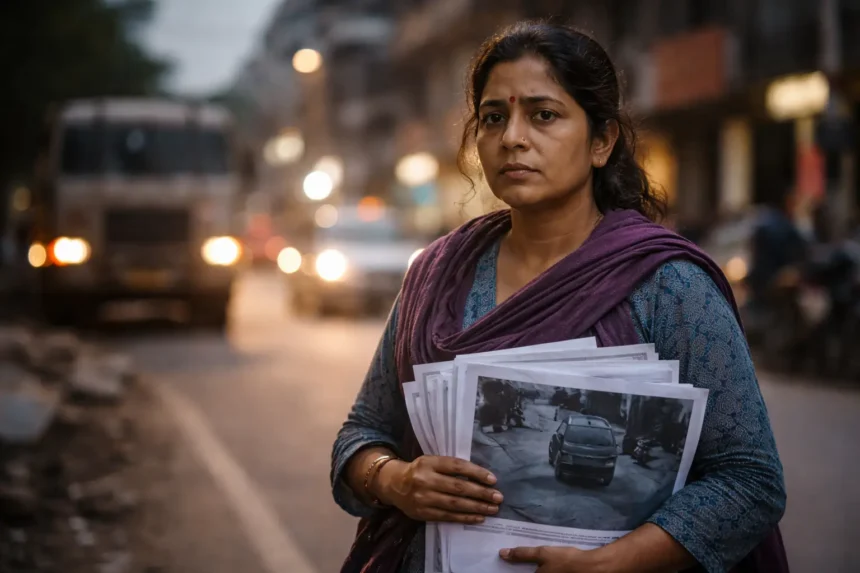

A grieving mother in Dehradun has exposed serious gaps in Uttarakhand’s law enforcement system. Lalita Chaudhary, a 43-year-old professional beautician, single-handedly tracked down the owner of the dumper that killed her 18-year-old son Kshitij Chaudhary after police closed the case citing lack of evidence.
On February 16, 2024, Kshitij was walking on a road in Prem Nagar, Dehradun, when an overspeeding dumper struck him from behind. He died the next day from injuries, just one day before he was scheduled to appear for the UP Police entrance exam. Passersby reportedly left him unattended on the road for nearly 45 minutes before help arrived.
Lalita Chaudhary immediately approached Prem Nagar police station and filed a case of culpable homicide. However, the investigation dragged on. In 2024, police submitted a final report declaring the driver untraceable and closed the case.
Lalita Chaudhary’s Relentless Solo Investigation
Lalita refused to accept the closure. For over 18 months, she conducted her own probe while managing her work as a beautician and raising her elder daughter alone.
More Read

She collected CCTV footage from the accident spot and surrounding areas in Prem Nagar. According to a detailed report by Times of India, she spent months reviewing hours of video, identified the dumper involved, and traced its owner, Ankit Chauhan, through RTO records and other leads. Armed with this clinching evidence, she met Dehradun SSP Prameendra Singh Dobal on April 4, and demanded the case be reopened.
Her determination forced police to act. The SSP ordered a fresh probe into the hit-and-run incident.
Police Failure and Systemic Apathy Exposed
The Uttarakhand police had access to technology, witnesses, and official records but failed to identify the vehicle or driver. They closed the case prematurely, leaving a grieving family without justice.
This case is not isolated. According to official data from the Integrated Road Accident Database (iRAD), Uttarakhand recorded 1,846 road accidents in 2025, resulting in 1,242 deaths and 2,056 injuries, a 14% rise in fatalities compared to 1,090 deaths in 2024.
Hit-and-run and overspeeding cases involving dumpers and trucks are common in the state’s hilly terrain. NCRB data shows nearly 85% of road deaths due to negligence in Uttarakhand were classified as hit-and-run cases, raising questions about investigation quality and premature closures.
In many instances, police submit final reports citing “untraceable” drivers, leading to high closure rates without resolution. This pattern reflects apathy and incompetence in the state’s law enforcement machinery.
Broader Road Safety Crisis in Uttarakhand Under Dhami Government
Uttarakhand ranks among states with high accident severity. Over the last 25 years, more than 34,000 road accidents have occurred, with fatalities per 100 accidents significantly above the national average in hilly regions.
Overspeeding dumpers and trucks pose particular risks on mountain roads. Despite repeated promises of improved road safety under the Pushkar Singh Dhami government, enforcement remains weak. Speeding violations, poor investigation of fatal crashes, and low conviction rates in hit-and-run cases continue to claim hundreds of lives annually.
Lalita Chaudhary’s case highlights how ordinary citizens, especially grieving families, are forced to do the police’s job. A single mother had to gather CCTV evidence and trace the vehicle owner because the system failed to deliver basic justice.
Key Statistics on Uttarakhand Road Accidents:
- 2025: 1,846 accidents, 1,242 deaths
- 2024: 1,747 accidents, 1,090 deaths
- Fatalities rose 14% year-on-year
- High severity rate in hilly districts
Injustice and Governance Failure in Road Accident Cases
This incident lays bare the incompetence and apathy in Uttarakhand’s police under the Dhami government. While the administration frequently announces crackdowns on crime and projects the Devbhoomi as safe, ground realities show ordinary citizens struggling for justice in routine cases like hit-and-run accidents.
Lalita Chaudhary’s extraordinary courage succeeded where the system failed. Her solo effort for 18 months exposed how police prematurely close sensitive cases, denying closure to victims’ families.
The case also raises larger questions about accountability. When a beautician with no investigative training can uncover evidence that police missed despite having resources, it points to systemic issues in training, motivation, and political will.
Small incidents like this erode public trust in law enforcement. Hundreds of road fatalities occur every year in the state, many involving overspeeding vehicles in Dehradun and other districts, yet resolution rates remain low.
In Conclusion:
Lalita Chaudhary’s determination has forced the reopening of her son Kshitij’s hit-and-run case. She identified the dumper and its owner after police declared the driver untraceable and closed the file.
This mother’s fight is a powerful example of individual resilience but also a damning indictment of governance failures in Uttarakhand. It reveals how the Dhami government’s law-and-order machinery often leaves grieving families to fend for themselves in road accident and hit-and-run cases that claim over 1,200 lives annually.
True justice requires proactive policing, not reliance on citizens to fill the gaps. Until systemic reforms address poor investigations and premature closures, stories like Lalita Chaudhary’s will continue to highlight the gap between official claims and ground reality.