
Uttarakhand has secured the top national rank in implementing the new criminal laws through the Inter-Operable Criminal Justice System (ICJS) 2.0. According to the latest CCTNS/ICJS Progress Dashboard released by the National Crime Records Bureau (NCRB), the state achieved an impressive score of 93.46.
This places Uttarakhand ahead of Haryana (93.41), Assam (93.16), Sikkim (91.82), and Madhya Pradesh (90.55). The BJP-led government under Chief Minister Pushkar Singh Dhami has highlighted this as a historic milestone in modernizing India’s justice system.
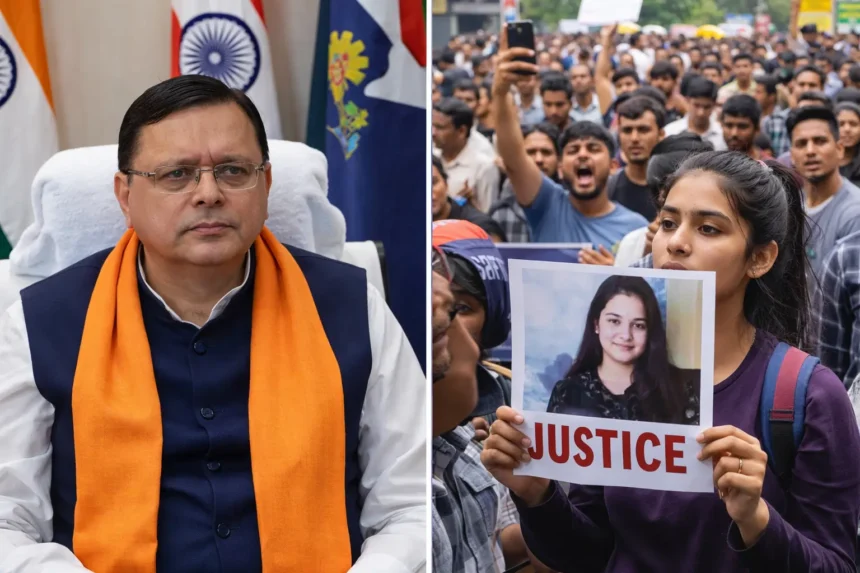
Yet, in March 2026, fresh protests and renewed demands for a time-bound, Supreme Court-monitored CBI probe in the 2022 Ankita Bhandari murder case continue to expose cracks in the state’s law-and-order narrative. Allegations of a VIP angle involving influential BJP-linked figures refuse to die down, raising questions about selective justice under Hindutva governance.
Uttarakhand’s Top Rank in ICJS 2.0 Implementation
The ICJS 2.0 framework integrates police (CCTNS), e-Courts, e-Prisons, e-Prosecution, and e-Forensics through a “One Data, One Entry” mechanism. This enables real-time data sharing, reduces paperwork, and accelerates case disposal.

Uttarakhand Police trained over 23,000 personnel belonging to the Bharatiya Nyaya Sanhita (BNS), Bharatiya Nagarik Suraksha Sanhita (BNSS), and Bharatiya Sakshya Adhiniyam (BSA) on the new laws. Mandatory videography of crime scenes via the e-Sakshya app and deployment of forensic mobile vans were prioritized.
State officials claim this digital push enhances transparency and efficiency. IG Sunil Kumar Meena described it as a benchmark in technological infrastructure and real-time data entry.
National Top 5 Rankings (NCRB Data):
- Uttarakhand: 93.46
- Haryana: 93.41
- Assam: 93.16
- Sikkim: 91.82
- Madhya Pradesh: 90.55
On paper, the BJP government in Uttarakhand projects itself as a leader in criminal justice reform.
The Ankita Bhandari Murder: A Lingering Scandal
On September 18, 2022, 19-year-old Ankita Bhandari, a receptionist at Vanantara Resort in Pauri Garhwal, was allegedly murdered after refusing “extra services” to a VIP guest. Her body was recovered from a forest near Rishikesh.
Three men including the resort owner Pulkit Arya and two employees were convicted in the case. However, persistent allegations point to a powerful VIP who was present that day and whose identity has been shielded.
Earlier this year, actress Urmila Sanawar, who claimed to be the wife of a former BJP legislator, released audio and video clips alleging involvement of senior BJP figures, including references to a leader nicknamed “Gattu.” These recordings triggered massive protests across Dehradun and other districts, with demands to name and prosecute the VIP.
Opposition parties, particularly Congress, have accused the state police of deliberately slow-pedaling the investigation and destroying evidence to protect influential BJP supporters.
Why Persistent Demands for CBI Probe Despite Top Rankings?
Despite Uttarakhand’s No. 1 ranking in ICJS 2.0, public trust in the state police remains low in high-profile cases involving political connections. Ankita’s parents have repeatedly demanded a CBI inquiry under Supreme Court supervision and full disclosure of call details involving the accused and alleged VIPs.
In January, CM Pushkar Singh Dhami recommended a CBI probe after meeting the family. By February, the CBI registered a fresh case against an “unknown VIP” and took over the investigation from Uttarakhand Police. Yet protests intensified into the following month. Activists and the family argue that the CBI probe lacks independent oversight. They insist on a time-bound six-month deadline and action against those who allegedly tampered with evidence.
Key Statistics and Timeline:
- Murder date: September 18, 2022
- Initial convictions: Three local accused
- Fresh allegations surface: January 2026 via social media clips
- CM recommends CBI: January 9, 2026
- CBI registers VIP case: February 3, 2026
- Ongoing protests: March 2026 demanding SC-monitored probe
According to The Hindu, Congress has slammed the BJP government for alleged VIP involvement and demanded impartial investigation without political pressure.
Hindutva Governance and Selective Justice in Uttarakhand
The BJP projects Uttarakhand as “Devbhoomi”, a model Hindu-majority state under Hindutva ideology. The government frequently highlights digital reforms and law-and-order achievements to burnish its image.
However, the Ankita Bhandari case reveals a pattern where powerful individuals with alleged BJP links appear shielded. Initial police investigations ruled out any VIP angle, only for fresh evidence and public outrage to force a reluctant CBI handover.
Critics argue this reflects broader institutional bias under Hindutva rule: swift implementation of centralized schemes like ICJS 2.0 for optics, but reluctance to deliver justice when it threatens political allies.
Similar concerns have surfaced in other BJP-ruled states where high-profile cases involving influential figures drag on or lose momentum. In Uttarakhand, where tourism and resorts cater to a certain elite, protecting “VIP” interests seems to override justice for ordinary citizens, especially young women from modest backgrounds like Ankita.
- Repeated protests involving thousands, mainly youth and women
- Family’s demand for call detail records of all accused and named VIPs
- Allegations of evidence destruction cited by opposition
Broader Implications for Criminal Justice Under BJP
Uttarakhand’s top rank in ICJS 2.0 is undeniably impressive on metrics of digitization and training. Yet technology alone cannot substitute for impartiality and political will.
The new criminal laws promised faster justice, zero tolerance for crime, and protection of the vulnerable. In the Ankita Bhandari case, however, four years after the murder, the family still fights for a credible probe into the alleged VIP angle.
This contrast exposes the gap between administrative rankings and ground-level delivery of justice. When cases threaten the ruling dispensation’s core support base or influential networks, even a technologically advanced system appears powerless and unwilling to act decisively.
Opposition leaders have linked this to a larger pattern of Hindutva-driven governance that prioritizes image management and majoritarian symbolism over accountability, especially when victims belong to ordinary Hindu families and perpetrators enjoy political patronage.
Rankings vs Reality in Uttarakhand
Uttarakhand’s No. 1 position in ICJS 2.0 showcases effective rollout of new criminal laws on paper. Yet the persistent, loud demands for a Supreme Court-monitored CBI probe in the Ankita Bhandari murder even after CBI’s partial takeover reveal uncomfortable truths.
In a state governed by BJP’s Hindutva ideology, technological modernization coexists with allegations of protecting powerful VIPs. Until the full truth emerges and justice is delivered without fear or favor, rankings alone cannot mask the erosion of public faith in the system.
The Ankita Bhandari case remains a stark reminder that true criminal justice reform requires not just digital dashboards, but political courage to confront powerful interests within one’s own ecosystem.